A Movie A Day #129: Tim Richmond: To the Limit (2010, directed by Rory Karpf)


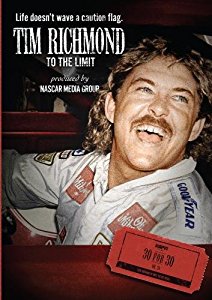
Tim Richmond was not the typical NASCAR driver.  In a sport that was largely dominated by blue-collar “good ol’ boys,” Richmond was from a wealthy Ohio family and considered himself to be a “cosmopolitan.”  Unlike many of the drivers, he was not a car expert but he still instinctively knew how to handle a 200 mph turn.  A charismatic showman, Richmond spent a few years as one of the sport’s rock stars.  Along with co-starring with Burt Reynolds in Stroker Ace, Richmond was also the basis for the character played by Tom Cruise in Days of Thunder.  Tragically, one the way to becoming the best, his career was sidelined by health problems, starting with a bout of double pneumonia.  When he was returned to the sport, he was sidelined again when a drug test came back positive and rumors of his hard-partying lifestyle made it difficult for him to find a sponsor.  Even as he fought to get the drug test overturned, he was hiding a bigger secret.  At a time when the merest rumor of having the disease could ruin someone’s life, Tim Richmond was battling AIDS.

Fans of NASCAR might enjoy this documentary, which was produced as a part of ESPN’s 30 For 30.  It is mostly made up of talking head interviews and archival footage of Richmond both racing and being interviewed.  I had never heard of Richmond before I watched this documentary but his charisma is obvious in the clips shown of him and those interviewed speak of him with enough awe that it is easy to believe that, had he not died, Richmond would have become one of the greatest racers of all time.  Mostly, this documentary serves as a reminder of the fear and paranoia of the early days of the AIDS epidemic.  Long before Magic Johnson famously announced that he was HIV positive, Richmond died isolated and fearful that the world would learn the cause of his condition.  This documentary serves as a reminder of who Tim Richmond was and who he could have been.
 

A Movie A Day #36: Four Falls of Buffalo (2015, directed by Ken Rodgers)


four-falls-of-buffalo-movie-posterIn America, they love winners and that’s especially true when it comes to the Super Bowl.  Every year, one team wins the Super Bowl and goes home to a parade and sometimes a riot.  Another teams loses the Super Bowl, often becomes a laughing-stock, and spends the next season searching for “redemption,” never mind that even the team that loses the Super Bowl still did something that 30 other NFL teams failed to do.
Just ask the Buffalo Bills.  In the early 1990s, the Bills accomplished something that no other football team had ever accomplished.  They went to four consecutive super bowls.  And yet, because they lost all four times, the 90s Bills are remembered for what they lost instead of what they accomplished.  If the Bills had won all four of those Super Bowls, they would be remembered as the greatest team of all time.  But because they lost, they are forever remembered as being  joke.

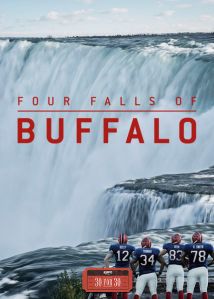
Four Falls of Buffalo is a documentary about those four Super Bowls, all told from the point of view of the players that lost and the city that loved them.  Four Falls of Buffalo is very much a fan’s film but it’s still interesting to watch.  Along with detailing what went wrong (and sometimes right) at all four of the Super Bowls that the Bills lost, it also features interviews with the Bills players.  Particularly notewothy is an interview with Scott Norwood, the kicker who missed a field goal that, had he made it, would have won Super Bowl XXV for the Bills.  Even though the city of Buffalo embraced him after the loss, it is obvious that missed kick still haunts him.

Watch Four Falls of Buffalo in honor of all the teams that made it to the Super Bowl but did not get that win.

A Movie A Day #35: This Was The XFL (2017, directed by Charlie Ebersol)


hhmRemember the XFL?

Though it may be regarded as a joke today, the XFL was a big deal for a few months in 2001.  The brainchild of the WWF’s Vince McMahon, the XFL was a football league that, like the USFL before it, would play during the NFL’s off-season.  McMahon promised that, if the NFL was now the “No Fun League,” the XFL would be the “Extra Fun League.”  McMahon’s longtime friend and the President of NBC sports, Dick Ebersol, purchased the rights to broadcast the XFL’s first two seasons.

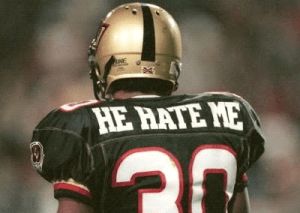
Ebersol and McMahon put together the XFL (8 teams and 2 divisions) in just a year’s time.  They recruited players who hadn’t been able to find a place in NFL.  Using many of the same techniques that he perfected in the world of professional wrestling, McMahon encouraged the players to be big personalities and allowed them to pick their own nicknames.  Rod Smart would briefly become a star as He Hate Me while another player requested to be known as Teabagger.  McMahon tweaked the rules, encouraging faster and more aggressive play.  Instead of a coin flip, each game would start with two opposing players scrambling for the ball.  The XFL was not only more violent than the NFL but it also had sexier cheerleaders.

xfl-cheers

In 2001, I was really excited for the XFL.  It was everything that an 18 year-old male football fan could hope for.  I was one of the 14 million people who watched the very first broadcast.  I watched half of the second broadcast and that was it.  I lost interest and I was not alone.  The XFL started with higher ratings than expected but the final games of that inaugural season set records for being the lowest-rated prime time sports telecasts in history.

What went wrong?  That’s what ESPN’s latest 30 for 30 documentary, This Was The XFL, explains.  Directed by Dick Ebersol’s son, Charlie, This Was The XFL features interviews with McMahon, the senior Ebersol, players like Rod Smart and Tommy Maddox, and sports journalists like Bob Costas.  The XFL’s rise and demise is presented as being a comedy of errors.  Already viewed with skepticism because of McMahon’s unsavory reputation, the XFL was doomed by a combination of terrible luck and bad gameplay that confirmed why many XFL players couldn’t find a place in the NFL.  During the first week, several players were injured during the opening scramble.  In the 2nd week, a power outage interrupted the broadcast of a game in Los Angeles.  With ratings in freefall, McMahon resorted to playing up the cheerleaders and sending Gov. Jesse “The Body” Ventura onto the field so that he could harass the coaches during the game.  Trying to do damage control, McMahon appeared on The Bob Costas Show and their hostile interview is one of the highlights of the documentary.  Even if the league ultimately failed, it is impossible not to admire McMahon’s determination to shake things up.

The XFL’s first season was also its last but, as This Was The XFL makes clear, its legacy is still evident today.  Miked-up players, the skycam, sideline interviews, all of these are the legacy of the XFL.  Even Jerry Jones, when interviewed, says that the XFL changed the way that NFL football is broadcast.

With this being Super Bowl weekend, take a moment to raise a toast to the memory of the XFL.

xfl

A Movie A Day #34: Small Potatoes: Who Killed the USFL? (2009, directed by Mike Tollin)


usfl

A part of ESPN’s 30 for 30 documentary series, Small Potatoes: Who Killed the USFL? tells the story of the United States Football League.  The USFL was not the first American football league to try to take on the NFL but, arguably, it was one of the most successful.  Playing a spring/summer schedule, the USFL lasted for three seasons, from 1983 to 1985.  During that time, the USFL introduced many rules that would later be adopted by the NFL, including the two-point conversion and the coach’s challenge.  Several future NFL superstars, like Herschel Walker and Steve Young, got their start in the USFL.

So, why is the USFL nearly forgotten today?  This documentary largely lays the blame at the feet of none other than Donald Trump.  Long before he was President or even a reality TV star, Trump wanted to own a football team.  When it became obvious that he wasn’t going to be able to buy an NFL team, Trump purchased the USFL’s New Jersey Generals.  Trump not only decided that the USFL needed to switch to a fall schedule and compete directly with the NFL but, under his direction, the USFL also filed an antitrust lawsuit against the NFL.  Ironically, the USFL won that lawsuit but were only awarded $3.75 in damages.  With the league’s financial resources depleted by the lawsuit, the USFL suspended the 1986 season and never came back.

For all the legitimate criticism that can be directed towards ESPN, the 30 for 30 documentaries have been consistently excellent.  While Small Potatoes features plenty of exciting game footage and interviews with former USFL players, it’s not surprising that the most interesting thing about it is listening to Trump revealingly discuss his time as a USFL team owner with the same mix of self-aggrandizement and defensive posturing that he uses to discuss the size of the crowd at his inauguration.  Unlike the majority of the players and former owners interviewed in Small Potatoes (including Burt Reynolds, who was one of the owners of the Tampa Bay Bandits), Trump still appears to take it personally that he was never taken seriously as the owner of a football team.

I did not know anything about the USFL before I watched Small Potatoes.  My only complaint is that I wish it had been longer.  The story of the USFL was too interesting to be confined to just one hour.