Someone is holding up stages and making off with a fortune of gold bullion. The government decides to send in a gun packer. Jack Denton (Jack Randall), the son of a legendary lawman, is sent to investigate, along with his sidekick Pinkie (Ray Turner) and Rusty the Wonder Horse. Jack goes undercover, telling an elderly ex-con (Barlowe Borland) that he’s a former partner of his, which leads Jack to the leader of the robbers, Chance Moore (Charles King).
There are a lot of familiar faces in this western. Not only does Charles King play yet another villain but Glenn Strange shows up in his customary role as the town sheriff. Lloyd Ingraham, Forrest Taylor, Victor Adamson, George Hazel, Dave O’Brien, and Tex Palmer all have roles. It’s interesting that the same actors showed up in these movies and almost always seemed to be playing the same roles. The only thing that changed was the hero. In this case, it’s Jack Randall, who may not have been a great actor but who was a believable western hero. His sidekick here is Ray Turner, a black actor who began his career during the silent era and who had a long career in the westerns. While Turner plays a subordinate character, the role still avoids a lot (though not all) of the demeaning racial stereotypes that were very common in most films from the 1930s. Jack treats Pinky with respect and they’re clearly friends outside of work. That may not sound like a lot but it was a big deal for a 1938 Poverty Row western.
The real hero here is Rusty the Wonder Horse. Rusty’s best scene? Jack, needing to climb a mountain, calls for Rusty to drop his lariat. Jack grabs the rope and Rusty pulls him up. Rusty truly earns the right to be called a wonder horse.
On the frontier, crooked lawyer Gabe Bowdre (Karl Hackett) is trying to secure all of the local water rights for himself and that means running off both the homesteaders and the ranchers. Bowdre and his men try to start a range war between the ranching Stocktown family and the homesteading Dawsons. Meanwhile, Dan Stockton (Bob Steele) has fallen in love with Gail Dawson (Louise Stanley) and marries her mere minutes before someone shoots his father in the back.
Gun Lords of Stirrup Basin has all the common elements that usually come with a B-western. I have lost track of how many times I have watched Karl Hackett play a crooked businessman who tries to start a range war to win either the water rights or the property deeds. Bob Steele spent a good deal of his career beating up Karl Hackett on screen.
What sets Gun Lords of Stirrup Basin apart is the Romeo and Juliet angle. While it’s predictable, the love story between Dan and Gail still adds more emotional depth than is usually found in these movies. The scene where all of the ranchers glare daggers at Dan’s new wife is powerful.
Bob Steele’s as good a hero as usual and Karl Hackett is a dastardly villain. Gun Lords of Stirrup Basin runs a little less than an hour, making it a good western for an afternoon break.
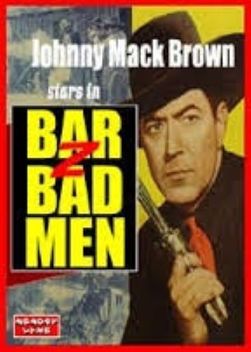
After getting kicked out of town for shooting the place up during a night of friendly fun, cowboy Jim Waters (Johnny Mack Brown) drops in on his old friend, rancher Ed Parks (Jack Rothwell). Ed has got a strange problem. There are cattle rustlers about but instead of stealing Ed’s cattle, they’re adding cattle to Ed’s herd. It’s an obvious scheme to try to create a feud between Ed and his neighbor, rancher Hamp Harvey (Frank LaRue). Before Jim and Ed can solve the problem, Ed is gunned down. Harvey is the number one suspect but Jim figures out the truth, that Harvey has been betrayed by one of his own employees and that all of this is a part of a scheme by Sig Bostell (Tom London) to take control of both ranches.
Bar-Z Bad Man is a B-western with a notably twisty plot as Bostell plays both sides against each other for his own benefit. As usual, Johnny Mack Brown makes for a good and convincing western hero. Whether he’s chasing someone on his horse or drawing his guns, Brown is always a convincing cowboy. What makes this film interesting is that it opens with Johnny Mack Brown engaging in the type of behavior that most B-western heroes would never think of doing. Shooting up the town and then getting exiled for his actions adds an element of redemption to Jim’s efforts to get to the bottom of Bostell’s schemes. Or it would if Jim ever really seemed to feel bad about shooting the town up. His excuse is that he was just having a good time. Try to get away with that in the real old west, Jim!
Bar-Z Bad Men is a good B-western for those who like the genre. The story is solid and Johnny Mack Brown is as convincing saving the west as he was shooting it up.
Missouri in 1864. The Civil War is raging and the state is divided between those who support the Union and those secretly support the Confederate guerillas led by Willian Quantrill (Ray Corrigan). The Union’s Major Baker (Jack Holt) is determined to track down rebel Bob Shelby (Jimmie Martin) and he enlists the Native American Chief Whitecloud (played by Chief Thundercloud) to help find him. Whitecloud has a personal vendetta against the Shelby family and, when he finds Bob, he executes him in cold blood. Bob’s sister, Jean Shelby (Ann Savage), is also a Confederate sympathizer and she seeks revenge. Complicating things is that Jean has fallen in love with Union Captain Fred Raymond (Alan Curtis).
One of the many B-westerns produced by Robert L. Lippert and directed by William Berke, Renegade Girl packs a lot of plot into just 65 minutes. The action is nonstop and fans of westerns will find all of the horse chases, gunfights, and threats of hanging that they could want. The main thing that distinguishes Renegade Girl from other B-westerns is the fierce performance of Ann Savage as Jean Shelby, a woman who will not stop until she gets her revenge. While the film’s portrayal of the Quantrill and Chief Whitecloud definitely goes against modern sensibilities, Ann Savage’s performance feels ahead of her time. No one is going to stand in Jean Shelby’s way.
Chief Thundercloud’s real name was reportedly Victor Daniels, though his past is shrouded in mystery. He claimed to be a Cherokee from Arizona, though he was listed as being Mexican on a marriage record that was filed before he started his film career. As Chief Thundercloud, he was a mainstay in westerns from the 30s to the time of his death in 1955. He was the first actor to play the Lone Ranger’s Tonto and he also played Geronimo in a 1939 Paramount film of the same name. His final film role was a posthumous appearance in John Ford’s The Searchers.
For those following at home, Lisa is attempting to clean out her DVR by watching and reviewing 38 films by the end of today!!!!! Will she make it? Well, it depends on whether or not she can finish the review below!)
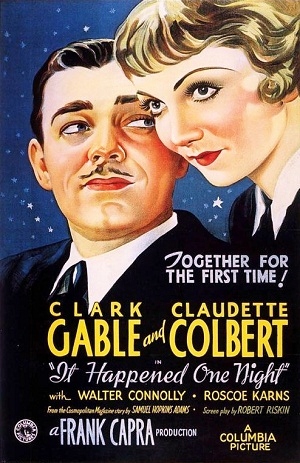
Before I talk too much about the 1934 film It Happened One Night, I want to tell a story about legs.
I’ve always been insecure about having a slightly large nose and once, when I was 17 years old, I was giving my mom a hard time about the fact that I had basically inherited it from her. I was going on and on and being fairly obnoxious about it. (Yes, believe it or not, I can occasionally be obnoxious…)
Finally, my mom held up her hand and said, “Yes, you got your nose from me but you also got my legs so stop crying!”
And you know what? I glanced down at my legs and I realized that she was right and that made me feel a lot better. Ever since then, I’ve taken a lot of pride in having a good pair of legs.
Now, you may be asking yourself what that has to do with It Happened One Night. Well, It Happened One Night is one of the ultimate “good legs” movies. That’s because It Happened One Night features the famous scene in which Claudette Colbert teaches Clark Gable the proper way to hitchhike. (If I ever take up hitchhiking, I’m planning on using the same technique.)
That’s the scene that It Happened One Night is justifiably famous for. However, It Happened One Night is more than just a film about hitchhiking.
It’s also a romance, one that features Claudette Colbert at her wackiest and Clark Gable at his sexiest. Reportedly, the sell of undershirts plummeted after Clark Gable took off his shirt and revealed that he wasn’t wearing one.
It was one of the first road movies and it was such a success that it remains influential to this very day. Any time you watch a movie that features two seemingly different characters getting to know each other on a road trip, you’re watching a movie that exists because of It Happened One Night. (And yes, that includes Tom Hardy and Charlize Theron in Mad Max: Fury Road.)
Frank Capra won his first Oscar for directing this film and It Happened One Night remains one of his most likable and least preachy films. Just compare the unpretentious, down-to-Earth style of It Happened One Night to Meet John Doe.
Perhaps most importantly, It Happened One Night was the first comedy to win the Oscar for best picture. It Happened One Night is a film that announces that a film doesn’t have to be a self-serious, pretentious epic to be great. Before the victory of It Happened One Night, the top prize was exclusively reserved for films like Cimarron and Calvalcade. (Seriously, just try watching some of those early winners today.) It Happened One Night‘s Oscar victory was a victory for the future of entertainment.
(By the way, as I sit here typing up this review, I keep accidentally typing It’s A Wonderful Life instead of It Happened One Night. That’s the power of Frank Capra.)
It Happened One Night tells the story of Pete Warne (Clark Gable). Pete is an out-of-work reporter. Though he may be down on his luck, he’s still confident and lovably cocky in that way that only Clark Gable could be. While riding on a bus from Florida to New York, Pete recognizes one of his fellow passengers as Ellie Andrews (Claudette Colbert), an heiress who has recently eloped with a buffoonish big game hunter named King Westley (Jameson Thomas). Ellie’s father wants to get the marriage annulled and has people all over the country searching for his daughter. Pete agrees not to call Ellie’s father if Ellie will agree to give him an exclusive story when she meets up with Westley in New York.
For the rest of the film, we follow Pete and Ellie as they cross the United States, spending awkward nights in motel rooms, getting kicked off of buses, and hitchhiking. Ellie gives lessons on how to get a car to stop. Pete delivers a long monologue on the proper way to undress before going to bed. Along the way, Pete and Ellie fall in love. It also becomes obvious that Ellie’s father is right about Westley only marrying her for her money.
They also meet a large cast of increasingly eccentric characters. Whether they’re dealing with the passengers on the bus or the cranky people staying at a rest stop or a motorist who won’t stop singing, Pete and Ellie do noy meet anyone who doesn’t have at least one odd quirk. Like many classic screwball comedies, It Happened One Night takes place in a world where everyone — from a bus driver to a desk clerk to a group of women waiting to use a shower at a rest stop — has something to say about everything. Some of the film’s funniest moments come from watching the normally smooth Pete have to deal with the increasingly crazy world in which he’s found himself.
(For her part, Ellie is at her happiest when things are at their strangest. Ellie’s the best.)
The other great moments come from simply watching Gable and Colbert interact. They have an amazing chemistry and it comes through in their performances. It’d odd to read that apparently neither Gable nor Colbert were happy to be cast in It Happened One Night because their performances are so much fun to watch. A love story only works if you love the characters and the love story in It Happened One Night definitely works.
As I stated above, It Happened One Night was the first comedy to win Best Picture. Beyond that, it was also the first movie to win all of the top 5 Oscars: Picture, Director, Actor, Actress, and Adapted Screenplay. (Those were also the only 5 nominations that It Happened One Night received.) For once, the Academy got it right. It Happened One Night remains a delightful film.
(Oh my God, y’all, I did it! That’s 38 films reviewed in 10 days and my DVR now has space to record all sorts of things! And making it all the better is that I finished this project by reviewing a truly wonderful comedy like It Happened One Night!)
“People all say that I’ve had a bad break. But today … today, I consider myself the luckiest man on the face of the Earth.”
— Lou Gehrig (Gary Cooper) at the end of The Pride of the Yankees (1943)
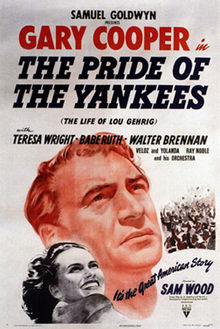
After airing Foreign Correspondent earlier tonight, TCM followed up by showing the 1943 best picture nominee, The Pride of the Yankees. Knowing that Pride of the Yankees was going to be a baseball film and that I know next to nothing about baseball, I recruited my sister, the Dazzling Erin, to watch the movie with me. Erin loves baseball and I knew that she would be able to explain anything that went over my head.
Well, I absolutely loved watching this movie with my sister but it turns out that The Pride of the Yankees isn’t really much of a baseball movie. True, it’s about a real life baseball player. Several actual players appeared as themselves. About 85% of the film’s dialogue deals with baseball and probably about 70% of the film features characters playing some form of the game. But the film never goes into any great detail about baseball or how it’s played. There’s no talk of strategy or rules or deeper meaning or anything else. Going into the film, I knew that baseball was a game that involved throwing, swinging bats, and running. And it turns out that was all that I needed to know.
The Pride of the Yankees is less about baseball and more about celebrity. It’s a biopic of Lou Gehrig, who today is best known for his battle with ALS, a disease that is also known as Lou Gehrig’s disease. Lou Gehrig died on June 2, 1941 and The Pride of the Yankees was released just a year later. Watching the film, it’s obvious that Gehrig was a beloved figure, the type of celebrity who, if he were alive today, would probably be the center of stories like, “Lou Gehrig Did Something This Weekend And It Was Perfect.” Watching the film, it easy to imagine how traumatic it must have been for the nation when a beloved athlete like Lou Gehrig died at the age of 37.
As a result, The Pride of the Yankees is less a biopic and more a case for canonization. From the minute that the film’s Lou Gehrig appears on-screen, he is presented as being the type of saintly athlete who, by promising to hit two home runs in one game, inspires a crippled child to walk. Lou is modest, kind, unpretentious, and never gets angry. Over the course of the film, he takes care of his mother, displays a worthy work ethic, and marries Eleanor. He and Eleanor have a perfect marriage without a single argument or a hint of trouble, except for the fact that Lou sometimes gets so busy playing baseball with the local children that he’s late coming home. There’s not a hint of sadness in their life, until Lou suddenly gets sick.
And really, it should not work. If ever there’s ever been a film that should be painfully out-of-place in our more cynical times, it would be The Pride of the Yankees. However, the film still works because Lou is played by Gary Cooper and Eleanor is played by Teresa Wright. These two excellent performers bring their considerable talents to making overly sentimental scenes feel credible. Gary Cooper was 40 years old when he made The Pride of the Yankees and there’s a few scenes — especially the ones where Lou is supposed to be a student at Columbia University — where Cooper is clearly too old for the role. But, for the most part, Gary Cooper did a great job as Lou Gehrig. Cooper is especially memorable when Lou first starts to show signs of being ill. Watching Lou struggle to swing a bat, I was reminded of a horse struggling to stand on an injured leg. It was almost painfully poignant.
The Pride of the Yankees was nominated for 11 Academy Awards, including best picture. However, it lost to another sentimental film that featured Teresa Wright, Mrs. Miniver.
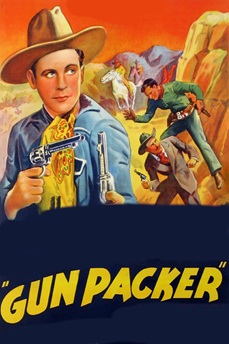 Someone is holding up stages and making off with a fortune of gold bullion. The government decides to send in a gun packer. Jack Denton (Jack Randall), the son of a legendary lawman, is sent to investigate, along with his sidekick Pinkie (Ray Turner) and Rusty the Wonder Horse. Jack goes undercover, telling an elderly ex-con (Barlowe Borland) that he’s a former partner of his, which leads Jack to the leader of the robbers, Chance Moore (Charles King).

 Through the Shattered Lens