4 Shots From 4 Horror Films: 1940s Part One


This October, I’m going to be doing something a little bit different with my contribution to 4 Shots From 4 Films.  I’m going to be taking a little chronological tour of the history of horror cinema, moving from decade to decade.

Today, we take a look at the first few years of 1940s.

4 Shots From 4 Horror Films

Dr. Cyclops (1940, dir by Ernest B. Schoedsack)

Dr. Cyclops (1940, dir by Ernest B. Schoedsack)

The Wolf Man (1941, dir by George Waggner)

The Wolf Man (1941, dir by George Waggner)

Cat People (1943, dir by Jacques Tourneur)

Cat People (1942, dir by Jacques Tourneur)

I Walked With A Zombie (1943, dir by Jacques Tourneur)

I Walked With A Zombie (1943, dir by Jacques Tourneur)

Film Review: The Most Dangerous Game (dir by Irving Pichel and Ernest B. Schoedsack


On a jungle island Count Zaroff awaits.

Zaroff is a Russian nobleman and a hunting enthusiast.  However, he’s grown bored with hunting the usual big game trophies.  Those don’t provide enough of a challenge for him.  Instead, he prefers to hunt humans because humans are the most dangerous game.  Humans can think.  Humans are clever.  Humans are deadly.  When big game hunter Bob Rainsford washes up on the island after a shipwreck, he is discovered by Zaroff’s men.  Rainsford discovers that Zaroff is a fan of his work.  Rainsford also learns that Zaroff is planning to hunt him next.

It’s a tale that we’ve all heard, in one form or another.  Ever since Richard Connell’s original short story was published in 1924, The Most Dangerous Game has inspired a countless number of adaptations.  Some of those have been direct adaptations while others have merely been inspired by Connell’s plot but, in the end, they all have the same thing in common.  No animal is more dangerous than man.

As far as my research has revealed, the very first cinematic adaptation of The Most Dangerous Game came out in 1932.  It was produced by Ernest Schoedsack and Merian C. Cooper, the same team that would later be responsible for the original King Kong.  Joel McCrea played Rainsford while Zaroff is played by Leslie Banks.  In order to provide some romance and perhaps to pad out the film to over an hour, a few extra shipwreck survivors are added.  There’s two sailors who don’t last long.  There’s also Eve Trowbridge and her brother, Martin.  Eve and Martin are played by Fay Wray and Robert Armstrong, both of whom would star in King Kong.  Zaroff’s imposing servant, Ivan, is played by Noble Johnson who also appeared in King Kong.  Are you picking up on a theme here?’

Other than the addition of the extra characters, this film version is pretty faithful to its source material.  Again, we have Zaroff “rescuing” Rainsford and then having a long philosophical discussion with him before announcing that it is Rainsford who will be hunted.  Unsurprisingly, the film’s Rainsford is a bit more heroic than the one who appears in the short story.  The literary Rainsford looks forward to defeating Zaroff at his own game while the film’s Rainsford is more concerned with getting off the island and protecting Eve.

All in all, it’s an entertaining film.  Of course, by today’s standards, it’s a bit creaky.  I mean, the film is 88 year old.  Still, Joel McCrea remains a convincing and compelling hero while Leslie Banks is enjoyably hammy in the role of Zaroff.  Zaroff is a role that calls for an actor who is willing to give into his most theatrical impulses and Banks doesn’t let the film down.  The jungle scenery is properly shadowy and even the miniatures used during the shipwreck sequence have a charm all their own.

Unfortunately, The Most Dangerous Game is one of those films that has slipped into the public domain.  As a result, there’s a lot of less-than perfect versions floating around.  (The version that I recently watched on YouTube was so grainy that it was nearly unwatchable.)  Fortunately, this film is a part of the Criterion Collection.  That’s the one to add to your collection.

Film Review: The Last Days of Pompeii (dir by Ernest B. Schoedsack and Merian C. Cooper)


The summer after I graduated high school, I took a trip to Italy.

I absolutely loved it.  There’s nothing more wonderful than being 18 and irresponsible in one of the most beautiful and romantic countries in Europe.  I also loved it because everywhere I looked in Italy, I saw the remains of history.  When I was in Rome, I visited the Colosseum.  When I was in Southern Italy, I visited Comune di Melissa, the village where some of my ancestors once lived.  When I visited Florence, I became so overwhelmed by the beauty of it all that I nearly fainted.

And then there was Pompeii.  I spent a day visiting the ruins of Pompeii and it was an amazing experience.  The eruption of Mt. Vesuvius in 79 AD may have been horrific for the Romans but it’s also gave history nerds like me a chance to step right into the past.  Beyond just the thrill of seeing how the world once was, I have two main memories of Pompeii:

First, there was the visit to Pompeii’s brothel.  An Australian tourist lay down on one of the stone slabs so that his family could take pictures of him.

Secondly, there was the fact that I wore a really pretty red dress for my visit but I failed to take into account that 1) the area around Pompeii is very hilly and 2) it was a very windy day.  So, I can say that I’ve not only visited but I’ve flashed Pompeii as well.

The destruction of Pompeii has inspired several books and more than a few films, as well.  One of the earliest was the 1935 film, The Last Days of Pompeii.

The Last Days of Pompeii opens with Marcus (Preston Foster), an extremely bitter blacksmith who lives in the bustling city of Pompeii.  Marcus is bitter because he’s not rich and his family has been just been run down by some jackass in a chariot.  Marcus does find brief fame as a gladiator but he’s stricken with guilt after he kills a man and then discovers that he’s made an orphan out of the man’s son.  Marcus adopts young Flavius, just to then discover that the boy is seriously ill.  A fortune teller informs Marcus that Flavius will be healed by “the greatest man in Judea.”  Marcus naturally assumes that this is a reference to the Roman governor, Pontius Pilate (Basil Rathbone).  However, upon traveling to Judea, Marcus meets a different great man and then watches as his adopted son is healed.

Jump forward about two decades.  Marcus is now a rich man and is in charge of Pompeii’s gladiatorial games.  Flavius (now played by John Wood) has grown up to be an idealistic young man who barely remembers the day that he was healed. What Marcus doesn’t know is that Flavius has been helping slaves escape from Pompeii.  When Flavius is arrested, it appears that Marcus is doomed to watch his own son be killed in the arena.

But wait a minute — what’s that coming down the mountain?  It’s kinda smoky and red and it looks like it might be really hot and …. oh damn.

Now, there’s two problems here.  First off, from a historical point of view, the film’s timeline doesn’t work out.  Jesus was crucified in 33 AD.  Pompeii was destroyed 46 yeas later, in 79 AD.  Therefore, there’s no way that Flavius should only be in his early 20s.  Secondly, just the fact that the film takes place in Pompeii pretty much gives away the ending before the story even begins.  Since you know that the volcano is eventually going to kill everyone, it’s hard to get too caught up in any of the drama.  You just find yourself sitting there and going, “When isssssssssss the volcano going to eeeeeeeeeeeeerupt!?”

On the plus side, Preston Foster is one of the more underrated of the Golden Age stars and he does a pretty good job here.  Plus, you have to love any film that features Basil Rathbone as a semi-decadent Roman.  Rathbone plays Pilate as both a bored libertine and a guilt-stricken convert and, both times, he’s impressive.

Despite being directed by the team behind the original King Kong, The Last Days of Pompeii is a bit slow but, if you’re specifically a fan of old sword-and-sandal epics, it’s entertaining enough.  See it for Foster, Rathbone, and the ghosts of old Pompeii.
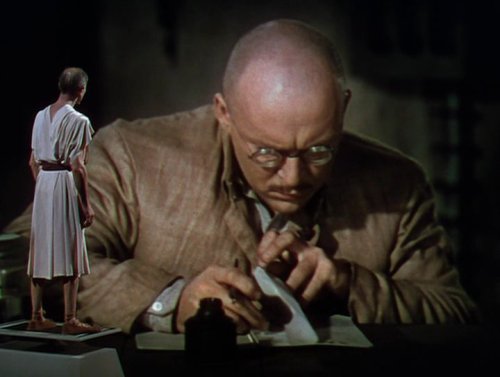
4 Shots From Horror History: Dr. Cyclops, The Wolf Man, Cat People, I Walked With A Zombie


This October, I’m going to be doing something a little bit different with my contribution to 4 Shots From 4 Films.  I’m going to be taking a little chronological tour of the history of horror cinema, moving from decade to decade.

Today, we take a look at the first few years of 1940s.

4 Shots From 4 Films

Dr. Cyclops (1940, dir by Ernest B. Schoedsack)

Dr. Cyclops (1940, dir by Ernest B. Schoedsack)

The Wolf Man (1941, dir by George Waggner)

The Wolf Man (1941, dir by George Waggner)

Cat People (1943, dir by Jacques Tourneur)

Cat People (1942, dir by Jacques Tourneur)

I Walked With A Zombie (1943, dir by Jacques Tourneur)

I Walked With A Zombie (1943, dir by Jacques Tourneur)