4 Shots From 4 Films is just what it says it is, 4 shots from 4 of our favorite films. As opposed to the reviews and recaps that we usually post, 4 Shots From 4 Films lets the visuals do the talking!
Today, the Shattered Lens takes a look at New York. It’s time for….
4 Shots From 4 New York Films
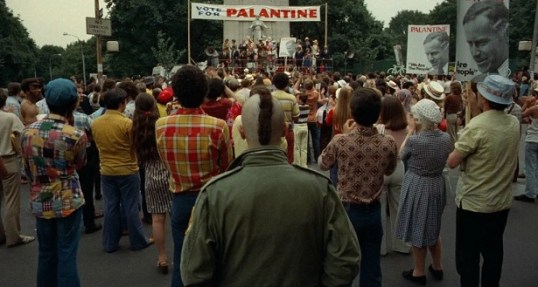
Taxi Driver (1976, dir by Martin Scorsese, DP: Michael Chapman)
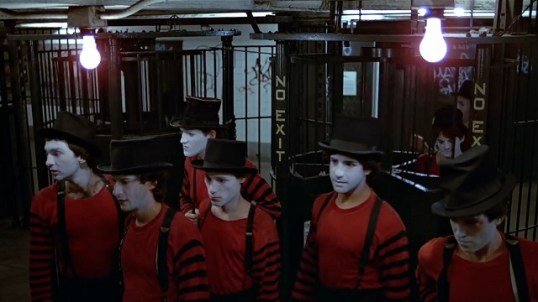
The Warriors (1979, dir by Walter Hill, DP: Andrew Laszlo)
Escape From New York (1981, dir by John Carpenter, DP: Dean Cundey)
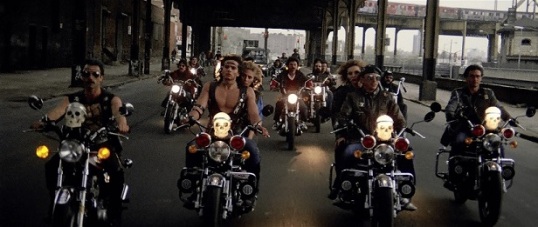
1990: Bronx Warriors (1982, dir by Enzo G. Castellari, DP: Sergio Salvati)
4 Or More Shots From 4 Or More Films is just what it says it is, 4 shots from 4 of our favorite films. As opposed to the reviews and recaps that we usually post, 4 Shots From 4 Films lets the visuals do the talking!
Today, the Shattered Lens whishes a happy 85th birthday to the legendary Italian director, Enzo G. Castellari! Here are….
4 Shots From 4 Enzo G. Castellari Films
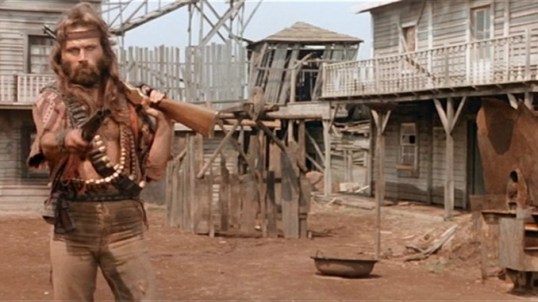
Keoma (1976, dir by Enzo G. Castellari, DP: Aaice Parolin)
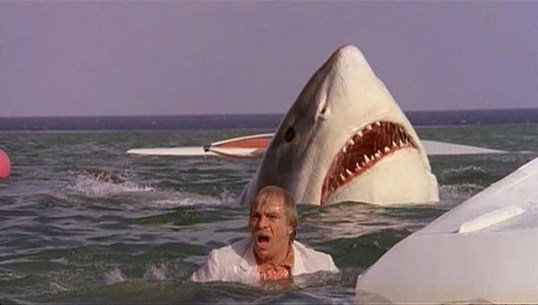
The Last Shark (1981, dir by Enzo G. Castellari, P: Alberto Spagnoli)
1990: Bronx Warriors (1982, dir by Enzo G. Castellari, DP: Sergio Salvati)
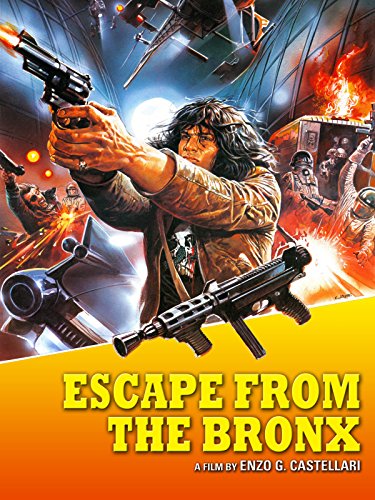
Escape From The Bronx (1983, dir by Enzo G. Castellari, DP: Blasco Giurato)
Produced in Italy and first released in 1985, Enzo G. Castellari’s Light Blast is a hybrid of several different genres. There’s a lot of action, there’s a bit of horror, and there’s also some sci-fi. Like the majority of Italian exploitation films that came out during the 80s, it’s designed to have a little something for everyone.
Erik Estrada plays Ronn Warren, a detective with the San Francisco Police Department. (Though the film was filmed on location and it did star American television star Erik Estrada, it’s still very much an Italian production, complete with badly dubbed dialogue and clumsy attempts to capture the peculiarities of American culture.) When we first see Ronn, he’s in his underwear and he’s carrying a turkey. Two inbred criminals are trapped in a bank and they’ve taken hostages. They’ve demanded that the police provide them with dinner and that the food be delivered by someone “not wearing a stitch of clothing.” Ronn is happy to oblige, though he doesn’t go completely naked because Ronn is one of those police detectives who has trouble following orders. Of course, as soon as he gets inside the bank, Ronn proves that he doesn’t need to be fully dressed to stop the bad guys. He just needs for the bad guys to be stupid enough to continually let their guard down and fall for extremely obvious tricks.
While Ronn is showing off his physique, Dr. Yuri Svoboda (played by Enio Girolami, who is credited as Thomas Moore in this film) is planning on terrorizing the city of San Francisco. He’s developed a giant laser gun that he transports on top of a van. Whenever he shoots the laser at any digital clock, it causes people to melt and buildings to explode. His first victims are a teenage boy and girl who are having sex in an abandoned railroad car. His next victims are the innocent spectators of a stock car race. What does Dr. Svoboda want!?
It turns out that he wants a lot of money. Now, if Dr. Svoboda tried this today, I imagine the city would quickly pay up and Dr. Svoboda would be given a police escort to the airport. But this film was made in the 20th Century, back when people were still willing to fight back against mad scientists with lethal death rays! Soon, Ronn Warren is running around San Francisco, battling Dr. Svoboda’s henchmen while trying not to get melted himself. And, of course, it would not be a movie about San Francisco if there wasn’t at least Bullitt-inspired car chase. For this chase, Ronn steals a stock car and chases the bad guys throughout the city. Whenever anyone gets in Ronn’s way, he and the car just jump over them while the film’s synth-heavy musical score goes appropriately crazy.
What to say about Light Blast? It’s a bit of a dumb movie but, to its credit, it doesn’t take itself too seriously. The melting effects are both so grotesque and so obviously fake that you won’t know whether to laugh or to scream. Castellari keeps the action moving quickly and Estrada delivers all of his lines through gritted teeth, an indication that both of them knew better than to worry about things like logic or motivation. Why Dr. Svoboda melting people? Because he wants to. How can he somehow get away with driving around in a van that has a very obvious laser gun on top of it? There wouldn’t be a film otherwise. That’s just the way Light Blast is. It’s stupid but it’s so unapologetic in its stupidity that it’s hard not to be entertained.
4 Or More Shots From 4 Or More Films is just what it says it is, 4 shots from 4 of our favorite films. As opposed to the reviews and recaps that we usually post, 4 Shots From 4 Films lets the visuals do the talking!
Today, the Shattered Lens whishes a happy 82nd birthday to the legendary Italian director, Enzo G. Castellari! Here are….
4 Shots From 4 Enzo G. Castellari Films
Keoma (1976, dir by Enzo G. Castellari, DP: Aaice Parolin)
1990: Bronx Warriors (1982, dir by Enzo G. Castellari, DP: Sergio Salvati)
Escape From The Bronx (1983, dir by Enzo G. Castellari, DP: Blasco Giurato)
Light Blast (1985, dir by Enzo G. Castellari, DP: Sergio D’Offizi)
All bad action films tend to feature it. (Actually, it shows up in some good action films as well.) Whenever a group of soldiers step on a mine and slowly flip through the air as a result of the subsequent explosion, that’s the Slo Mo of Doom. Whenever an important supporting character is shot and the film suddenly slows down so that each frame of their collapse is their highlighted, that’s the Slo Mo of Doom. Sometimes, it’s a way of saying, “Hey, you should care more about this violent death than you care about all of the other violent deaths in this movie.” Sometimes, it’s a way of showing off the fact that the producers could afford stunt people, even if they couldn’t afford anything else. Other times, it’s just a way to pad out the running time so that a movie can at least reach the 90 minute mark before the end credits roll. Regardless of the reason why it’s deployed, Slo Mo of Doom is usually a good sign that you’re watching a cheesy action film.
Last night, when I watched the 1983 Italian film, Escape from the Bronx, with a group of friends, we counted at least six instances of the Slo Mo of Doom. There may have been even more, it’s hard to say. Along with frequent slow motion, Escape from the Bronx features a lot of flame throwers, several corporate bad guys, and an abundance of graffiti. It also featured Henry Silva as a villain named Floyd Wangler and Antonio Sabato, Sr. as a flamboyant rebel leader who dressed like he was appearing in an Off Broadway adaptation of The Fantasticks. In short, it was a classic of its kind.
Escape From The Bronx takes place in, what was then, the future. (To be specific, the story is said to take place in the year 2000.) The Bronx has become such an eyesore that an evil corporation wants to blow up all the buildings and rebuild. Unfortunately, the residents of the Bronx know how difficult it is to find an apartment in New York City and they don’t want to move. In order to change their minds, Floyd Wangler and his army of jackbooted, flame thrower-wielding bad guys invade the Bronx. “Leave the Bronx!” they announce. “It is time to leave the Bronx.” And, to be honest, the Bronx looks like a terrible place to live so maybe they have a point.
A motorcycle-riding bad boy named Trash (played by Mark Gregory) doesn’t want to leave the Bronx so he goes underground. While the buildings are being blown up and people are being set on fire, Trash teams up with Doblon (Antonio Sabato, Sr.) and his gang of flashy rebels. Working with a mercenary named Strike (Giancarlo Prete) and journalist named Moon Gray (Valeria D’Obici), Trash plots to kidnap the president of the corporation. Of course, by doing so, Trash might be doing exactly what Floyd wants him to do.
Both John Carpenter’s Escape from New York and George Miller’s Mad Max films were very popular in Europe and Escape From The Bronx was one of the many Italian films to imagine New York (or, in this case, one unfortunate borough of New York) as being some sort of a post-apocalyptic wasteland. (In fact, Escape From The Bronx was a sequel to another film called The Bronx Warriors. The adventures of Trash could not be contained to just one film.) One could argue that Escape From The Bronx was an early warning against the horrors of gentrification, with the poor being set on fire so that the rich can blow up their homes and make even more money. Personally, I thought the film was much more about the struggle of the Italian film industry to come to terms with the legacy of Mussolini. Floyd Wangler may have had a silly name but, as played by Henry Silva, he was the chilling epitome of the authoritarian impulse come to life. With his black uniform and his steely gaze, it was easy to imagine Floyd as one of the fascists who marched on Rome in 1922. There’s a definite political subtext to Escape from the Bronx, one that can easily get overshadowed by the prominent use of the Slo Mo of Doom.
That’s not to say that Escape from the Bronx is a particularly good film, of course. There’s a few decent action scenes but the middle part of the film drags and Mark Gregory doesn’t have much screen presence. Henry Silva is better-cast as the bad guy but it’s hard to take a villain named Floyd seriously. That said, Escape from the Bronx is an entertaining film to watch with a group of friends. This is a film that invites you to talk back to the screen and, with all of its costumed rebels, it’s actually a good film for October. Whatever its flaws, I defy anyone to watch this film without getting “Leave the Bronx” stuck in their head.
And, if nothing else, you can always have fun counting all of the Slo Mo of Doom.
Chances are this is going to sound familiar to you.
The 1981 film, The Last Shark (a.k.a. Great White), takes place in a small seaside community. A teenager goes out in the water, doesn’t pay enough attention to the surroundings, and ends up getting eaten. Local civic leader named Peter Benton (James Franciscus) wants to shut down the beach. A crusty old shark hunter named Ron Hammer (Vic Morrow) says that he can take care of the problem. However, Mayor William Wells (Joshua Sinclair) refuses to even admit that there’s a shark in the water. After all, sharks are not only bad for business but also could potentially keep him from being President someday!
However, the shark attacks continue. After his son is nearly eaten by a shark — a great white, to be exact — even the mayor is forced to admit that something must be done….
If you think that the plot of The Last Shark sounds like it has a lot in common with Jaws…. well, you’re right. And you’re not alone! Universal Pictures though that The Last Shark borrowed a bit too much from Steven Spielberg’s seminal film as well. In 1982, Universal filed a lawsuit to block the film’s distribution in the United States. Though the film played for a month (and grossed 18 million dollars) while the case worked its way through the legal system, a federal judge eventually ruled that The Last Shark was too similar to Jaws and, as a result, The Last Shark was not only yanked from theaters but it also didn’t even get a proper video release until 2013! Because of all this, The Last Shark has developed a cult following. It’s literally the film that the major studios didn’t want people to see. Of course, The Last Shark was neither the first nor the lat film to rip-off Jaws. It was, however, one of the few to make a good deal of money and I imagine that was the main motivation behind Universal’s lawsuit.
Interestingly enough, The Last Shark actually has more in common with Jaws 2than with Jaws. Just as in Jaws 2, a bunch of stupid teenagers make the mistake of going after the shark themselves. Also, much as in Jaws 2, the shark manages to bite down on a helicopter and pull it under the water. A quality shark movie always features at least one helicopter getting destroyed. That the original Jaws become a classic despite not featuring any helicopter destruction is a testament to Steven Spielberg’s ability as a director.
As for The Last Shark, it’s a thoroughly shameless and undeniably entertaining film. Director Enzo G. Castellari (who directed several Franco Nero films and might be best-known to American audiences for directing the original Inglorious Bastards) keeps the action moving at steady pace and even manages to give us a few striking images of shark mayhem. (The scene where a man gets bitten in half manages to be both shocking and ludicrous at the same time.) James Franciscus appears to be taking himself far too seriously in the role of Peter Benton but Vic Morrow seems to be having a good time as the ill-tempered shark hunter.
A few other thoughts on The Last Shark:
Mayor Wells, who has presidential ambitions, also has a mustache and a haircut that makes him look like a 70s porn actor. (In fact, with the exception of James Franciscus, nearly every adult male in this movie has a mustache.) Whenever Mayor Wells walked through a scene, I found myself expecting to hear a lot of bass and plenty of wah wah on the soundtrack.
Secondly, it would appear that the best way to track down a shark is to drop a steak in the water. At least, that’s the lesson I learned from watching The Last Shark. There are actually a handful of scenes of shark hunters announcing that they’re about to go hunt for the shark and then holing up a steak. Forget about using blood or noise to attract your prey! Instead, just toss some spare ribs in the ocean and wait for the shark to show up!
Anyway, Italian filmmakers were always fairly shameless when it came to ripping off successful movies. In fact, one reason why I love Italian cinema is because of that very lack of shame. Whatever its flaws, The Last Shark is a film totally without shame and, for that reason, it’s more than worth viewing.
4 Shots From 4 Films is just what it says it is, 4 shots from 4 of our favorite films. As opposed to the reviews and recaps that we usually post, 4 Shots From 4 Films is all about letting the visuals do the talking.
Today is the first day of summer so these 4 shots all celebrate films about summer vacation!
4 Shots From 4 Summer Films
Race With The Devil (1975, dir by Jack Starrett)
Hitch-Hike (1977, dir by Pasquale Festa Campanile)




 Through the Shattered Lens