Retro Television Reviews: A Great American Tragedy (dir by J. Lee Thompson)


Welcome to Retro Television Reviews, a feature where we review some of our favorite and least favorite shows of the past!  On Sundays, I will be reviewing the made-for-television movies that used to be a primetime mainstay.  Today’s film is 1972’s A Great American Tragedy!  It  can be viewed on YouTube!
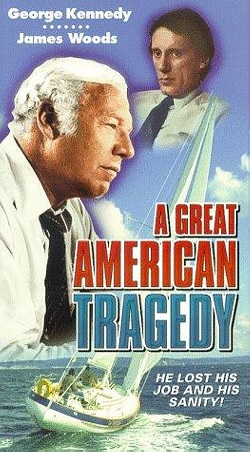
Brad Wilkes (George Kennedy) had a good career, working as an aerospace engineer.  He was able to buy a nice house.  With his wife, Gloria (Vera Miles), he was able to raise a good family.  He was even able to buy a sailboat, one that is the pride of the entire marina.  But then, one day, he’s told that the company is letting him go.

Returning to his home, Brad tells Gloria that he’s lost his job but that everything’s going to be okay because not only does he have a $10,000 pension but he’s sure he can find a new job.  “Of course, I might not be making $35,000 a year….” he says.

(Watching at home, I said, “Pfffft!  I make more than that!”  But, of course, Brad is talking about $35,000 in 1972 money, which would be the equivalent of a quarter of a million today.)

However, Brad soon discovers that getting a new job will not be as easy as he assumed.  It turns out that there are a lot of people out there looking for work and most of them are younger, cheaper, and better educated than Brad.  The bills start to pile up.  His former boss (Robert Mandan) informs Brad that his pension is going to be $7,000 less than he thought.  Brad forces himself to go down to the unemployment office so that he can collect $25 a week and then suffers the humiliation of being offered a loan by his well-meaning son-in-law (played by a youngish James Woods).  Gloria gets a job at the same clothing store where she used to shop and her lecherous boss (Kevin McCarthy) starts to hit on her.

For Brad, the final humiliation comes when he has to sell the boat.  A younger boat owner (Tony Dow, with a huge mustache) puts Brad in contact with a woman named Paula (Natalie Trundy).  Paula wants to buy the boat and, after they take it out on the water, Brad finds himself tempted to cheat on his wife.  It all gets to be too much for Brad and soon, he’s on a plane to Nevada where hopefully one good night at the craps table will be enough to pay his bills….

Watching this film, I found myself feeling very sorry for Brad while, at the same time, becoming very frustrated with him.  On the one hand, his company tossed him out after years of loyal service and then tried to screw him out of his pension.  On the other hand, Brad spent almost the entire movie in denial about how bad things actually were.  It’s one thing to be proud and it’s another to just be stubborn.  Knowing that he has next to no money, Brad still insists on throwing his annual 4th of July party and he even invites his former boss to come over and celebrate.  Brad simply cannot bring himself to admit that his old life is over but really, who can blame him?  He’s not the one who chose to be fired.

A Great American Tragedy was directed by J. Lee Thompson, who also did Cape Fear, The Guns of Navarone, the Planet of the Apes sequels, and several Charles Bronson films.  There are no fight scenes to be found in A Great American Tragedy but Thompson does get good performances from his cast and the film makes great use of George Kennedy’s likability.  The viewer remains sympathetic to Brad, even when he makes mistake after mistake.  A film about a formerly secure family suddenly discovering just how much the economy sucks, A Great American Tragedy remains just as a relevant today as when it was first made.
Horror Film Review: Rosemary’s Baby (dir by Roman Polanski)


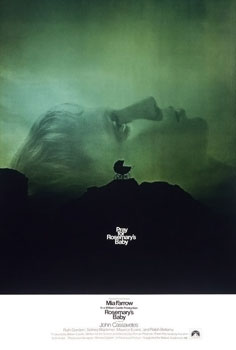
Rosemarys_baby_poster

“This is no dream!  This is really happening!”

— Rosemary Woodhouse (Mia Farrow) in Rosemary’s Baby (1968)

Yes, Rosemary, it is.

The classic 1968 horror movie Rosemary’s Baby is probably best remembered for a lengthy and wonderfully surreal “dream” sequence in which naive newlywed Rosemary Woodhouse (Mia Farrow) is raped by the Devil while a bunch of naked old people stand around her and chant.  At one point, she sees her husband, Guy (John Cassavetes), saying that she’s awake and that she knows what’s going on.  Their neighbor, Minnie Castevet (Ruth Gordon), tells him that Rosemary can’t hear anything and that it’s like she’s dead and then snaps at him, “Now, sing!”  It’s a great sequence, one of the greatest of Roman Polanski’s career, a perfect blending of horror and dark comedy.

For me, the most interesting part of that dream sequence comes at the start.  Rosemary envisions herself naked on a boat and, as she tries to cover herself, who is sitting next to her?  None other than John F. Kennedy!  Suddenly, Rosemary is wearing a bikini and she’s relaxing out on the deck with a glamorous group of people who I assume were meant to be Kennedy relatives.  As the boat leaves the dock, Rosemary sees that her friend and protector, Hutch (Maurice Evans), is standing on the dock.

“Isn’t Hutch coming with us?” Rosemary asks.

“Catholics only,” John F. Kennedy hisses in that famous accent, “I’m afraid we are bound by these prejudices.”

“I understand,” a dazed Rosemary replies.

And it’s a wonderful little moment, though I have to wonder if I’d react as strong if my own background wasn’t Irish Catholic.  But still, there’s something so wonderfully subversive about a bunch of elderly Satanists pretending to be the Kennedys.

And really, Rosemary’s Baby is a wonderfully subversive film.  I imagine it was even more subversive when it was first released back in 1968.  It’s been ripped off and imitated so many times that it has undoubtedly lost some of its impact.  (That’s one reason why I wish I had a time machine, so I could go back in the past and see it was truly like to see a classic film for the first time.)  But still, 47 years after it was initially released, Rosemary’s Baby is still a surprisingly effective horror film.

The film opens with newlyweds Rosemary and Guy moving into the Bramford, an exclusive New York apartment building.  Guy is an actor who, despite having appeared in two off-Broadway shows (one of which was entitled Nobody Likes An Albatross and really, that is so true) and a few motorcycle commercials, is still waiting for his big break.  There are hints that, before she married Guy, Rosemary had a very active and interesting life (when we briefly meet her old friends, they all seem to be a lot more exciting than boring old Guy) but, when we meet her, Rosemary appears to have happily settled into a life of domesticity.

Life at the Bramford is strange.  For one thing, Guy and Rosemary appear to be the only young people living in the entire building.  (There is a young woman named Terry but she ends up jumping out of a window.)  The Woodhouses befriend elderly Minnie Castevet and her husband, Roman (Sidney Blackmer.)  Roman claims to have traveled all over the world and embarrasses the Catholic Rosemary by criticizing the Pope.  Minnie, meanwhile, is the noisiest person in the world.  Guy makes fun of both of them and, yet, he still decides to spend his free time with Roman.

One day, Guy gets a role that he had previously lost.  Why?  Because another actor is struck by a sudden case of blindness.  Shortly afterward, Rosemary has her “dream.”  She wakes up and discovers that her body is covered with red scratches.  Guy claims that he had sex with her while she was asleep and promises to cut his fingernails.

Soon, Rosemary is pregnant but the Castevets insist that she use their doctor, the firm and sinister Dr. Saperstein (Ralph Bellamy, who just 8 year earlier had played FDR in Sunrise at Campobello).  Rosemary knows that something is wrong with the baby but she can’t get anyone to listen to her.  It all leads to one of the best and most iconic endings in the history of horror cinema.

Rosemary’s Baby is a classic of fear and paranoia and it holds up surprisingly well.  See it this October, whether you’re Catholic or not.

(However, do not see the needless 2014 remake.  Seriously, what the Hell was up with that?)

http://www.youtube.com/watch?v=PewtQsgN5uo

(By the way, is anyone else amazed that I made it through this entire review without making a single joke about either Ronan Farrow or Mia’s lame Sharknado live tweet?  I am shocked.)