Barbie (dir. by Greta Gerwig)


I may be the wrong person to be writing about Barbie. As a guy, I can’t really empathize with all of the elements of womanhood. I’ll never experience childbirth, nor fully understand all of the issues women have to deal with (though watching the women in my family proved insightful over the years). The closest I’ll know is either through writing or having a girl character in Grand Theft Auto Online and having to deal with players shooting my character to hell for not getting into their ride when I clearly have one of my own.

Still, I can appreciate both the fun and the serious notes that Barbie offered.

I spent last Christmas with a friend’s family, watching as they passed gifts between each other. During the gift giving, my friend passed along a small wrapped box to his wife. She smiled up at him from the sofa, but looked at the box with a hint of confusion. Tearing into it, she gasped and then broke into tears, which silenced the room.

The unwrapped present was a Barbie Doll, complete in a luxurious dress. I think it might have been the Oscar De La Renta one.

She explained that when she was little, living in Colombia, she had always wanted a Barbie. Sure, there were dolls to be had, but nothing like a Barbie. I listened to this and smiled, associating it as the female equivalent of asking your parents for a Transformer but only ever receiving GoBots instead. I could relate.

It also reminded me of my little sister, who had the Dream House, the Car, and a box full of clothes. She’d humor me with my Transformers, I’d humor her with Barbie life, either borrowing a Ken or her Kimber from her Jem line. We’d hop in the convertible and drive.

I can imagine James Earl Jones’ character in Field of Dreams noting that Barbie “has marked the time” throughout history.

So, when it was announced that there was an actual Barbie movie being made, I knew I’d check it out, especially with all of the Oppenheimer madness on the same weekend. I decided to watch Oppenheimer first (a 5pm showing), and then Barbie (at 9:30pm) this past Thursday. This proved to be a good idea. Barbie‘s lighthearted approach was a stark contrast to Oppenheimer’s tone.

I enjoyed Barbie, which opens with a homage to 2001: A Space Odyssey and a narration by Dame Helen Mirren. It’s the tale of a Barbie – Stereotypical Barbie, if you need particulars (Margot Robbie, Babylon) who lives her life in Barbieland with all of the Barbies and the Kens. One Ken (Ryan Gosling, The Gray Man) has his heart set on Barbie. Life is nice in Barbieland, sunning by the beach during the day and partying at night. However, once our Barbie begins to have thoughts about death and her existence, the magic around her begins to be disrupted. With the help of a Crazy Barbie (Kate McKinnon, DC’s League of SuperPets), our Barbie finds herself on a quest towards the Real World to find her companion – similar to Toy Story‘s toys and their owners – and fix what’s gone wrong. Adding to the mayhem is Mattel, whose CEO (Will Farrell) discovers the breach between Barbie Land and the Real World and sends his own agents after Ken and Barbie.

Can Barbie make things right? Will Ken just tag along for the ride?

Written by Greta Gerwig & her husband, Noah Baumbach, Barbie‘s plot is pretty straightforward. Barbie is lighthearted throughout and the audience (which was pretty packed) seemed to enjoy it. My showing lost a mother and two kids in the front row around the time the story reached the Real World, however. Or perhaps they moved back to a higher row. The story gets itself involved with the complex role of women in society, which is both welcome and expected. While it’s not as heavy handed as The Handmaiden’s Tale in what it’s trying to say, I thought the story worked well and was extremely accessible, for the most part. Like many movies these days, Barbie has something to say about the times we live in. I’m not entirely sure how everyone else will handle it. I’m curious to know more about Gerwig’s other works. Although the film is shy of the 2 hour mark, it moves quite quickly.

Barbie is on par with Christopher Nolan’s Oppenheimer for the casting. There’s such a great line up here. Simu Liu (Shang-Chi and the Legend of the Ten Rings), Kingsley Ben-Adir (Marvel’s Secret Invasion), and John Cena (Fast X) as some of the Ken’s in town. From Netflix’s Sex Education, you have Ncuti Gatwa, Emma Mackey and Connor Swindels They’re paired off with Alexandra Shipp (Love, Simon), Nicola Coughlin (Netflix’s Bridgerton), Rhea Perlman (Matilda) and singer Dua Lipa. Longtime Barbie fans will also recognize Midge (Emerald Fennell, director of Promising Young Woman) and Allen (Michael Cera) in the mix. Barbie feels like a labor of love, with both the acting and the set design. Gosling and Robbie as the leads are fantastic. I can’t imagine a better person than Robbie for Barbie and Gosling gets a bit more with the songs he gets to sing. All in all, it’s a great party, and they’re both at their comedic best here.

The standouts, though happen to be both America Ferrera (How to Train Your Dragon) and Ariana Greenblatt (65). If Robbie and Gosling are the perfect Ken and Barbie, than I would argue that Ariana and America had the perfect characters for helping the audience understand some of the parts we (guys, in particular) don’t get. The audience loved their interactions, and there was at least one part that garnered some applause and cheers from the crowd.

From a production design standpoint, everything is there in Barbie Land. The Barbie Dream house, the car, the pool. Whoever worked on these designs obviously played with the toys growing up and made a near flawless recreation. It felt like Bumblebee, with Transformers that were more like their animated counterparts than jagged pieces of shrapnel.

While there isn’t anything particularly special in the sound department (that’s more Oppenheimer‘s territory), music plays a big part in the Barbie experience. Whether it’s Gosling singing his heart out while pining for Barbie, or a lovely piece by Billie Eilish, it’s all fun and caring.

Overall, Barbie really surprised me. It manages to take something extremely simple – a doll loved by many – and surprisingly turn it into a thought provoking piece that may have you thinking differently about your mothers & grandmothers (or any of the women around you). At least, after you’ve stopped chuckling and or nodding with the music.

It’s time to party with Greta Gerwig’s Barbie Teaser!


Anyone who’s ever had a sister has encountered Barbie (and all of her costumed variants) at some point in their lives. Just as my sister played along with my Star Wars/ Transformers / Teenage Mutant Ninja Turtles adventures, I played along with her and the Barbie Dream House and convertible, borrowing Kimber from her Jem set.

The teaser is cute, borrowing a bit from 2001: A Space Odyssey. We’re not sure what the story is, but the theme is definitely looking good.

Greta Gerwig (Little Women, Lady Bird) releases Barbie next year, starring Margot Robbie, Ryan Gosling, Emma Mackey, Simu Liu, Michael Cera, Will Farrell, Alexandra Shipp, Nicola Coughlan, Kate McKinnon and Ariana Greenblatt.

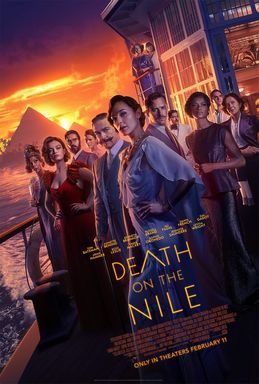
Film Review: Death on the Nile (dir by Kenneth Branagh)


The main mystery at the heart of Kenneth Branagh’s adaption of Agatha Christie’s Death on the Nile is not who committed the film’s murders but just how seriously we, the audience, are meant to take what we’re watching.

In this much-delayed (by COVID and a cast full of actors who could not escape personal scandal) follow-up to 2017’s Murder on the Orient Express, Kenneth Branagh again plays the eccentric detective Hercule Poirot.  Poirot is again in an exotic land, this time Egypt.  And again, circumstances have conspired to isolate him and a group of wealthy and glamorous suspects from the rest of the world.  In Murder on the Orient Express, everyone was stuck on a train.  Here, they are stuck on a boat.  Admittedly, the boat provides a nice view of the pyramids but, eventually, even those testaments to engineering seem to be mocking the people stuck on the boat.  The pyramids, after all, have survived for centuries.  The same cannot be said for the people who have come to see them.  Over the course of the film, there are several murders.  (Indeed, Death on the Nile is significantly bloodier than Murder on the Orient Express and, unlike what happened on the Orient Express, the majority of the victims have done nothing to deserve their grisly fate.)  Like Murder on the Orient Express, Death on the Nile is based on a novel by Agatha Christie.  Branagh changes a few details from Christie’s novel, which is understandable since it’s important to keep the audience guessing.  For instance, Bouc (Tom Bateman), who was Poirot’s assistant in Murder on the Orient Express, returns in Branagh’s film version and provides some continuity between the two films.  It also provides a nice side-mystery as the audience tries to figure out how Poirot and Bouc could just happen to run into each other in Egypt.  Fear not, the film offers up a solution.

As is to be expected, the victims and the suspects are brought to life by a cast of stars and familiar character actors, all of whom act up a storm.  Some, of course, do a better job of embracing the melodrama than others.  Armie Hammer and Gal Gadot play a glamorous couple and, regardless of how we feel about Hammer as a human being, it works because Gadot and Hammer both look they could have stepped out of a sophisticated, 1930s RKO comedy.  (Hammer’s stiff line readings, which are totally appropriate for his character, would actually be a highlight of the film if he wasn’t Armie Hammer.)  Russell Brand is oddly subdued as the doctor with the secret while Dawn French and Jennifer Saunders show up to keep all of the British comedy fanatics happy.  Sophie Okonedo plays a jazz singer and how you react to her character will depend on how much patience you have for anachronistic musical numbers.  (There’s a surprisingly large amount of them.)  Annettte Bening plays Bouc’s mother and there’s really not a subtle moment to be found in her performance but again, it works because Death on the Nile is not a particularly subtle film.  It’s a film that demands a certain amount of calculated overacting and Bening is enough of a veteran performer to deliver exactly what the film needs.

No, there’s nothing particularly subtle about Death on the Nile but then again, that’s always been a part of Kenneth Branagh’s appeal.  Branagh’s endless (and often justified) faith in his own abilities as a director and an actor means that Branagh is willing to do things that others would avoid, whether that means making a 4-hour version of Hamlet or a black-and-white film about growing up in Belfast or, for that matter, a gaudy Agatha Christie adaptation in which he plays the lead detective.  Death on the Nile is a celebration of melodrama, beautiful people, and nice clothes.  Even the fact that the Egyptian backdrops are obviously phony works to the film’s advantage, giving the proceedings a bit of a retro, Hollywood studio system feel.  At its best, Death on the Nile is an homage to old-fashioned camp..

And yet, there are hints that Branagh means for the film to be something more.  The films opens with a prologue, one that is not included in Christie’s book or in anything else that Christie wrote about Poirot.  The prologue, which is filmed in black-and-white, features Poirot getting terribly wounded during World War I and growing his famous mustache to cover his scars.  We also discover that the great love of Poirot’s life was a nurse who died during the war.  Later, while solving the murder, Poirot often talks about how he has shut himself away from the world, never wanting to risk falling in love again.  There’s even a hint that Poirot has fallen for one of the suspects.  Branagh’s a good actor and can obviously pull off Poirot’s inner turmoil but those little serious asides still feel out of place in a film that features Armie Hammer and Russell Brand as romantic rivals.  It’s hard not to wonder if Branagh is in on the joke or if he’s seriously attempting to use Poirot as a symbol for an alienated and traumatized society.

One could argue that Poirot uses his mustache to hide from the world in much the same way that many people have spent the past two years using their masks to hide from COVID.  Except, of course, Death on the Nile was actually filmed three years ago, before anyone had even heard of COVID-19.  The film was first delayed by the theaters shutting down.  It was delayed a second time by the scandals surrounded Armie Hammer.  (Indeed, this film will probably be the last major studio release to feature Armie Hammer.)  It was finally released in February of this year and, within a month, it was on Hulu and HBOMax.  It didn’t exactly kill at the box office but I think Death on the Nile will be rediscovered over the years.  It’s a minor entry in Branagh’s filmography but it’s still enjoyably silly, regardless of whether that was Branagh’s intention or not.