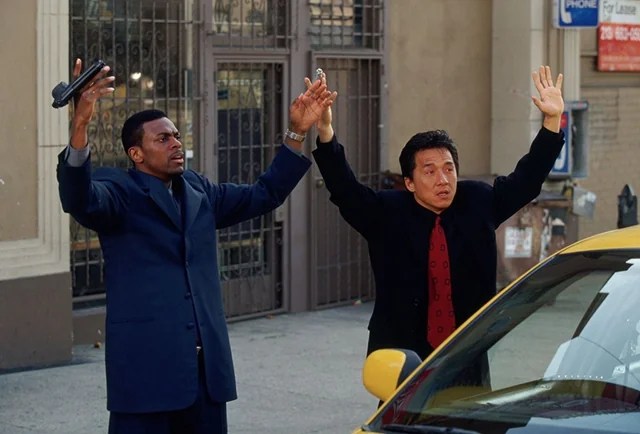
RUSH HOUR – 1998, a special year for this fan of Hong Kong action cinema!


1998 was certainly a special year for me as a fan of Hong Kong cinema but first let me provide a little context… After 150 years of British rule, Hong Kong was being handed over to communist China on July 1, 1997. This left a lot of uncertainty in Hong Kong’s local film industry. Because of that uncertainty, many of Hong Kong’s most popular filmmakers decided it was time to take their talents abroad. Director John Woo had already left for America in the early 90’s and had made successful films like HARD TARGET, BROKEN ARROW and FACE/OFF. This gets us to 1998, the year that many of Hong Kong’s biggest action stars would release their first American films. Chow Yun-fat would reprise his popular, honorable hitman role in his first American film, THE REPLACEMENT KILLERS, which was produced by John Woo and directed by Antoine Fuqua. Jet Li would make a strong impact as the badass villain in the 4th installment of the LETHAL WEAPON franchise. And then there’s Jackie Chan, probably the biggest of all the Hong Kong movie stars. Jackie had been banging around Hollywood as early as 1980 without a lot of fanfare in the west. But in 1996 Chan had a solid American box office hit when his Hong Kong production RUMBLE IN THE BRONX was dubbed and released in America. Armed with that success and a sizable budget provided by an American studio, Chan would get his own big release in 1998, the action-comedy RUSH HOUR!

In RUSH HOUR, Jackie Chan plays inspector Lee, a Hong Kong police detective who’s also a friend to Chinese Consul Han (Tzi Ma), currently serving in Los Angeles. When Consul Han’s daughter Soo Yung is kidnapped, he asks Lee to come to America to assist him and the FBI in rescuing her. The FBI doesn’t really want Lee’s help so they ask the Los Angeles police department to assign someone, anyone, to stay with Lee and keep an eye on him so he doesn’t get in the way of their investigation. Enter fast-talking, LAPD Detective James Carter. After some initial clashes and disagreements, the mismatched duo eventually begins working together to find the criminal mastermind behind the kidnapping, Juntao.

I watched RUSH HOUR at the movie theater on my birthday in 1998. I loved every second of it. A few weeks later I was on a business trip in Chicago, I told my boss how good the film was, and we went to see it as well. I enjoyed it just as much the 2nd time. I’m a big fan of “buddy cop” films like LETHAL WEAPON and BAD BOYS, and RUSH HOUR is an excellent addition to that sub-genre of action films. Jackie Chan and Chris Tucker have an excellent chemistry together. Their comedic interplay is hilarious and entertaining. It’s one of the main reasons I enjoy the movie so much. Jackie Chan was 44 years old when RUSH HOUR was released, but he was still extremely athletic so his brand of martial arts action and comedy still worked. The movie would go on to gross just short of $250 million at the worldwide box office and establish Jackie Chan as a bonafide star in the American film market. 2001’s RUSH HOUR 2 would be an even bigger hit, making almost $350 million worldwide. No one works harder or gives more of himself to his film productions than Jackie Chan, and it was nice seeing him achieve the truly worldwide success that he had earned! 
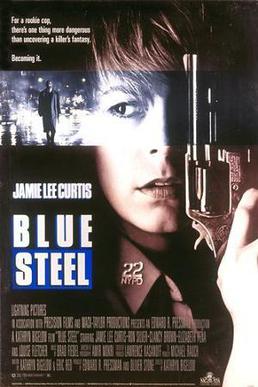
Blue Steel (1990, directed by Kathryn Bigelow)


On her first night on the job, rookie cop Megan Turner (Jamie Lee Curtis) blows away a robber (Tom Sizemore) who was holding up a convenience store.  The robber was holding a gun when he was shot but, right after his body hits the ground, the gun is stolen by a stockbroker named Eugene Hunt (Ron Silver).  Somehow, no one notices Eugene grabbing the gun from the floor and he improbably gets away from the crime scene without any of the investigating officers noticing that he’s concealing a gun in his suit.

Because Eugene stole the gun, Megan is accused of shooting an unarmed man and she is suspended from the force.  Meanwhile, Eugene becomes obsessed with the gun, hears voices, and starts to shoot random people.  He even carves Megan’s name on one of the bullets.  When the bullet is found in the body of one of Eugene’s targets, Megan becomes the number one suspect even though it wouldn’t make any sense for a murderer to carve their name on the evidence.  This isn’t The Wire.  None of the dead are going to be found with a note in their hand that says, “Tater Killed Me.”  It should be obvious to everyone that Megan is being set up but instead, everyone just assumes Megan is a stupid murderer who doesn’t know how to cover her tracks.  Eugene also starts to date Megan but when Megan rejects him after he confesses to being the murderer, Eugene starts to stalk her and her friends.  Not even Megan’s new boyfriend (Clancy Brown) can keep her safe from a stockbroker with a grudge.

Blue Steel benefits from Kathryn Bigelow’s stylish direction and Jamie Lee Curtis’s dedicated performance but it suffers because Eugene is so obviously crazy from the get go that it never makes sense that he would be able to get away with his crimes for as long as he does.  Even after Megan realizes that Eugene is crazy, she can’t get anyone to believe her even though everything about Eugene suggests that he’s the murderer.  Not even confessing to the crime is enough to keep Eugene in prison.  Somehow, Eugene is able to commit multiple murders and attempted murders right in front of Megan and then escape before Megan or anyone else can even react.  Megan’s been trained at the Police Academy while Eugene has no criminal training whatsoever but he’s still always able to outthink and outrun her.  It makes it seem as if Megan just isn’t a very good cop.  Luckily, Bigelow, Curtis, Silver, and Clancy Brown would all be involved with better movies in the future.

Horror Film Review: Jacob’s Ladder (dir by Adrian Lyne)


The 1990 film Jacob’s Ladder asks the question, “Who is Jacob Singer?”

Is Jacob (played by Tim Robbins), a soldier serving in Vietnam who has just been severely wounded in an enemy attack and who is now barely clinging to life in a helicopter?

Is Jacob a withdrawn postal worker who lives in 1970s New York with his girlfriend, Jezzie (Elizabeth Pena), and who is haunted by horrifying visions of faceless, vibrating figures and viscous demons?  This Jacob is haunted by ill-defined past incidents.  Whenever he gets depressed, Jezzie is quick to demand that he snap out of it and that he stop thinking about anything other than the present day.  This Jacob can only watch as all of his old friends either sink into paranoia or die.  He hears rumors that they all may have been part of some sort of experiment involving LSD.  He’s sure that he served in the army but when he attempts to hire an attorney, he’s informed that the army has no record of him ever having served in combat and that they say he was discharged for psychological reasons.

Or is Jacob the husband of Sarah (Patricia Kalember) and the father of Gabe (Macaulay Culkin — yes, that Culkin)?  This is the Jacob who occasionally wakes up in bed with his wife and tells her that he’s been having the weirdest dream, one where he was living with “that crazy woman” from the post office, Jezebel?

Which one of these three realities is the truth for Jacob?  At times, Jacob himself doesn’t even seem to be sure.  Perhaps the one thing that you can be sure about in this movie is that whenever Jacob closes his eyes, he’s going to reopen them and discover that he’s in a different time and place.  Jacob spends almost the entire film trying to work out what’s happening in the present, what’s happening in the past, and what’s just happening in his head.

And, to be honest, it all gets a bit pretentious at times.  The film’s script has a lot on its mind.  In fact, it might have a little bit too much going on.  No sooner have you soaked in what the film has to say about denial and acceptance than you’re suddenly getting a crash course in MK-ULTRA and other mind-control conspiracy theories.  Whenever Jacob isn’t seeing demons and faceless apparitions, he’s being kidnapped by government agents.  There’s so much going on that this film can get a bit exhausting.

Fortunately, the film itself is such a triumph of style that it doesn’t matter that the script is a bit of a mess.  Director Adrian Lyne does a great job bringing Jacob’s nightmarish world to life.  Jacob seems to live in a world where the skies are permanently overcast and the streets are always wet after a recent storm.  When Jacob makes the mistake of walking down a subway tunnel, Lyne frames it as if Jacob is literally following a tunnel into Hell.  When a subway train rushes by Jacob, we catch disturbing glimpses of featureless faces facing the windows.  When Jacob sees a demon at a party, Lynne films the moment so that, just like Jacob, it takes us a few minutes to realize what we’re seeing.  And when Jacob is kidnapped and taken to a Hellish hospital, the scene is nightmarish in its intensity.

Tim Robbins gives a great performance as the emotionally withdrawn and haunted Jacob.  (In fact, he’s so good that it makes it all the more sad that he really hasn’t had a decent role since he won an Oscar for 2003’s Mystic River.)  He’s matched by Elizabeth Pena, who constantly keeps you wondering if Jezzie truly cares about Jacob or if she’s just another part of the conspiracy that seems to have taken over his life.

Jacob’s Ladder is an intensely effective, if somewhat messy, horror film.  Apparently, like almost every other horror film released in the 20th century, it’s currently being remade, with the remake due to released on February 9th.  Just in time for Valentine’s Day!

Lisa Cleans Out Her DVR: Girl On The Edge (dir by Jay Silverman)


(I’m currently in the process of cleaning out my DVR!  It’s going to take me forever because I have like absolutely no self-control and I’ve got over 150 things to watch!  For instance, I recorded Girl On The Edge off of Showtime on February 19th!)

Hannah Green (Taylor Spreitler) is a 15 year-old dancer and is even more troubled than the typical teenage girl.  She is struggling to deal with her parent’s divorce.  Her father, Hank (Gil Bellows), has remarried and, though loving, he doesn’t know how to talk to his daughter.  After the manipulative Tommy (Shane Graham) rapes her at a party and pictures of her are posted online, Hannah stops dancing and descends into depression, self-harm, drugs, and alcohol.  With no idea what to do, her father and stepmother stage an intervention and send Taylor to a “healing center,” a ranch in the wilderness where Hannah and other troubled girls attend therapy sessions, take care of horses, and hopefully, begin the process of recovery.

Girl on the Edge actually feels like two movies that, when smashed together, make for something of an awkward fit.  The better of the two movies deals with Hannah and how her stay at the ranch affects her.  At first, Hannah is resistant to the discipline.  She resents being told what to do and, most heart-breakingly, even risks getting expelled from the program so that she can attempt to contact the boy who raped her.  (“Kill yourself slut,” he writes back.)  Taylor Spreitler gives such a good performance as Hannah that, at times, it was difficult for me to watch.  When I was sixteen, I was rebellious and angry.  I knew Hannah’s pain and, even more importantly, I also knew her anger.  Spreitler’s performance is matched by Peter Coyote, playing the tough-minded founder of the ranch, and the late Elizabeth Pena, who played Hannah’s therapist.

But then there was the second film, which was basically Hank sitting around and feeling guilty.  And don’t get me wrong.  Gil Bellows gives a good performance as Hank.  There are a lot of scenes where Hank is silent and lost in thought but, just through his posture and the sadness in his eyes, Bellows shows us exactly what’s going on inside of Hank’s mind.  Hank ends up confronting Tommy at the ice cream parlor where he works.  He also ends up confronting Travis Lee (Rex Lee), the sleazy head of the company that created the app that Tommy used to stalk Hannah online.  Rex Lee, who is probably best known for playing Jeremy Piven’s assistant on Entourage, gives an over-the-top and rather cartoonishly evil performance.  It feels thoroughly out-of-place, especially when compared to the more naturalistic performances of … well, of everyone else in the cast.

Even if I’m not a huge fan of rehabilitation centers, I am a huge fan of movies about out-of-control teenagers so I enjoyed that aspect of Girl on the Edge.  I think, ultimately, the main reason why this film works is because it’s a very sincere movie.  Cynicism is not to be found in this film’s DNA.  You can tell that the filmmakers really believed in the movie’s message.  Everyone’s heart was in the right place and that goes a long way towards helping the film get over a few rough patches.  Girl on the Edge has its flaws.  Some of the dialogue is a bit too on the nose.  Occasionally, you do wish that it had been directed with a slightly more subtle touch.  But, ultimately, this is one of those movies that is so well-intentioned that it feels a bit petty to get too snarky.

Sometimes, you just have to be willing to appreciate a little sincerity.