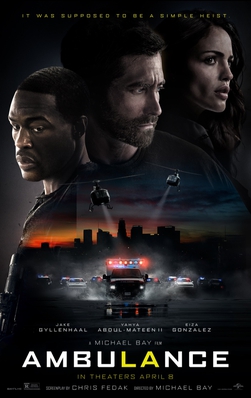
Ambulance is the ultimate Michael Bay movie.
Obviously, whether or not that’s a good thing for you personally will depend on how you feel about Michael Bay. As a director, Bay specializes in kinetic thrill rides, the type of films where the camera never stops moving, the characters are attractive but shallow, and every plot development is an excuse for another action sequence. Michael Bay is hardly the first, only, or last director to put action and spectacle above characterization and a coherent storyline. However, he might very well be the most shameless about it. Michael Bay’s approach has not made him a favorite of the critics but it has usually proved successful with audiences. Personally, I’ve smirked at a lot of scenes in a lot of Michael Bay films. (I still laugh whenever I remember the slow motion shot of the children playing in front of the faded JFK campaign poster in Armageddon.) But, in this age of self-important filmmakers, it’s hard not to appreciate a director who just wants to have a good time.
And, make no doubt about it, Ambulance is definitely a good time. The film’s plot is simple. Jake Gyllenhaal and Yahya Abdul-Mateen II rob a bank. When the robbery goes wrong, they hijack an ambulance. In the back of the ambulance is an EMT played by Eliza Gonzalez, who is desperately trying to keep a wounded cop (Jackson White) from dying. Gyllenhaal and Abdul-Mateen also want to make sure that the cop doesn’t die because they know that, if they’re captured, the penalty for being a cop killer is considerably worse than the penalty for being a bad bank robber. With the entire LAPD and the FBI in pursuit, the two men drive the ambulance through Los Angeles, trying to find a way to escape. Essentially, Michael Bay said, “You know how everyone enjoys a chase scene? What if we made the chase scene last for 136 minutes?” And wisely, some people gave him money to do just that.
(Actually, that’s just the way that I like to imagine it. Ambulance is actually a remake of a Danish film and Michael Bay originally passed on the project. But, as they put it in The Man Who Shot Liberty Valance, print the legend.)
Jake Gyllenhaal may be top-billed but the star of Ambulance is definitely Michael Bay. In many ways, there’s not much about Bay’s direction here that’s different from what he’s been doing since The Rock. The camera moves a lot. The images are sharp and clear. The rapid-fire editing captures the chaos of the action scenes, occasionally at the cost of letting the audience know just who exactly is shooting at who. But what sets apart Ambulance from other Bay films is that Michael Bay finally discovered his greatest collaborator, the drone. Bay’s camera flies across Los Angeles, zooming over buildings and down streets and essentially making the viewer as much a part of the chase as Gyllenhaal and the cops pursuing him. Ambulance moves with so much energy and confidence that it doesn’t matter that it’s a bit too long and that Gyllenhaal’s plan often doesn’t make much sense. Ambulance is a thrill-ride, a film that rewards anyone who is willing to just go with it. It’s an example of what Lucio Fulci called “pure cinema,” where the story itself is not as important as the way the director puts it all together. I enjoyed it. That ambulance barreling through the streets of Los Angeles was the 21st century equivalent of the speeding train that thrilled and terrified audiences during the silent era.
Unfortunately, Ambulance struggled a bit at the box office. I’m a bit confused as to why, other than it wasn’t a part of a franchise or a sequel (like The Batman, Dr. Strange, and Top Gun: Maverick) and it didn’t have the mix of strong reviews and pop cultural cachet that led audiences to make Everything Everywhere All At Once into a hit. Along with reviews that were more interested in criticizing Michael Bay in general as opposed to actually considering whether or not the film itslef worked, Ambulance was damaged by the fact that audiences were still getting used to the idea of leaving their homes for a night out. I get the feeling that a lot of people looked at the commercials for Ambulance and said, “That’s something I can watch at home.” (Admittedly, that’s what I did.) It’s a shame that Michael Bay’s ultimate (and, I would say, best) film is also one of the few to be deemed a box office failure. The film is currently on Peacock. Try to watch it on the biggest screen you can find.
 Through the Shattered Lens