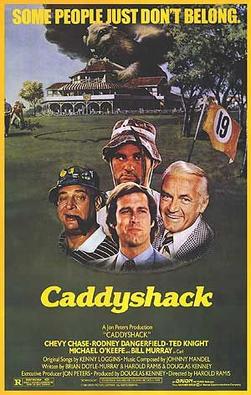
Caddyshack (1980, directed by Harold Ramis)


Whenever I think about Caddyshack, which is one of the funniest moves ever made, I think first of the Gopher, burrowing across the course and dancing to the music.

I then think about Bill Murray, playing the demented groundskeeper and growing his own special grass that you can both play golf on and smoke afterwards.

I remember Rodney Dangerfield dancing on the green while Ted Knight throws a fit.  This was the first film that I ever saw Rodney Dangerfield in.  “It looks good on you, though,” was one of those simple lines that Rodney could turn into a classic.

I remember Ted Knight, appearing in one of his few film roles, and saying, “Well, we’re waiting!” and drawing out every single word.

I remember the scene in the pool.  You know which one I’m talking about.

I remember Chevy Chase, back when he was still funny.

Then I remember how Rodney Dangerfield’s classic last line, “We’re all going to get laid,” was changed to “We’re all going to take a shower!” for television.  Why the censors thought that sounded less dirty than the original, I’ll never know.

I remember the Bishop getting struck by lightning while playing the best game of his life.

And, of course, I remember Cindy Morgan as Lacy Underall.

I remember so many classic moments and funny lines that I’m always surprised when I rewatch the movie and discover that it’s not really about the Gopher, Bill Murray, Rodney Dangerfield, Chevy Chase, or even Lacy Underall.  Instead, the main character in the movie is Danny Noonan (Michael O’Keefe), a teenage caddy at Bushwood Country Club who wants to win a scholarship so he can go to college and avoid having to work in the lumber yard with his father (Albert Salmi).  Danny has a friendly rivalry with caddy Tony D’Annuzio (Scott Colomby) and is dating Maggie (Sarah Holcomb).  Danny has to decide whether to ally himself with the snobs (led by Ted Knight) or the slobs (led by Rodney Dangerfield).

Caddyshack was originally envisioned as being Danny’s story but, once filming started, Harold Ramis (making his directorial debut) realized that the comedic characters were actually more interesting.  The movie went from being a straight-forward coming-of-age story to an almost plotless collection of gags and jokes, with both Bill Murray and Rodney Dangerfield improvising the majority of their dialogue and the Gopher emerging as the film’s true star.  That was bad news for the younger actors playing the caddies, who all found their roles greatly reduced in the film’s final cut but that was good news for audiences.  Caddyshack may not have much of a narrative structure but it does have some of the funniest people who ever lived at the peak of their powers.

Despite a legendarily troubled production, Caddyshack was a huge success with audiences and eventually, the critics came around as well.  Harold Ramis always said that he had a hard time watching it because all he could see were the mistakes that he made.  All audiences could see, though, was a hilariously funny movie that continues to bring people joy to this day.

The TSL Grindhouse: The Spook Who Sat By The Door (dir by Ivan Dixon)


1973’s The Spook Who Sat By The Door opens with Senator Hennington (Joseph Mascolo) in a panic.

The Senator is running for reelection and is struggling to appeal to white voters and minority voters at the same time.  White voters are happy that the Senator recently gave a speech in favor of “law and order” but now, he’s polling weakly with black voters.  His wife (Elaine Aiken) suggests that the Senator win back black voters by demanding that the CIA hire more black agents.

The CIA responds to the political pressure by hiring Dan Freeman (Lawrence Cook) to be their first black agent.  Freeman is given the standard CIA training and taught how to start revolutions in other countries.  However, after he completes his training, Freeman is assigned no real responsibilities.  He is given a desk job and spends most of his day making copies.  Whenever a senator or a reporter visits CIA Headquarters, Freeman is trotted out so that the CIA can claim to be diverse.  Freeman understands that he’s a token.  He knows that his job is to basically sit by the door and be seen.  But Freeman actually has bigger plans.

After spending a few years at the CIA, Freeman resigns and heads back to Chicago to work as a social worker.  Using what he learned at the agency, he starts to recruit young black men as freedom fighters.  He and the Cobras (as they’re called) launch their own guerilla war against the establishment in Chicago.  Some of their tactics are violent and some of them are not.  Freeman understands the importance of winning both hearts and minds and he recruits Willy (David Lemieux) to serve as his lead propagandist.  Because Willy is light-skinned, he is also assigned to rob a bank because Freeman knows that both the witnesses and the police will mistake him for being white and will be less likely to fire on him.  (The other members of the Cobras wear whiteface during the robbery.)

Freeman hopes that he will be able to recruit his childhood friend, Dawson (J.A. Preston), to the cause.  Dawson, however, now works as a detective for the Chicago PD and has been assigned to beak up the Cobras.  Will Freeman be able to bring over Dawson and what will happen if Dawson resists?

Based on a novel by Sam Greenlee (who was one of the first black men to be recruited to work with the United States Information Agency and who based many of Freeman’s CIA experiences on his own), The Spook Who Sat By The Door has achieved legendary status as a film that the FBI reportedly tried to keep out of theaters.  Theater owners were pressured to either not book the film or to only book it for a week before replacing it with a less incendiary film.  As a result, The Spook Who Sat By The Door became a difficult film to see.  As often happens, the efforts to censor the film only added to its revolutionary mystique.

Of course, in 2024, one can go on YouTube and watch the film for oneself.  It’s definitely uneven film, one that has pacing issues (especially at the beginning) and also one that suffers due to its low budget.  Depicting the overthrow of the government on a budget will always be a challenge.  Some of the acting is a bit amateurish but Lawrence Cook broods convincingly as Freeman and he’s well-matched by J.A. Preston’s portrayal of the more down-to-Earth Dawson.  At its best, there’s a raw authenticity and anger to the film that immediately captures the viewer’s attention.  It’s the rare political film to actually feature conversations about actual politics and it’s a film that asks how far people would be willing to go to accomplish change.  The Spook Who Sat By The Door suggests that the true villains are the members of the establishment who cynically embraced the civil rights struggle in their words but not in their actions.  In the end, Dan Freeman becomes a bit of a fanatic but the film suggests that perhaps a fanatic was what the times demanded.