Wolf (1994, directed by Mike Nichols)


Will Randall (Jack Nicholson), the editor-in-chief of a New York Publishing house, doesn’t get much respect, not from his wife (Kate Nelligan), not from his boss (Christopher Plummer), and certainly not from Stuart Swinton (James Spader), the sleazy executive who is plotting to steal his job and destroy his marriage.  But then, one night, Will runs over a black wolf on a country road.  When he tries to helps it, the wolf bites him.  Soon after, Will starts to feel different whenever the moon is full.

I remember that, when Wolf came out in 1994, some people said that casting Jack Nicholson as a werewolf seemed like typecasting.  Nicholson apparently understood this as well so he actually downplays his usual mannerisms for the first part of the movie and gives a convincing performance as a harried executive who is worried he’s about to lose his job.  It’s only after he is bitten that Will Randall starts to come alive.  Not only does he develop the predator instinct necessary to survive in New York City but he also, without fear, pursues his boss’s daughter, Laura (Michelle Pfeiffer, at her most beautiful).  Typecast or not, Jack Nicholson is excellent in Wolf.  Equally good is James Spader as Will’s business rival, who starts to show some predator-like aspects of his own.

Director Mike Nichols was not normally a horror director and, around the midway point, his direction falters and there are times when he just seems to be going through the motions.  He gets good performances from his cast but doesn’t know how to craft a good jump scare.  The best parts of the movie are when Wolf uses lycanthropy as a metaphor for petty office politics, with Will “marking” his territory while talking to Stewart and showing a renewed killer instinct.  Wolf works better as a social satire than as a horror movie.

Fans of Frasier will be happy to see David Hyde Pierce in a small but key role.  He delivers the film’s best line.  Fans of Friends may also notice David Schwimmer in a small role.  He says nothing worth remembering.  Their presence, though, is a reminder of just how much American culture changed in 1994.  By the end of the year, both went from small roles in Wolf to co-starring in the two of the most popular sitcoms in America.
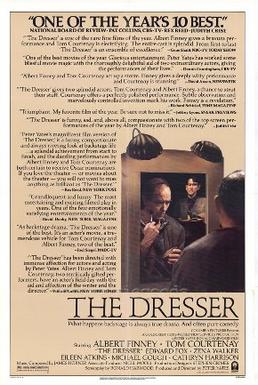
Lisa Reviews An Oscar Nominee: The Dresser (dir by Peter Yates)


(With the Oscars scheduled to be awarded on March 4th, I have decided to review at least one Oscar-nominated film a day.  These films could be nominees or they could be winners.  They could be from this year’s Oscars or they could be a previous year’s nominee!  We’ll see how things play out.  Today, I take a look at the 1983 best picture nominee, The Dresser!)

Taking place during World War II, The Dresser is a story of the theater.

Sir (played by Albert Finney) was once a great and famous Shakespearean actor but that was a long time ago.  Now, he is reduced to playing in regional theaters, traveling across Britain with a company made up of a motley collection of forgotten has-beens and never-weres.  He can still draw an audience, one made up of elderly theater goers who remember seeing him in London and people who are merely looking for a distraction from the war.  While bombs echo outside, Sir alternates between playing Othello and King Lear.  Backstage, Sir talks about the memoir he’s going to write and barks out orders to the members of his company.

Though Sir’s overly florid style of acting may seem old-fashioned, there’s no denying that his talent.  We don’t see much of his performance but, when we do see him, we never doubt his claim that he was once declared to the greatest King Lear to have ever appeared on the British stage.  Onstage, Sir is in complete control.  Offstage, he often struggles to remember where he is or what play he’s going to be performing.  At one point, when he’s meant to be getting ready to play Lear, he puts on his Othello makeup.

Fortunately, Sir has a dresser.  Norman (Tom Courtenay) doesn’t appear to have much of a life outside of taking care of Sir’s every whim.  Perpetually high-strung but blessed with a biting wit and an all-important bottle of Brandy that he takes a drink from whenever Sir gets too difficult to deal with, Norman is the one who holds the theatrical company together and who, most importantly, protects Sir.  When Sir can’t remember who he’s playing, Norman reminds him.  When Sir harasses a young actress, Norman is the one who hushes it up.  When Sir insults another actor (Edward Fox), Norman is the one who brokers a peace.  When it’s time for Sir to play King Lear, Norman is the one who helps Sir to transform into Shakespeare’s most tragic monarch.  Neither Sir nor the rest of the acting company seems to have much respect for Norman. The other actors consider Norman to be an ass-kisser and Sir … well, Sir doesn’t have much respect for anyone.  But for Norman, a gay man living at a time when homosexuality was illegal in Britain, Sir’s theatrical company provides him with the only safe place he’ll ever find.

The Dresser is an adaptation of a stage play.  (A few years ago, another version was produced for the BBC with Ian McKellen as Norman and Anthony Hopkins as Sir.)  It’s a good film, though I imagine that it’ll be best appreciated by people who have actually worked in theater.  Finney and Courtenay are both great and I also liked the performance of Edward Fox.  That said, it’s definitely a filmed play the feels more appropriate for PBS than for a movie screen.  As a result, it seems to be a bit of an odd pick for a Best Picture nomination.  I imagine that, much like Birdman, it benefitted from being a movie about actors and performing.

The Dresser lost Best Picture to Terms of Endearment.  It’s still worth seeing, if just for Courtenay’s final monologue.

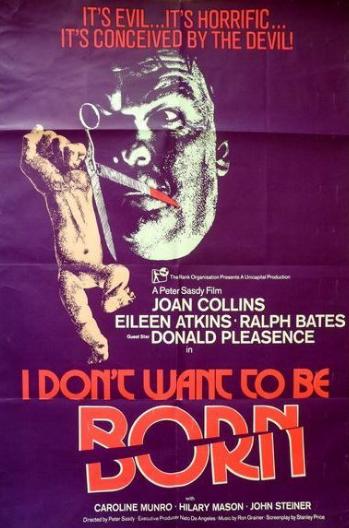
The TSL’s Horror Grindhouse: I Don’t Want To Be Born (dir by Peter Sasdy)


“I don’t want to be born!”

“That’s too bad, kid!  YOU’RE COMING OUT!”

Now, admittedly, that dialogue is never heard in the 1975 British horror film, I Don’t Want To Be Born.  However, if I had heard that particularly exchange in this film, I would not have been surprised.  That’s just the type of movie that I Don’t Want To Be Born is.  It’s a thoroughly ludicrous, totally ridiculous movie and what makes it all the more memorable is that it doesn’t seem to realize how silly it all is.  This is a batshit crazy movie that tells its story in the most serious way possible.  This damn film is almost somber, it’s so serious.

Lucy (played by Joan Collins) is a stripper who performs her act with a perverted dwarf named Hercules (George Claydon).  When Hercules tries to force himself on Lucy, he is tossed out of the club by Tommy (who is played by John Steiner, a good actor who somehow always turned up in movies like this one.)  After she and Tommy make love, Lucy is confronted by Hercules who curses her, telling her that she will have a baby “as big as I am small and possessed by the devil himself!”

Oh, Hercules, you weirdo.

9 months later, Lucy’s life has somehow completely changed.  She’s no longer a dancer.  Now, she’s married to a rich Italian named Gino (played by Ralph Bates, speaking in a bizarre accent).  When Lucy has her baby, it’s a long and difficult delivery.  The baby is huge!  Not only is he huge, but he also has a bad temper and unnaturally sharp nails.  The first time that Lucy holds him, he attacks her.  Whenever the baby is introduced to anyone new, he responds by biting them.  When Tommy drops by to take a look at the baby that might be his son, he ends up with a bloody nose!

But that’s not all this baby can do!  Anytime he’s left alone in a room, the room ends up getting destroyed.  Eventually, he apparently figures out how to climb trees and how efficiently slip a noose around the neck of anyone who walks underneath him.  And don’t think that you can escape this baby simply because you’re taller and faster.  One unfortunate person is decapitated, even though he’s standing at the time.  How did the baby reach his neck?  Who knows?

Does this baby need an exorcism?  Lucy’s sister-in-law, Sister Albana (Eileen Atkins), certainly believes that it does!  As Lucy thinks about whether the baby’s behavior is in any way odd, she glances over at the baby and — OH MY GOD!  The baby has Hercules’s face!

And it just keeps going from there.  Again, I feel the need to repeat that this film is meant to be taken very seriously.  The script may be full of awkward and clichéd dialogue but most of the cast attempts to act the Hell out of it.  Speaking of the cast, there’s a lot of familiar horror people in this one.  Along with John Steiner, there’s also Caroline Munro and Donald Pleasence.  Those three give performances that somehow manage to remain credible, perhaps because they had the experience necessary to understand what type of movie they were in.  But the rest of the cast … you feel bad for them because they’re just trying  so hard.

It’s a terrible movie but it’s so weird that I have to recommend that everyone see it once.  If for nothing else, see it for the scene where Hercules responds to an attempt to exorcise the baby by swaying drunkenly on the stage.  It’s weird and it’s hard for mere words to do it justice.

“No wonder this baby didn’t want to be born!”

That line is also nowhere to be found in this movie.  It’d be nice if it was, though.

A Movie A Day #44: Let Him Have It (1991, directed by Peter Medak)


The year is 1953.  The place is Croydon.  Derek Bentley (Christopher Eccleston) is 19 years old but has the mental capability of an 11 year-old.  Unable to hold down a job and judged unfit for the national service, Derek drifts into a gang led by 16 year-old Christopher Craig (Paul Reynolds).  When Derek and Craig are caught burglarizing a warehouse, it leads to a tense rooftop confrontation between Craig and the police.  Derek has already been captured by the time that the police demand that Craig hand over his gun.  Bentley shouts, “Let him have it, Chris!”  Craig opens fire, killing one officer.

Because he’s a minor, Craig is only facing a prison sentence for killing the police officer.  But, as a legal (if not mental) adult, Derek will be hung if he’s found guilty.  Under the common purpose doctrine, it doesn’t matter that Derek didn’t actually shoot the gun.  The only thing that matters is what Derek meant when he said, “Let him have it, Chris!”  Derek says that he was telling Craig to hand over his gun.  The Crown says that Derek was ordering Craig to open fire.

Let Him Have It is based on a true story.  The case of Derek Bentley was one of the many cases that eventually led to the death penalty being abolished in the UK.  Let Him Have It was released at the height of a long campaign to secure a pardon for Derek.  That pardon was finally issued in 1998, though it was too late to help Derek Bentley.

Let Him Have It is a powerful and angry docudrama, one that reveals in searing detail how Derek was railroaded by the British legal system.  In his film debut, Eccleston gives a powerful performance as Derek and he is ably supported by both Paul Reynolds and, in the role of Derek’s father, Tom Courtenay.  Let Him Have It leaves little doubt as to why the case of Derek Bentley remained a cause célèbre for 45 years after his initial trial.