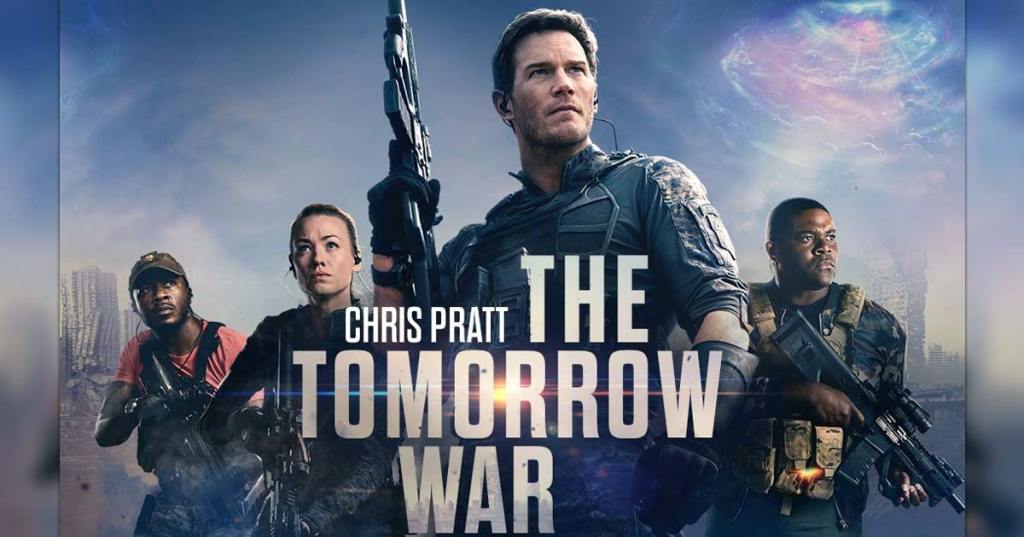
The Tomorrow War, Review by Case Wright


I loved this movie and really loved live tweeting it with Lisa Bowman. There are some critics (killjoys) who want to pick on the movie because it doesn’t “make sense.” No one said this was being made for the Science Channel; so, just cool it and enjoy! Do I think that time travel is a bunch of nonsense? Yes, but so what?! I don’t believe in “Letters of Transit,” Facehuggers, or the Force.

I can relate to the hero A LOT; he’s a Veteran with Daddy issues who is trying to get a career going in STEM and he has a young daughter. The film opens with us learning he is teaching high school science and can’t get a private sector job. He feels like he’s meant for more, but can’t get there. He and his wife are hosting a Christmas party and watching soccer. Dan, I know that times are tough, but why bring soccer into it? I don’t think that people watch soccer on purpose. How could they? Why make your life harder? Our future-selves appear and ask for help in fighting aliens who are turning us into snacks. We agree to help and mobilize a global draft.

This is where most critics get worked up. Why help fight a battle that is already lost? I’ll tell you! The movie makes more sense than people think. Why send Dan Forester (Chris Pratt) and millions of other people from our time to fight aliens from the future? They needed cannon fodder while they protected researchers who created a toxin to kill the male and female aliens. Without that toxin, Dan would not have been able to defeat the alien queen. Take that! The whole plan is to get the toxin finished and have Dan go back and kill all the aliens with it. Without it, she would’ve eaten him. Yes, we needed the cannon fodder. If Dan succeeds, wouldn’t that bring all the draftees back to life? Yeah, maybe? Einstein didn’t really didn’t have to deal with too many aliens and wormholes. I would put that in the column of …. relax.

Back to the movie, Dan gets drafted and his wife wants him to get his estranged father to help him remove his draft tracking device. Dan’s father abandoned him and his mother; so, Dan gets angry at his father and decides to honor his draft commitment and fight aliens. He goes to the future with no training, fights aliens, and retrieves the toxin. Way to go, Dan.

These monsters are gross and good adversaries. They’re fast, they shoot spikes, the eat you, they have natural armor, and can coordinate attacks. We are doomed. After he gets the toxin, he meets his grown daughter Muri who is the head of the resistance. We learn Dan fell into a depression because he couldn’t live a bigger life and he abandons his family just like his father did. This is why Muri drafted Dan: She wanted him to be his best self and to be the special person that he needed to be after his military life was over. She gives her father a chance to be a hero again. When Muri finishes the toxin, he goes back to save the future or the past …it’s kinda confusing.

I have given quite a bit of the film away, but it’s still amazing. I appreciate the critique that Charlie (Sam Richardson) brought too much humor to the film. I actually liked it, but I could’ve lived without it as well. Instead of the endless jokes, I would’ve liked more development of Dorian (Edwin Hodge). His lines popped more and brought more seriousness to the film. Were Charlie’s jokes funny? Yes, but while the jokes went on, I thought- I really wish I could hear more from Dorian interacting with Dan.

The direction was very well done. I love a well choreographed action movie without a lot of cutaways. This delivered. I was surprised to learn that Chris McKay’s filmography was heavily in animation. I hope he gets more opportunities for live action. The final battle scene was a lot of fun. I liked that the female characters had depth, kicked ass, and had real arcs. Because of that, my daughters love watching the movie with me. I can only write that we haven’t seen the movie six times.
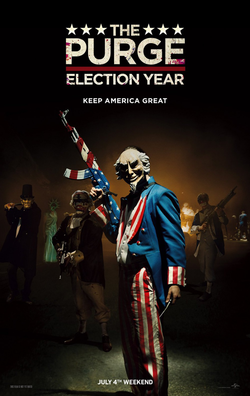
Film Review: The Purge: Election Year (dir by James DeMonaco)


The_Purge_Election_Year

I had really high hopes for The Purge: Election Year.

While the first Purge film was definitely flawed, it still had an interesting and thought-provoking premise behind it.  What would we do, the film forced us to ask, if we could do anything we wanted to for one night out of the year?  Would you hide in your house or would you go out and randomly kill people?  Yes, The Purge had its flaws but it was an interesting film.

And then, in 2014, The Purge: Anarchy was released.  Anarchy was one of the best films of 2014 (a film that saw no shortage of great films).  It was a big, loud, and over-the-top masterpiece of the pulp imagination, one that managed to be as thought-provoking as the first film while also keeping audiences entertained.  It was a political movie, perhaps one of the most overtly political to be released over the past ten years.  And yet, it was also amazingly entertaining.  By further exploring the type of society that would come up with something like an annual Purge, Anarchy forced audiences to think even as it gave them reasons to cheer and hiss.  For many viewers, it also served as an introduction to a tough and grizzled actor named Frank Grillo.  In the role of the enigmatic but ultimately good-hearted Leo Barnes, Frank Grillo gave an outstanding performance.

Well, The Purge: Election Year continues its exploration of the culture behind the Purge.  And Frank Grillo is back as Leo.  It should be said that, just as he did in Anarchy, Grillo supplies Election Year with some of its best moments.  Much like Clint Eastwood, Grillo can communicate an entire backstory just be squinting his eyes.

But overall, Election Year is a disappointment.  As I watched it, I found myself wondering if maybe director James DeMonaco should have quit when he was ahead and ended the series with Anarchy.  Anarchy pushed the idea behind The Purge about as far as it could go and it is perhaps not surprising that Election Year often feels like a rehash that was constructed out of leftovers.

Election Year finds Leo working as head of security for U.S. Sen. Charlie Roan (Elizabeth Mitchell).  Charlie, who saw her family massacred during an earlier purge, is running for President on an anti-Purge platform and it appears that she’s about to overtake the candidate of the New Founding Fathers, the Rev. Edwidge Owens (Kyle Secor).  The New Founding Fathers decide that the best way to take care of Charlie would be to assassinate her on Purge Night.  They announce that, for the first time since the Purge began, government leaders will no longer be granted immunity.

In short, anyone can be killed!

Leo’s idea is for Charlie to stay inside during Purge Night but, if that happened, there wouldn’t be a movie.  Naturally, Leo and Charlie eventually end up on the streets and they get to witness a few surreal and violent moments, none of which have quite the impact of anything we previously saw in Anarchy.  They are given some assistance by a deli owner (Mykleti Williamson) and, naturally, they meet up with rebel leader Dante Bishop (Edwin Hodge).  Just like in the previous film, Leo is eventually forced to decide between purging and showing mercy.

And it’s really never that interesting.  The whole film just falls flat.  The first two Purge film worked because they convinced you that something like The Purge could actually happen.  When, at the end of Anarchy, Leo chose not to murder someone, it felt like a great moment because you truly believed that Leo could have gotten away with murder if he wanted to.  But Election Day is never convinces you that you’re watching anything more than a standard issue sequel.  With the exception of Frank Grillo and Kyle Secor (more about him in a moment), none of the actors are particularly memorable or believable.  In fact, Mykelti Williamson gives a performance that is almost amazingly bad.

I think a huge part of the problem is that the character of Charlie is never credible.  Elizabeth Mitchell is a good actress and has appeared in some of my favorite TV shows (she was Juliet on Lost, for instance) but you never believe that she’s a dynamic senator who is destined to save America from itself.  Every character in the film has at least one moment in which he or she is required to talk about how much they love Charlie.  The film spends so much time worshipping her that it apparently forgot to make her believable.

(It’s hard not to compare Election Year to Anarchy.  Anarchy advocated revolution.  Election Year argues that the system will eventually correct itself, going so far as to present the revolutionaries as almost being villains because they’re not properly deferential to a wealthy white liberal.)

However, I do have to say that Election Year is occasionally elevated by the thoroughly over-the-top performance of an actor named Kyle Secor.  It’s almost as if Secor alone understood that Election Year needed a jolt of pure adrenaline and, at the end of the film, he goes out of his way to provide it.  He bulges his eyes.  He shrieks out his lines.  His entire body shakes and it’s damn near brilliant.  He’s a lot of fun and his performance is probably the most entertaining thing about Election Year.

Undoubtedly, there will eventually be a sequel to Election Year.  Hopefully, it’ll be an improvement.

the-purge-ey-pstr01

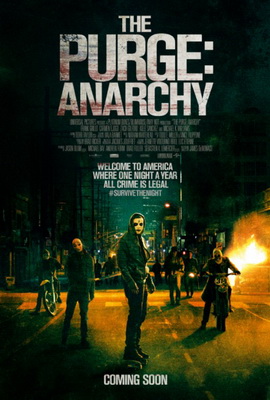
For Your Consideration #2: The Purge: Anarchy (dir by James DeMonaco)


The_Purge_–_Anarchy_Poster

Yes, I know what you’re saying.

“Seriously, Lisa!?  We should give awards consideration to The Purge: Anarchy!?  Are you serious!?”

Yes, actually I am quite serious.  Notice that I didn’t say that we should necessarily give The Purge: Anarchy any awards or that we should even nominate it.  I just said consideration.  For whatever flaws that The Purge: Anarchy may have, it’s actually one of the better and, in its way, one of the more thought-provoking mainstream American films released this year.  Working within the guise of being a simple genre film, The Purge: Anarchy is one of the few films to give serious consideration to the politics and culture that could both lead to and result from dystopia.

What I’m saying is that — despite what the critics may have said last summer — The Purge: Anarchy is actually one of the most subversive and intellectually curious films released this year.  You just have to be willing to look past all of the action conventions and instead focus on the film’s subtext.

The Purge: Anarchy takes place one year after the end of the first Purge film.  America is still led by the New Founding Fathers and every year, for one night, all crime is legal.  As the national media constantly assures everyone, the Purge is responsible for every good thing about America.  And even though there are a few rebels who claim that the Purge is not necessarily a good thing, most people chose to believe that — as long as it’s government-sanctioned — it’s for the best.

Whereas the first Purge film took place solely inside one family’s house and focused on the domestic melodrama within, The Purge: Anarchy focuses on what goes on outside of the gated sanctuaries of the rich.  As quickly becomes apparent, the Purge is less about purging negative feelings and more about keeping the non-rich, non-white population under control.  While the poor kill each other in the streets, the rich pay for the privilege to kill poverty-stricken “volunteers” in the safety of their own homes.  (Some of the volunteers agree to die out of the hope that their family will be sent some money.  Most are just rounded up on the streets, killed, and forgotten.)

Perhaps even more so than the first film, The Purge: Anarchy works because it feels so plausible.  We live in a society where we are continually told that moral rights and wrongs can be determined by man-made laws.  When a man is filmed being literally choked to death by a pack of police officers, we’re told that it was the man’s fault because he was failing to respect authority and many choose to believe it because “the law is the law.”  (Never mind, of course, whether the law is being fairly applied or makes any sense to begin with.)  If a man in uniform is murdered, it’s rightfully called a crime.  If a man in uniform commits a murder, we’re told it’s simply a part of the job.

And so, that’s why I suggest that The Purge: Anarchy deserves greater consideration than it’s been given.  Yes, it is a genre film and yes, it is an installment in an action franchise.  However, it’s also far closer to the truth than many people are willing to acknowledge.

The Purge: Anarchy Trailer #2: Grillo Strikes back


purge-anarchy-poster616

Last summer’s surprise hit, The Purge, was something that ended up being better than it should’ve been. Using a premise that the United States of America has a yearly 12-hour event where all crimes are legal in order for the population to vent their frustrations was an interesting one. The fact that this event was cooked up by what the film calls America’s Second Founding Fathers was a nice touch.

The film itself started well enough but ended up becoming another take on the home invasion trope. At least, the box office success of the film meant a sequel was quickly greenlit. What we have with The Purge: Anarchy takes the original film’s premise and goes much wider in scope and scale. Instead of the film using a home invasion premise we now go the “Most Dangerous Game” route. If we’re to believe what the latest trailer is showing it’s that the Purge Event might be something cooked up by those rich and powerful.

We also have the very awesome Frank Grillo channeling his inner Frank Castle and using the Purge event to find those who killed his son in the year’s previous Purge.

This sequel has me more excited for it than I probably should, but if the film pulls off half of what this trailer promises then I’ll be satisfied.

Oh, if The Purge was real then people better not be trying to give me a visit because I’m ready.