The 16th episode of One Step Beyond was called The Burning Girl and it dealt with a teenage girl (Luana Anders, who would later star in Dementia 13 and appear as a hippie in Easy Rider) who, whenever she got upset, could apparently cause fires to spontaneously erupt. It was written by Catherine Turney and directed by host John Newland himself.
It was originally broadcast on May 5th, 1959 — presumably long before Stephen King even had the idea to write about a girl named Carrie.
The one that most people seem to know and which regularly shows up on cable is the 1991 version. This version was directed by Martin Scorsese and features Oscar-nominated performances from Robert De Niro and Juliette Lewis. This is the version that has De Niro speaking in a broad Southern accent and attacking people while speaking in tongues. If you’ve ever watched a rerun of an old sitcom and wondered why the laugh track was going wild at the sight of a tattooed prisoner lifting weights in a cell while portentous music boomed in the background, it’s because you were watching a parody of Scorsese’s Cape Fear.
That, however, is not the first version of Cape Fear.
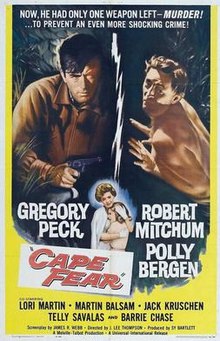
The first version of Cape Fear came out in 1962. It was a black-and-white film that was directed by J. Lee Thompson. In this version, the recently released rapist, Max Cady, is played by Robert Mitchum. Sam Bowden, the attorney that Cady blames for his incarceration, is played by Gregory Peck. Whereas the Scorsese version was highly stylized, the original Cape Fear is brutally straight forward. (While Scorsese’s Cape Fear goes on for over two hours, the original Cape Fear tells its story in a brisk 100 minutes.) While I think that Scorsese’s Cape Fear has its strong points, the original Cape Fear is superior in almost every way.
The original is certainly far more frightening than the remake. What the original may lack in stylization, it makes up for in plausibility. It’s scary because you can imagine everything in the film actually happening. Robert Mitchum and Gregory Peck may both be iconic film stars but they’re also believable as human beings.
For modern audiences, it’s easy to smirk at Peck with his upright image and his sonorous voice but what made Peck a great actor was his ability to make it all seem natural. Peck never seemed like he was acting like an honest man who always tried to do the right thing. Instead, he simply was that man. It’s perhaps significant that Peck played Sam Bowden the same year that he played another honest lawyer, Atticus Finch, in To Kill A Mockingbird. The only real difference between them is that, whereas Atticus was always confident and sure of himself, Sam is frequently helpless. He knows that Max is stalking him and his family and he’s just as aware that there’s nothing he can do about it. When Max rapes a woman (Barrie Chase) that he meets at a bar, she refuses to testify against him. When Sam’s dog turns up dead, everyone knows that Max killed him but there’s no way to prove it. When Sam hires three men to intimidate Max, Max beats them up and promptly tries to get Sam disbarred. When Sam finally resorts to plotting Max’s murder, we’re seeing Atticus Finch pushed beyond his limit.
As for Robert Mitchum, his animalistic performance is frightening precisely because it feels very real. Everyone has known a Max Cady, even if they didn’t realize it at the time. Max gives a fiercely physical performance, often appearing shirtless and strutting through his scenes with a sexual arrogance that’s both frightening and, at times, far more tempting than anyone would want to admit. The scenes in which Max attacks Barrie Chase and Polly Bergen (who plays Peck’s wife) are absolutely terrifying but, for me, the most disturbing moments in Cape Fear are the moments when Max is silent. Even when he’s not speaking, Mitchum allows you to see every depraved thought going through is head.
What’s the scariest moment for me? When the camera catches Max watching Sam’s teenage daughter (Lori Martin). It’s not just that I know what’s going on in Mitchum’s mind as he stares at her. It’s because I know what it’s like to be watched. It’s a scene that’s unsettling because it makes me consider just how many Max Cadys are out there right now.
The battle between Max and Sam is a fascinating one. In prison, Max studied enough law to become as knowledgeable about how to manipulate it as Sam. Under pressure, Sam grows more violent and more willing to circumvent his oath to uphold the same law that Max is now using against him. It makes for a frightening film, one that will stick with you long after you watch it.
Traditionally, films about teenagers tend to age terribly. The language, the clothes, the attitudes, and even the humor; it’s all usually out-of-date within five years or so. One need only watch something like A Summer Place to both see how dated a film can become and to see how one generation’s idol can appear rather ludicrous to future generations. (And yes, I am talking about Troy Donahue…) What makes Rebel Without A Cause unique is that it’s a movie about teenagers that was released way back in 1955 and yet, nearly 60 years later, it still feels fresh and relatable.
Of course, it helps that the title character is played by James Dean who, to put it lightly, was no Troy Donahue.
Rebel Without A Cause tells the story of three alienated teenagers trying to survive in the suburbs of Los Angeles. (“…and they all came from good homes!” the film’s poster informs us.) Plato (Sal Mineo) is a painfully sensitive 15 year-old who has been abandoned by his parents and is being raised by the family’s maid. (Since this movie was made in 1955, the fact that Plato is gay is obvious but never explicitly stated.) Judy (Natalie Wood) is the girlfriend of Buzz (Corey Allen) and is acting out because she feels that’s the only way she can can get her father to pay attention to her. And then there’s Jim Stark (James Dean), whose family has just moved to Los Angeles and who is constantly in the middle of the fights between his overbearing mother (Ann Doran) and his weak-willed father (Jim Backus).
During Jim’s first day at high school, he not only manages to make an enemy when Buzz spots him attempting to flirt with Judy but he also gets to go on a field trip to the Griffith Observatory, where the students are told that the entire universe is going to end eventually. After the field trip, Buzz challenges Jim to a knife fight. Jim agrees only after the rest of Buzz’s gang (including a young Dennis Hopper) accuse him of being “chicken.” However, after a security guard breaks up the fight, Buzz challenges Jim to a “chicken run.”
(People in the 50s were obsessed with chickens.)
That night, Jim and Buzz both drive stolen cars towards the edge of a cliff. The first driver to jump out of his car loses. Before they start their engines, Buzz smiles and tells Jim, “I like you.” Yay! Jim’s finally made a friend! Uh-oh, Buzz just drove over the cliff and his car exploded! Well, so much for that friendship. Now, with Buzz’s gang swearing revenge and their parents incapable of understand what happened, Jim, Judy, and Plato are on the run. They end up hiding out in an abandoned house and find a brief moment of happiness before the gang and the police show up to ruin everything.
The challenge of reviewing Rebel Without A Cause is trying to find a new way to say what everybody already knows. Rebel Without A Cause is a great film that’s distinguished by Nicholas Ray’s sensitive direction and James Dean’s iconic performance in the lead role. Whenever I see Rebel Without A Cause, I’m always struck by just how much unexpected nuance there is Dean’s interpretation of Jim Stark. We always think of James Dean as being the epitome of cool and I think we tend to forget that, at least in the beginning of the film, Jim is anything but that. Instead, he’s awkward and shy. His attempts to flirt with Judy lead to her calling him “a real yo-yo.” As much as he tried to fit in with the rest of his classmates, he’s a permanent outsider. (Just consider what happens with his infamous “moooo” during the presentation at the observatory.) He has a lot to say but he doesn’t know how to say it and every time that he tries to express what he’s feeling, he’s ignored by adults who don’t have the patience to listen. Dean brings such a raw intensity to these scenes that I always find myself wanting to reach out and hug him and tell him that everything’s going to be okay, even though I know that it’s not. Even today, it’s still easy to see why every teenager in the 50s either wanted to be or to be with Jim Stark.
Also, whenever I watch the film, I’m reminded of how much I relate to the character of Judy. I think that’s because, when I was 16, I might as well have been Judy. Natalie Wood’s performance might not be as showy as James Dean’s but it’s equally effective.
Of course, one reason why Rebel Without A Cause has become iconic is because James Dean died shortly after filming ended. (In fact, some of his scenes had to be redubbed by Dennis Hopper, who reportedly could do an exact imitation of Dean’s voice.) It’s interesting to wonder what would have become of James Dean if he had lived. Would he have continued to be one of our best actors or would he have eventually been forgotten or forced to appear on television? Personally, I like to think that James Dean would have remained a great actor but he would have been too much of an iconoclast to remain in Hollywood. Eventually, in my alternative universe, James Dean moved to Europe and teamed up with Klaus Kinski to star in a series of spaghetti westerns. And they were great.
As for Rebel Without A Cause, it remains a great movie nearly 60 years after it was first made. And really, what more needs to be said?


 Through the Shattered Lens