Film Review: Noriega God’s Favorite (dir by Roger Spottiswoode)


Everyone’s an expert on the Panama Canal nowadays.

Largely, that’s a result of President-elect Donald Trump openly musing about taking the canal back from Panama.  As soon as Trump uttered those words, every self-appointed pundit on every social media site in existence immediately jumped over to Wikipedia and skimmed over the articles on Panama, the Panama Canal, and Teddy Roosevelt.  Then, after Jimmy Carter died, those same people jumped onto Wikipedia and skimmed articles about Carter selling the canal to Panama for a dollar and the controversy that followed.  For weeks, it has been impossible to look at Twitter or Bluesky or even Mastodon without seeing someone giving their opinion on the canal, the 1989 American invasion of Panama, and the connection between the CIA and Manuel Noriega, the man who served as Panama’s military dictator for most of the 80s before being deposed and tossed into prison for being a drug smuggler.

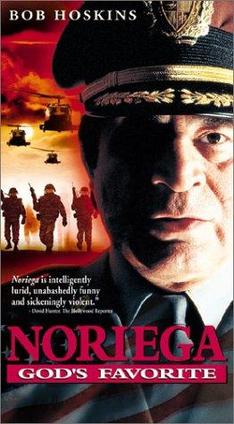
Myself, I know better than to get my information from Wikipedia.  Instead, I get my information from movies.  For that reason, I attempted to educate myself on Panama and the canal by watching 2000’s Noriega: God’s Favorite.

Directed by Roger Spottiswoode, Noriega: God’s Favorite opens with a title card informing us of the story so far.  Manuel Noriega was born in the slums of Panama.  He grew up in poverty and was shunned because his mother was not married to his father.  Noriega spent his youth doing whatever he had to do in order to survive.  He was clever and ruthless but it wasn’t until he entered the Panamanian National Guard that he was able to really use those skills to his advantage.  Noriega became a CIA asset and worked his way through the ranks.  In 1983, with the support of American intelligence, Noriega became the de facto dictator of Panama, even though he never officially held any sort of title or executive position.

The film follows Manuel Noriega (Bob Hoskins) over the course of his final years as Panama’s dictator.  He’s portrayed as being a ruthless man who often pretends to be a buffoon in order to get his enemies to underestimate him.  He works with the CIA but still passes along intelligence to Fidel Castro (Michael Sorich), who is seen hitting on Noriega’s wife (Denise Blasor) during a visit to Cuba.  Noriega presents himself as a family man while having a number of mistresses.  He claims to an ally in the United States’s War on Drugs while attending cocaine-fueled parties.  He presents himself as being a pragmatist while actually being very superstitious.  A CIA agent (Edward Ellis) wins Noriega’s trust by manipulatively interpreting Bible verses for him.  When an army officer (played by Nestor Carbonell) tries to lead a coup against Noriega, he can only watch helplessly as Noriega personally executed all of his co-conspirators, going so far as to even chop off one man’s hands.  By the end of the scene, Noriega is drenched in blood but he’s undeniably happy.  Everyone knows that Noriega is an impulsive and dangerous dictator but the CIA allows him to stay in power until he starts to become an inconvenience.  Once Noriega’s notoriety starts to overshadow his usefulness, the U.S. promptly invades and Noriega’s power crumbles around him.

Bob Hoskins might seem like a strange choice to play a South American dictator but he does a good job in Noriega, playing the title character as being both a charismatic dictator and also an overgrown child who has never gotten over the struggles of his youth.  (Early on in the film, he is seen getting treatments to smooth his pockmarked skin, an indication that all the power in the world can’t cure lifelong insecurity.)  In the end, Noriega has much in common with the gangster that Hoskins played in The Long Good Friday.  Noriega is ruthless enough to become powerful but he ultimately falls victim to his own hubris.  When you’re in charge of something as valuable as the Panama Canal, the last thing you should do is anger the country that built it.

Retro Television Reviews: The Master 1.5 “High Rollers”


Welcome to Retro Television Reviews, a new feature where we review some of our favorite and least favorite shows of the past! On Fridays, I will be reviewing The Master, which ran on NBC from January to August of 1984.  The show can be found on Tubi!

Viva Las Vegas!

Episode 1.5 “High Rollers”

(Dir by Peter Crane, originally aired on March 2nd, 1984)

“Hi, I’m Max Keller….”

This week’s episode The Master opens with Max (Timothy Van Patten) and McAllister (Lee Van Cleef) standing on top of a mountain in the Nevada desert.  McAllister explains to Max that a ninja will sometimes be required to quickly descend from a roof or a cliff to the ground below.  (Uhmmm …. okay.)  McAllister has Max rappel down the side of the mountain.  Though hesitant at first, Max does so and reaches the ground fairly quickly.  However, before Max can brag too much on himself, he discovers that McAllister is already down there, waiting for him.

“Expect the unexpected,” McAllister explains.

I already mentioned this last week but I can’t help but feel that Max’s “ninja training” is mostly just McAllister amusing himself by seeing how far he can push his student.

Weekly ninja training completed, it’s time for Max and McAllister to drive to …. VEGAS, BABY!

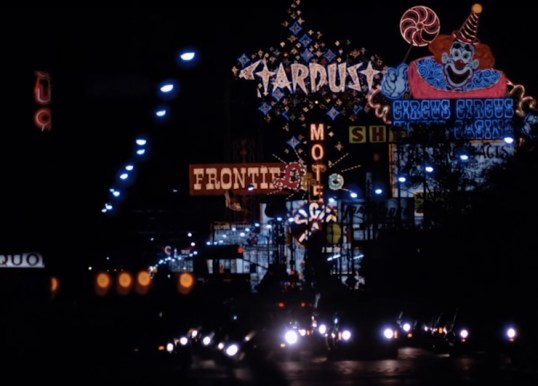
That’s right!  In this episode, Max and McAllister visit the ultimate American playground, Las Vegas.  Of course, there’s a long history of movies and television shows being filmed in Vegas.  In many ways, Las Vegas is the epitome of American ingenuity, a glitzy playground that has been built in an otherwise inhospitable desert.  Many great directors — from Martin Scorsese to Francis Ford Coppola to David Lynch to Paul Schrader — have found their inspiration in Las Vegas’s unique aesthetic.

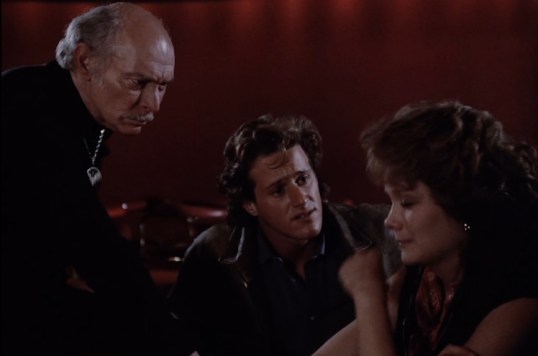
Unfortunately, the Las Vegas that we see in The Master seems to be incredibly tacky.  There’s very little of the glitz and glamour that we typically associate with Las Vegas.  Instead, the action takes place in one rather dingy hotel and casino, the place where it looks like a month’s worth of chewing gum has been hidden under the tables and smashed into the carpet.  A group of thieves, led by the mysterious Blake (Art Hindle), are planning on forcing a showgirl named Tracy (Terri Treas) into helping them rob the hotel.  Tracy happens to be Max’s former girlfriend and, in fact, she’s the whole reason that he’s visiting Las Vegas in the first place.

Blake’s plan to rob the casino is ludicrously complicated.  Basically, his plan rests on convincing Tracy to flirt with the owner of the hotel and to convince him to invite her up to his room for a drink.  In the owner’s room, Tracy is to drug his drink and then, when he’s passed out, she’s supposed to steal his keys.  In order to make sure that she does this, Blake kidnaps her annoying 12 year-old daughter, Suzie (Angela Lee Sloan).

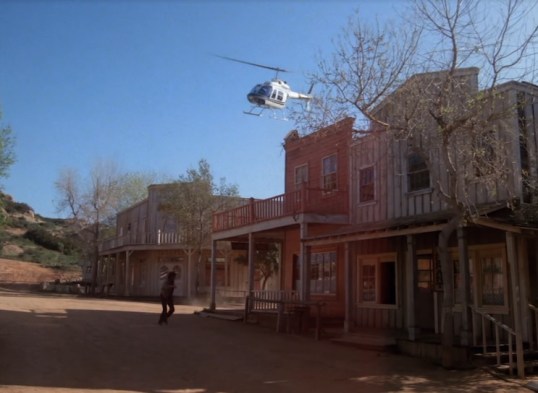
While Tracy is drugging the owner of the hotel, a bomb is set to explode at the nearby power station.  With all of Vegas plunged into darkness, it will be all the easier for Blake’s men to shoot tear gas into the casino.  While everyone’s disorientated, Blake will open the casino’s safe and then he and his associates will head to an abandoned western movie set in the middle of the desert.  From there, they will wait for the arrival of a helicopter that will take them to safety.

I mean, seriously, what happened to the concept of keeping things simple?  Blake’s plan is dependent on so many things happens at the exact right moment that there’s no way any halfway intelligent criminal would have agreed to have been a part of it.  Along with all of the obvious things that could go wrong, Blake also has failed to take into account that he might be followed to the old west town by a ninja and his idiot sidekick.

Which is pretty much what happens.  McAllister and Max show up at about the same time as the helicopter.

This leads to an elaborate fight in the old west town.  On the one hand, it’s a nice homage to Lee Van Cleef’s days as a spaghetti western star.  At once point, McAllister even tells Max that he feels oddly at home in the old west town.  “I always wanted to be a cowboy,” McAllister says.  On the other hand, it’s also pretty obvious that all of the action sequences and fight scenes feature not Lee Van Cleef but Lee Van Cleef’s much less stocky stunt double.  That takes away from the excitement of seeing Van Cleef return to his roots.

That said, there is a cool moment where Van Cleef’s stunt double jumps over the helicopter.

One of the good things about this episode is that we did learn a few new details about Max and McAllister’s relationship.  For instance, when Max wants to beat up Blake’s men, McAllister warns Max that he’s allowing his temper to control him.  Later, Max has an epiphany in which he realizes that, unlike Blake’s men, he could never bring himself to kill someone.  It’s actually a nicely human moment and it took me by surprise.  It’s a moment that suggests that The Master perhaps had higher ambitions than just being a typical action show.

We also learned a little more about Max’s backstory.  As he tells Tracy, his mother and his brother were both killed in a plane crash and he and his father had a falling out shortly afterwards.  Max says that he doesn’t know where his father is.  When Max says that, his relationship with McAllister suddenly makes a lot more sense.  Max puts up with McAllister because he’s looking for a new father figure.  That said, I’m still pretty sure that most of McAllister’s training exercises are just McAllister’s way of amusing himself at Max’s expense.

While I appreciated all of that, this episode was a bit too messy to really work.  The casino stuff was difficult to follow and, as I mentioned before, Blake’s big scheme was a bit too big for its own good.  I did like the fight scenes in the old west town but, unfortunately, the episode was nearly finished by the time that McAllister and Max arrived.  This episode had a lot of potential but it still felt like it was never as good as it could have been.

Next week: Max and McAllister hit up New Orleans!  Mardi Gras, baby!