A lot of that is because I’ve never been stung by a wasp so I have no idea whether or not I’m allergic. Considering that I’m allergic to almost everything else, it just seems likely that I would be allergic to wasps as well.
Another reason why I dislike wasps is that, opposed to hard-working honey bees, wasps just look evil. They fly straight at you. They get tangled in your hair. They try to build their nests right next to your air conditioning unit. They’re the worst!
1957’s MonsterFromGreenHell is all about evil wasps. A group of scientists, working with the space program, come up with the brilliant idea of sending wasps into space. When the wasp rocket crashes back to Africa, it leads to giant wasps and paralyzed victims. Can the scientists who created the problem fix things? Or will nature have to take care of itself?
Watch and find out! This film is one of many “giant monster’ films to come out of the 50s but it’s perhaps more interesting as an examination of the fears of what would happen when mankind finally went into space. Today, we take space exploration for granted. In 1957, it was very exotic and, I imagine to some, very frightening.
One final note: Barbara Turner, the female lead in this film, is also the mother of actress Jennifer Jason Leigh.
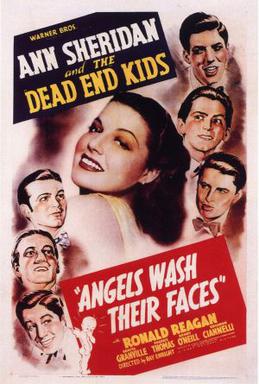
Gangster William Kroner (Bernard Nedell) and his henchman Martino (Eduardo Ciannelli) frame teenager Gabe Ryan (Frankie Thomas) for setting several buildings on fire. Because Gabe has just gotten out of reform school and is a member of a local neighborhood gang, they know that no one will believe him or his sister, Joy (Ann Sheridan).
What Kroner and Martino did not count on were the Dead End Kids (Billy Halop, Bobby Jordan, Leo Gorcey, Gabriel Dell, Huntz Hall, and Benard Punsley). They’re not going to sit by while the adults send their friend to jail. Plus, one of their friends was killed in one of the fires. The kids are out for revenge and sympathetic district attorney Pat Remsen (Ronald Reagan) is on their side.
As a publicity stunt, the city is holding an election for “Kid Mayor.” The Kid Mayor gets to run the city for a week. What could go wrong? Billy Halop decides to run for Kid Mayor so that he can order the arrest of Kroner and then beat a confession out of him.
Angels Wash Their Faces was one of the last of the studio-made Dead End Kid films. After this one, they would be sent down to Poverty Row and their films would be more obviously comedic. Angels Wash Their Faces starts out as a juvenile delinquent drama, with Gabe struggling to rebuild his life and keep on the right track. Then it becomes a goofy comedy, with Billy Halop running for mayor and unleashing vigilante justice on the bad guys. I’m not sure that any city would actually give the “kid mayor” the power to lock people up. Whoever came up with the idea of a kid mayor should be run out of politics.
On the positive side, Ann Sheridan is beautiful. Future president Reagan is his usual friendly self. On the negative side, the movie, overall, lacks the edge that made the first few Dead End Kids films memorable and the Dead End Kids themselves seem to be pretty much interchangeable. Huntz Hall would have made a better mayor.
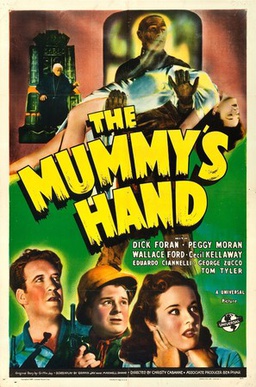
In 1940, having brought back The Invisible Man and Frankenstein’s Monster, Universal Pictures decided that it was also a good time to bring back The Mummy!
The Mummy’s Hand takes place in what we’re told is Egypt, though it’s obvious just a Universal backlot. Two archeologists — Steve Banning (Dick Foran) and Babe Jenson (Wallace Ford) — are penniless and stuck in Egypt. Babe wants to find a way to return to Brooklyn and his ex-girlfriend. Steve is a bit more serious about archeology, though it must be said that he’s no Indiana Jones when it comes to discovering relics and taking them to museums. If Indiana is the type who will risk his life to search a hidden cave in the Amazon Rain Forest, Steve is far more likely to just wander around an Egyptian market until he comes across someone selling an ancient vase.
Which is exactly what happens! Steve finds someone selling a vase and, after he learns where it came from, he buys the vase. He takes the vase to Prof. Andoheb (George Zucco), not knowing that Andoheb is an Egyptian high priest who has been sworn to protect the tomb of Princess Ananka. When Andoheb realizes that the vase could lead to the discovery of the tomb, he lies and claims that it’s a forgery. He then “accidentally” breaks it in order to keep Steve from showing the vase to anyone else. Steve, however, is not deterred and a chance meeting with an American magician named Tim Sullivan (Cecil Kellaway) leads to Sullivan agreeing to finance Steve’s expedition to discover where the vase came from. Sullivan’s daughter, Marta (Peggy Moran), worries that Steve and Babe are just trying to steal her father’s money so she insists on coming on the expedition with Steve. Also following the expedition is Andoheb, who is himself starting to fall for Marta and who is hoping that he can use a secret serum hidden in the tomb to make both himself and Marta immortal.
Of course, the tomb itself is protected by Kharis (Tom Tyler, under a ton of bandages), a mummy who is immortal due to the serum and who has sworn to protect the tomb from any outsiders. Kharis moves slowly but efficiently. He’s a ruthless and silent killer, one whose eyes appears to just be two black holes, the better to reflect his own lack of a soul.
The main problem with The Mummy’s Hand is that it takes forever for the Mummy to actually show up. This is only a 67-minute film and the Mummy mayhem doesn’t really start until around the 50 minute mark. As a result, the viewer spends a lot of time watching Steve and Babe wander around Egypt and essentially act like stereotypical American tourists. Even when the expedition finally gets started, the audience still has to sit through endless scenes of Marta accusing Steve of being some sort of con artist. This is a movie that will truly leave you saying, “When is the mummy going to show up!?”
That said, The Mummy itself is a frightening creature, especially with his empty eyes. Mummy’s are naturally frightening, especially when they’re walking towards you and dragging their decaying bandages behind them. The Mummy is effective, I just wish he had been featured in more of the movie.
(With the Oscars scheduled to be awarded on March 4th, I have decided to review at least one Oscar-nominated film a day. These films could be nominees or they could be winners. They could be from this year’s Oscars or they could be a previous year’s nominee! We’ll see how things play out. Today, I take a look at the 1940 best picture nominee, Kitty Foyle!)
Kitty Foyle opens with a title card informing us that, before the film can tell us the story of Kitty Foyle, it is necessary to remind audiences of how Kitty Foyle — and so many other “white-collar” girls — arrived in their present (which is to say, 1940) situation.
We then get a strange little montage of life at the turn of the century. A woman meets a man. The man marries the woman. They’re a happily married couple. The man goes to work. The woman takes care of the house. The man comes home. Everything’s perfect. Then suddenly — oh my God, it’s the suffragettes! They’re holding rallies! They’re parading around with signs! They’re demanding the right to vote! They’re demanding prohibition! Suddenly, women are expected to be independent and to have careers…
Which leads us to New York in the 1940s, where a bunch of women in an elevator discuss how difficult it is to find a good husband, especially now that they’re all busy working as salespeople and administrative assistants. Apparently, this is the price that we all had to pay for the right to vote. On the one hand, the women who cast their first votes in 1920 elected Warren G. Harding and spared the nation from another four years of Wilsonianism. On the other hand, it’s now difficult to find a husband.
Fortunately, Kitty Foyle (Ginger Rogers) doesn’t have that problem. She has a wonderful suitor, a man who has just asked her to marry him. His name is Dr. Mark Eisen (James Craig). He may not have a lot of money but he’s handsome, he’s considerate, and he spends all of his time providing medical care to the poor and indigent. When Mark asks her to marry him, he asks her if she’s sure that she’s over that man from Philadelphia. Kitty says that she is.
Of course, as soon as Kitty returns home, that man from Philadelphia is waiting for her. Wyn Stafford VI (Dennis Morgan) is handsome, rich, and totally in love with Kitty. Of course, he’s also married to his second wife. (The identity of his first wife isn’t revealed until late in the film but you’ll be able to guess who she is.) Wyn is in love with Kitty and he wants her to run away to South America with him. Kitty says yes.
However, as Kitty is packing to leave, her reflection in the mirror starts talking to her. It turns out to be a pretty judgmental mirror. The rest of the film is an extended flashback, showing us how Kitty was raised by her single father (Ernest Cossart), how she first moved to New York, and how she met and fell in love with both Wyn and Mark. Will she run off and live in wealthy sin with Wyn? Or will she stay in New York and marry honest, hard-working Mark?
The main problem with Kitty Foyle is that there really isn’t much suspense as far as the film’s central dilemma is concerned. Mark is a living saint who heals children. Wyn is a heel who wants to abandon his wife and son so that he and Kitty can live in South America. About the only thing that Wyn has going for him is that he’s got a better sense of humor than Mark but, in 1940, that wasn’t necessarily considered to be a good thing. There’s really no question about who Kitty is going to pick and, in fact, the answer is so obvious that you kind of lose respect for Kitty when it takes her so long to make up her mind. It’s like being told you could either marry a Nobel Peace Prize winner or someone who embezzles from a charity and replying, “Let me think about it…”
Of course, the main focus of Kitty Foyle is less on the love triangle and more on Ginger Rogers’s performance as Kitty. This was one of Ginger’s first films after she stopped making films with Fred Astaire and it’s obvious that the film’s main theme was that Ginger Rogers could do more than just dance with Fred. In Kitty Foyle, she gets to make jokes. She gets to cry. She gets to fall in love. She gets a huge dramatic scene in which she mourns the loss of a child. She does it all and yes, she does it very well. Still, Kitty Foyle is never as much fun as the movies that she made with Fred.
Before watching a film like 1940’s Foreign Correspondent, it helps to know a little something about history.
Nowadays, when we think about World War II, there’s a tendency to assume that, from the minute that Hitler came to power in Germany and started to invade the rest of Europe, the entire world united against the Nazis. The truth is actually far more complex. The world was still recovering from World War I and throughout the 1930s, even as the Axis powers were growing more and more aggressive, respected intellectual leaders and politicians continued to argue that peace must be maintained at all costs. Pacifism was such a popular concept that otherwise intelligent people were perfectly willing to make excuses for Hitler and Mussolini. For five years, the UK followed a policy of appeasement towards Nazi Germany. Even after war broke out between Britain and Germany, the U.S. remained officially neutral. In the 1940 presidential election, President Franklin D. Roosevelt — running on a platform of neutrality — was overwhelmingly reelected over internationalist Wendell Willkie.
Foreign Correspondent, an American film made by a British director, opens before the start of World War II. An American newspaper editor, Mr. Powers (Harry Davenport), is frustrated because none of his foreign correspondents seem to be able to understand the truth of the situation in Europe. They all claim that there is going to be no war in Europe but Mr. Powers feels differently. He also feels that the newspaper’s most celebrated and respected foreign correspondents are just a bunch of out-of-touch elitists. Instead of sending another upper class academic, Mr. Powers decides to send a hard-boiled crime reporter to cover the situation in Europe. Johnny Jones (Joel McCrea) has never been to Europe and that’s exactly why Mr. Powers decides to send him. In one of the film’s more clever moments, he does, however, insist that Johnny write under the more distinguished sounding name of “Huntley Haverstock.”
(Foreign Correspondent‘s pointed criticism of out-of-touch elitists repeating the establishment line remains just as relevant today as it was in 1940.)
From the minute the brash and tough Johnny arrives in Europe, he finds himself caught up in a huge conspiracy. He’s been assigned to report on a group known as the Universal Peace Party and, since this film was directed by Alfred Hitchcock, we automatically know that any organization with the word “Peace” in its name has to be up to something shady. The Universal Peace Party has been founded by Stephen Fisher (Herbert Marshall), who appears to sincere in his desire to avoid war. Johnny meets and falls in love with Fisher’s daughter, Carol (Laraine Day).
From the minute that Johnny witnesses the assassination of distinguished Dutch diplomat Von Meer (Albert Bassermann), he suspects that things are not how they seem. Working with Carol and a British journalist named Scott ffolliot* (delightfully played by the great George Sanders), Johnny discovers that Von Meer was not killed at all. Instead, a double was assassinated and Von Meer was kidnapped by a group of spies.
But who are the spies? After nearly getting killed by one of Fisher’s bodyguards, Johnny starts to suspect that Stephen Fisher might not be as into world peace as was originally assumed. Complicating matters, however, is the fact that Johnny is now engaged to marry Carol…
Foreign Correspondent is a wonderfully witty thriller, one that has a very serious message. While the film is distinguished by Hitchcock’s typically droll sense of humor (eccentric characters abound and the scene where Edmund Gwenn keeps getting interrupted before he can attempt to push Joel McCrea off of a tower is both funny and suspenseful), the film’s message was that America could not afford to stay neutral as war broke out across Europe. As the all-American Johnny Jones says at the end of the film:
“All that noise you hear isn’t static – it’s death, coming to London. Yes, they’re coming here now. You can hear the bombs falling on the streets and the homes. Don’t tune me out, hang on a while – this is a big story, and you’re part of it. It’s too late to do anything here now except stand in the dark and let them come… as if the lights were all out everywhere, except in America. Keep those lights burning, cover them with steel, ring them with guns, build a canopy of battleships and bombing planes around them. Hello, America, hang on to your lights: they’re the only lights left in the world!”
Foreign Correspondent was nominated for best picture of 1940 but it lost to another far different Hitchcock-directed film, Rebecca.
——
* Yes, that is how he spells his last name. As he explains, his family dropped the capital name in his surname after an ancestor was executed by Henry II. Since it was George Sanders doing the explaining, it somehow made perfect sense.



 Through the Shattered Lens