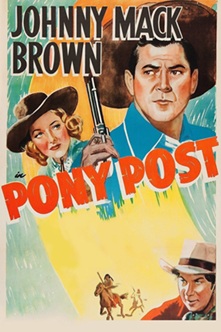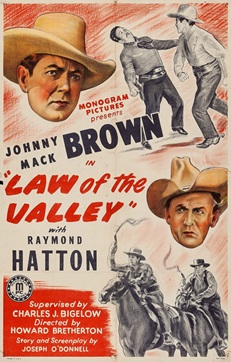
Pony Post (1940, directed by Ray Taylor)


In the days of the Old West, Griff Atkins (Stanley Blystone) manages a Pony Express station but, because of his gambling debts, he actually encourages the Indians and the outlaw Richard brothers (John Rockwell and Ray Teal) to attack the Pony Express riders and steal their horses.  Major Goodwin (Tom Chatterton) tries to put a stop to all this by firing Griff and putting Cal Sheridan (Johnny Mack Brown) in charge.  Griff and the Richard brothers continue their outlaw ways and eventually, the head of one of the relay stations is killed in one of their raids.  While the dead man’s daughter, Norma (Nell O’Day), investigates the murder, Cal works to bring peace the line and falls in love with Goodwin’s daughter, Alice (Dorothy Short).  Meanwhile, aspiring Pony Express rider Shorty (Fuzzy Knight) tries to invent a trampoline system that will help him to mount a horse.

No matter how bad things get in the west, you can always count on Johnny Mack Brown to bring some order and to get it done in less than an hour.  Johnny Mack Brown was always a good hero and that’s the case here.  Eventually this film has all of the horse riding and tough fighting that fans of the genre expect from these westerns but, for a short movie (it only runs for 59 minutes), it still seems to take a while for it to really get going.  The first half of the movie is more about Fuzzy Knight singing songs and trying to become a rider than it is about anything else.  I usually enjoy Fuzzy’s antics but, like the B-western themselves, they are definitely an acquired taste for most viewers.

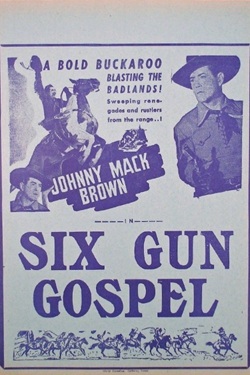
Six Gun Gospel (1943, directed by Lambert Hillyer)


Marshals Nevada Jack McKenzie (Johnny Mack Brown) and Sandy Hopkins (Raymond Hatton) are sent to the frontier mining community of Goldville to determine who is responsible for hijacking all of the gold that should be coming out of the town.  Not surprisingly, it’s all the work of another dastardly saloon owner (Kenneth MacDonald) who is planning on stealing all the gold, chasing off all the settlers, and then selling their land to the railroad company.  While Sandy goes undercover as the town’s new preacher, Jack agrees to ride shotgun on a gold shipment, along with with Dan Baxter (Eddie Drew).  Dan is in love with Jane Simms (Inna Gest), the daughter of honest miner Bill Simms (Kernan Cripps).

Johnny Mack Brown made a countless number of westerns for several different production companies but it seems like they always featured a crooked saloon owner and a plan to sell the land to a railroad company.  Luckily, nobody watches these movies for the plots and that was probably true even when they were first released.  People watch these movies for the nostalgia value of watching a movie where it’s good vs evil and good always triumphs without leaving any sort of lingering doubt about whether or not the heroes did the right thing.  Johnny Mack Brown is as authentic on a horse and carrying a gun as he ever was and there’s a scene where he manages to get a gun despite being tied up that’s pretty cool.  The appeal of Johnny Mack Brown was that he always seemed like he could do the things that he did in the movies in real life as well.  Raymond Hatton provides comic relief, pretending to know the hymns being sung by his congregation and providing some songs of his own.  There’s enough gun fights and horse chases to provide nostalgic happiness for fans of the genre and that’s the important thing.

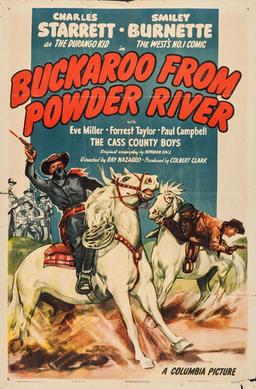
Buckaroo From Powder River (1947, directed by Ray Nazarro)


Pop Ryland (Forrest Taylor) is a frontier outlaw who makes law-breaking a family business.  With his two sons, Pop is planning on flooding the territory with counterfeit bonds.  His stepson, Tommy (Paul Campbell), doesn’t want anything to do with any criminal activity so Pop sends for McCall (Frank McCarroll), an assassin.  In a letter, Pop explains that he wants his stepson murdered.  When federal agent Steve Lacey (Charles Starrett) captures McCall, he finds the letter.  Steve heads into town and goes undercover, pretending to be McCall.  He also uses his other identity, the Durango Kid, to thwart Pop’s plans.

More than usual, this Durango Kid film leans more into the undercover aspect of Steve’s work.  What’s interesting is that, after Tommy fakes his own death, Tommy also disguises himself as the Durano Kid and keeps his stepfather from suspecting that Steve is actually a member of law enforcement.  It’s actually pretty clever, as far as these movies go, and it answers the question of why no one ever wonders why Steve and Durango are never in the same place at the same time.

Smiley Burnette shows up as Steve’s sidekick and he sings a few songs with the The Cass County Boys.  Along with Smiley’s antics, this film has all of the horse chases and gunfights that we expect from a Durango Kid movie.  Most of the usual stock company is present, including Ted Adams and Kermit Maynard.  As always, Charles Starrett looks authentic riding horse and handling a gun.  If you’re not into westerns, this film won’t convert you.  But, for fans of the genre, this is another entertaining outing for the Durango Kid,

Renegade Girl (1946, directed by William Berke)


Missouri in 1864.  The Civil War is raging and the state is divided between those who support the Union and those secretly support the Confederate guerillas led by Willian Quantrill (Ray Corrigan).  The Union’s Major Baker (Jack Holt) is determined to track down rebel Bob Shelby (Jimmie Martin) and he enlists the Native American Chief Whitecloud (played by Chief Thundercloud) to help find him.  Whitecloud has a personal vendetta against the Shelby family and, when he finds Bob, he executes him in cold blood.  Bob’s sister, Jean Shelby (Ann Savage), is also a Confederate sympathizer and she seeks revenge.  Complicating things is that Jean has fallen in love with Union Captain Fred Raymond (Alan Curtis).

One of the many B-westerns produced by Robert L. Lippert and directed by William Berke, Renegade Girl packs a lot of plot into just 65 minutes.  The action is nonstop and fans of westerns will find all of the horse chases, gunfights, and threats of hanging that they could want.  The main thing that distinguishes Renegade Girl from other B-westerns is the fierce performance of Ann Savage as Jean Shelby, a woman who will not stop until she gets her revenge.  While the film’s portrayal of the Quantrill and Chief Whitecloud definitely goes against modern sensibilities, Ann Savage’s performance feels ahead of her time.  No one is going to stand in Jean Shelby’s way.

Chief Thundercloud’s real name was reportedly Victor Daniels, though his past is shrouded in mystery.  He claimed to be a Cherokee from Arizona, though he was listed as being Mexican on a marriage record that was filed before he started his film career.  As Chief Thundercloud, he was a mainstay in westerns from the 30s to the time of his death in 1955.  He was the first actor to play the Lone Ranger’s Tonto and he also played Geronimo in a 1939 Paramount film of the same name.  His final film role was a posthumous appearance in John Ford’s The Searchers.

Challenge of the Range (1949, directed by Ray Nazarro)


On the frontier, someone is raiding the homes of ranchers like Jim (Henry Hall) and Judy Barton (Paula Raymond).  The Homeowners Association summons Steve Roper (Charles Starrett) to bring a stop to the raids.  Everyone suspects that Cal Matson (Steve Darrell) and his son, Rob (Billy Halop), are behind  the raids but Steve, as the Durango Kid, discovers that a third party is trying to set everyone at war with each other for his own benefit.

The entry in the Durango Kid series was Charles Starrett’s 103rd western.  It’s not a particularly distinguished entry, relying heavily on stock footage.  I did find the idea of the film’s bad guy trying to manipulate the Bartons and the Matsons into destroying each other to be interesting but the movie doesn’t do much with it and the identity of main villain will be obvious to anyone who watches the film.  There is one good scene where Steve disarms three bad guys and then makes them walk all the way back to town without their boots on.  Steve doesn’t mess around.

Smiley Burnette provides the comic relief and a few songs.  This time, Smiley’s a dime store writer researching his next book.  Musically, he is accompanied by The Sunshine Boys.  103 movies in and Smiley still hasn’t figure out that Steve and Durango are one of a kind.

Roaring Rangers (1946, directed by Ray Nazarro)


Another frontier town is in trouble.

Sherriff Jeff Conner (Jack Rockwell) is having trouble ridding his town of outlaws so his son, Larry, (Mickey Kuhn) writes a letter to his hero to ask for help.  He addresses the letter to “Durango Kid, Texas.”  That’s all it takes for Steve Randall (Charles Starrett) and his sidekick, Smiley Burnette, to show up in town.

Steve and Smiley apply to be deputies but Sheriff Conner explains that someone is circulating a petition to get him fired.  Steve dresses up as the Durango Kid and pressures the citizens to give the Sheriff another chance.  Realizing that the Durango Kid is making them look bad, the outlaws decide to dress up one of their own as Durango and make the Kid look bad.  With the town turning on Durango, will Durango and Smiley be able to save Sheriff Conner from an assassination attempt?

This Durango Kid film is different from the rest of the series in that, for once, Steve is hired to be a deputy instead of a sheriff.  This really is Sheriff Conner’s story, as he tries to win the respect of the town and keep its citizens safe, even while his own brother (Ed Cassidy) is working with the outlaws.  There are all the usual horse chase and shootouts but this time, Durango and Smiley are mostly around to provide support to a man who is trying to do the right thing.  B-western fans will enjoy it.

Smiley sings a few songs, as always.  This time, musical accompaniment is provided by Merle Travis and his Bronco Busters.

Cyclone Fury (1951, directed by Ray Nazarro)


Brock Masters (Mark Roberts) has been awarded a contract to supply the army with horses.  Corrupt businessman Grat Hanlon (Clayton Moore) wants that contract for himself so he sends his henchmen to kill Brock.  Because Brock has no known relatives, Grat believes that both the horses and the contract will soon be his.

However, Brock does have an heir!  He adopted an Indian child named Johnny (Louis Lettieri).  Johnny inherits the contract and both the Durango Kid (Charles Starrett) and Smiley Burnett are going to make sure that Johnny is able to deliver the horses.  Smiley is also going to find some time to sing some songs that have even less to do with the story than usual.

Cyclone Fury was one of the later entries in the Durango Kid series.  By the time it was made, Colombia was no longer willing to spend much money on the series so that majority of the film’s action scenes are lifted from other Durango Kid movies.  If you’ve never seen another Durango Kid movie, the action scenes are exciting and feature some impressive stunts.  If you have seen another Durango Kid movie, this one is going to seem really familiar.

For western fans, the main appeal here will be seeing Clayton Moore playing a bad guy.  Moore had already played The Lone Ranger when he appeared in this movie.  At the time Cyclone Fury was made, Moore had been unceremoniously fired from his most famous role and The Lone Ranger was being played by John Hart.  Hart would only last a season and Moore would subsequently be invited back to play the role that defined his career.  As for Cyclone Fury, Moore is convincing as Grat, though the character himself is just a typical Durango Kid bad guy.  The Durango Kid was always going up against seemingly respectable businessmen who were actually outlaws.

One final note: Moore’s Lone Ranger co-star, Jay Silverheels, appears in this film but only in archival footage from an early adventure of The Durango Kid.

Law of the Canyon (1947, directed by Ray Nazarro)


When a gang of outlaws starts hijacking freight wagons and then ransoming them back to their owners, government agent Steve Langtry (Charles Starrett) is sent to investigate.  He both goes undercover as an inexperienced traveler and as the masked Durango Kid.  As always, he is accompanied by Smiley Burnette.  In this installment, Smiley tries to invent a machine that can find silver and he also sings a few songs.  His backing band, The Lone Star Cowboys, follow him everywhere that he goes but they don’t actually get involved in the action.

This is another Durango Kid movie, with all of the usual horse chases and shootouts.  The same action montage that started Phantom Valley also starts this movie.  As always, Charles Starrett is convincing when riding a horse or shooting a gun.

What sets this Durango Kid movie apart from the others is the main villain.  Dr. Middleton (played by a regular member of the Durango Kid stock company, Fred F. Sears) appears to be a kindly man who serves as a middleman between the citizens and the outlaws.  Actually, he is working with the outlaws and receives a commission of every ransom that he negotiates.  The reason he can get away with it is because he’s drugged the Sheriff (George Cheseboro)!  He attempts to drug Durango too but luckily, Smiley drinks the water instead.

While it won’t convert anyone who isn’t already a fan of the genre or the character, this is another entertaining outing for the Durango Kid.

Horror on the Lens: The Amazing Colossal Man (dir by Bert I. Gordon)


For today’s horror on the lens, we present the 1957 film, The Amazing Colossal Man!

Directed by Bert I. Gordon, The Amazing Colossal Man tells the story of what happens when Lt. Col. Glenn Manning (Glen Langan) is exposed to an atomic blast, the force of which not only burns off his clothes but leaves him bald as well!  At first, everyone is convinced that there’s no way Glenn Manning will survive but, to everyone’s surprise, he does survive.

And he starts to get bigger!

That’s right — radiation does the craziest things!

Soon, Glenn’s a giant and he’s not very happy about it.  As the government tries to keep both the accident and the mutation a secret, Glenn grows more and more bitter and angry.  And it certainly doesn’t help matters when the scientists decide they want to inject him with a giant syringe.

Seriously, you’ve got to see this syringe!

Anyway, The Amazing Colossal Man is one of those fun sci-fi films that elitist critics love to criticize.  But you know what?  If you’re watching a movie like this because you want to nitpick every little detail, you’re missing the point.  The Amazing Colossal Man is a 1950s B-movie and, when taken on those terms, it’s a lot of fun.

Add to that, Glen Langan really throws himself into the title role!

Enjoy The Amazing Colossal Man!

http://www.youtube.com/watch?v=UaCcMVTAKME