Horror Film Review: The Mummy’s Hand (dir by Christy Cabanne)


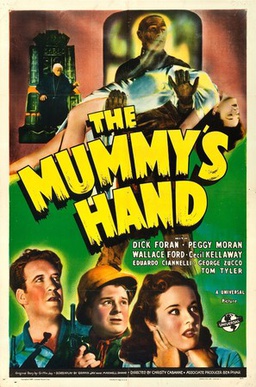
In 1940, having brought back The Invisible Man and Frankenstein’s Monster, Universal Pictures decided that it was also a good time to bring back The Mummy!

The Mummy’s Hand takes place in what we’re told is Egypt, though it’s obvious just a Universal backlot.  Two archeologists — Steve Banning (Dick Foran) and Babe Jenson (Wallace Ford) — are penniless and stuck in Egypt.  Babe wants to find a way to return to Brooklyn and his ex-girlfriend.  Steve is a bit more serious about archeology, though it must be said that he’s no Indiana Jones when it comes to discovering relics and taking them to museums.  If Indiana is the type who will risk his life to search a hidden cave in the Amazon Rain Forest, Steve is far more likely to just wander around an Egyptian market until he comes across someone selling an ancient vase.

Which is exactly what happens!  Steve finds someone selling a vase and, after he learns where it came from, he buys the vase.  He takes the vase to Prof. Andoheb (George Zucco), not knowing that Andoheb is an Egyptian high priest who has been sworn to protect the tomb of Princess Ananka.  When Andoheb realizes that the vase could lead to the discovery of the tomb, he lies and claims that it’s a forgery.  He then “accidentally” breaks it in order to keep Steve from showing the vase to anyone else.  Steve, however, is not deterred and a chance meeting with an American magician named Tim Sullivan (Cecil Kellaway) leads to Sullivan agreeing to finance Steve’s expedition to discover where the vase came from.  Sullivan’s daughter, Marta (Peggy Moran), worries that Steve and Babe are just trying to steal her father’s money so she insists on coming on the expedition with Steve.  Also following the expedition is Andoheb, who is himself starting to fall for Marta and who is hoping that he can use a secret serum hidden in the tomb to make both himself and Marta immortal.

Of course, the tomb itself is protected by Kharis (Tom Tyler, under a ton of bandages), a mummy who is immortal due to the serum and who has sworn to protect the tomb from any outsiders.  Kharis moves slowly but efficiently.  He’s a ruthless and silent killer, one whose eyes appears to just be two black holes, the better to reflect his own lack of a soul.

The main problem with The Mummy’s Hand is that it takes forever for the Mummy to actually show up.  This is only a 67-minute film and the Mummy mayhem doesn’t really start until around the 50 minute mark.  As a result, the viewer spends a lot of time watching Steve and Babe wander around Egypt and essentially act like stereotypical American tourists.  Even when the expedition finally gets started, the audience still has to sit through endless scenes of Marta accusing Steve of being some sort of con artist.  This is a movie that will truly leave you saying, “When is the mummy going to show up!?”

That said, The Mummy itself is a frightening creature, especially with his empty eyes.  Mummy’s are naturally frightening, especially when they’re walking towards you and dragging their decaying bandages  behind them.  The Mummy is effective, I just wish he had been featured in more of the movie.
Previous Universal Horror Reviews:

  1. Dracula (1931)
  2. Dracula (Spanish Language Version) (1931)
  3. Frankenstein (1931)
  4. Island of Lost Souls (1932)
  5. The Mummy (1932)
  6. The Invisible Man (1933)
  7. The Bride of Frankenstein (1935)
  8. Dracula’s Daughter (1936)
  9. Son of Frankenstein (1939)
  10. Black Friday (1940)
  11. The Invisible Man Returns (1940)
  12. The Wolf Man (1941)
  13. Ghost of Frankenstein (1942)
  14. Invisible Agent (1942)
  15. Frankenstein Meets The Wolf Man (1943)
  16. Son of Dracula (1943)
  17. House of Frankenstein (1944)
  18. The Invisible Man’s Revenge (1944)
  19. House of Dracula (1945) 
  20. Creature From The Black Lagoon (1954)

30 Days of Noir #14: Shoot to Kill (dir by William Berke)


The 1947 film, Shoot to Kill (also known as Police Reporter), opens with both a bang and a crash.

The police are chasing a car down one dark and lonely road.  When that car crashes, the police are shocked to discover who was inside of it.  Two men and one woman, all well-dressed.  The men are both dead but the woman is merely unconscious.  The police identify one of the men as being the notorious gangster, Dixie Logan (Robert Kent).  It makes sense that Logan would be fleeing the police but what about his two passengers, newly elected District Attorney Lawrence Dale (Edmund MacDonald) and Dale’s wife, Marian (Luana Walters)?

The police may not be able to get any answers but fortunately, there’s a reporter around!  Mitch Mitchell (Russell Wade) is a crime reporter and, seeing as how he knew both Lawrence and Marian, he seems like the perfect person to get some answers.  (In fact, it was Mitch who first suggested that Lawrence should hire Marian as his administrative assistant, therefore setting in motion the whirlwind romance that would end with them married.)  Mitch goes to see Marian in her hospital room and he asks her what happened.

It’s flashback time!  Yes, this is one of those films where almost the entire film is a flashback.  That, in itself, is not surprising.  Some of the best film noirs of all time were just extended flashbacks.  (D.O.A, Double Indemnity, and Sunset Boulevard, to name just a few examples.)  What sets Shoot to Kill apart is the fact that, occasionally, we even get characters having a second flashback while already in someone else’s flashback.  We’re through the the film noir looking glass here, people.

Lawrence Dale, we’re told, was elected district attorney because he managed to secure the conviction of notorious gangster Dixie Logan, despite Logan’s insistence that he was no longer involved in the rackets.  However, what we soon discover is that not only was Logan actually innocent but Dale specifically prosecuted him as a favor to some of Dale’s rival gangsters.  That’s right, Lawrence Dale was on the take!  It also turns out that Marian has some secrets of her own.  When she first showed up at Dale’s office, she was doing more than just looking for a job.  As for her marriage to Dale …. well, I really can’t tell you what the twist is here because it would spoil the entire film.

Shoot To Kill may clock in at just 64 minutes but it manages to pack a lot of twists and turns into just an hour.  In fact, I’d argue that it probably tries to do a little bit too much.  At times, the film is a bit difficult to follow and a few inconsistent performances don’t help matters.  For instance, Russell Wade is likable as the crime reporter but he still doesn’t exactly have a dynamic screen presence.  Much better cast are Luana Walters and Edmund MacDonald, who both do a good job as, respectively, a femme fatale and a sap.  At the very least, history nerds like me will be amused by the fact that Edmund MacDonald was obviously made up to resemble Thomas E. Dewey, the former Manhattan District Attorney who twice lost the U.S. presidency.

The best thing about Shoot To Kill is the look of the movie.  Filmed in grainy black-and-white and full of dark shadows, crooked camera angles, and men in fedoras lighting cigarettes in alleys, Shoot to Kill looks the way that a film noir is supposed to look.

Regardless of whether it was the filmmaker’s original intention, Shoot To Kill plays out like a low-budget, black-and-white fever dream.  It’s definitely a flawed film but, for lovers of film noir, still worth a look.

30 Days of Noir #5: The Hoodlum (dir by Max Nosseck)


He’s a bad seed, that Vincent Lubeck!

At the start of the 1951 film, The Hoodlum, Vincent (played by the legendary Lawrence Tierney) is rotting away in prison.  Even though the parole board is considering whether or not to release him, things aren’t looking good for Vincent.  The warden (Gene Roth) has taken it upon himself to attend the parole hearing and remind them of Vincent’s long criminal record.  Vincent’s been in trouble for as long as he’s been alive.  The warden says that allowing Vincent to walk the streets will just make the streets even more unsafe.

However, Vincent’s mother (Lisa Golm) swears that she’ll keep an eye on Vincent.  She will give Vincent a place to live and she’s even arranged for Vincent to get a job at the family gas station, where he’ll be working under his brother, Johnny (played Lawrence’s younger brother, Edward Tienery).  Moved by a mother’s tears, the board grants Vincent parole.

Big mistake.  As soon as Vincent’s out of prison, he starts making plans to return to his old life.  He has no interest in working in a gas station and he resents Johnny’s success.  Vincent is the type of bum that steals his brother’s girlfriend, gets her pregnant, and doesn’t feel the least bit guilty when she jumps off a roof to her death.

Vincent’s also the type who always has a scheme going.  For instance, it turns out that his brother’s gas station is right across the street from both the town mortuary and the bank!  Soon, Vincent is hanging out with his old gang and plotting to rob an armored car.  Vincent’s not going to let anyone stand in his way.  Not the police.  Not his lover.  Not even his own brother.  The only person that Vincent seems to care about is his sickly mother and, even then, Vincent doesn’t actually care enough to stay out of trouble.

The Hoodlum is a low-budget gangster noir.  It’s only an hour long so it doesn’t waste any time.  Instead, it jumps straight into its often sordid story.  From the minute that Vincent gets out of prison, he’s greedily watching that bank and telling off anyone who looks at him funny.  What makes Vincent an especially despicable character is that he’s not even good at what he does.  If Vincent was some sort of criminal mastermind, you could at least get some sort of guilty pleasure out of watching him rob that armored car.  Instead, Vincent’s an idiot who not only messes up everything that he does but who isn’t even smart enough to understand that he’s screwed up.

Fortunately, Vincent is played by Lawrence Tierney.  Tierney was a veteran tough guy, an actor who played killers onscreen and who spent a good deal of his offscreen time sitting in jail.  (Tierney had a bad habit of getting into bar brawls.)  In the role of Vincent, Tierney is a force of pure, uninhibited destructive energy.  When he glares at his brother, you feel the resentment.  When he rushes at a security guard while holding a gun, you never doubt that he’s capable of using it.  Tierney gives such a raw and angry performance that you can’t stop watching him.  Vincent quickly overstays his welcome but Tierney remains a fascinating actor.

The Hoodlum is a short and brutal little movie, one that works best as a showcase for the intimidating talent of Lawrence Tierney.