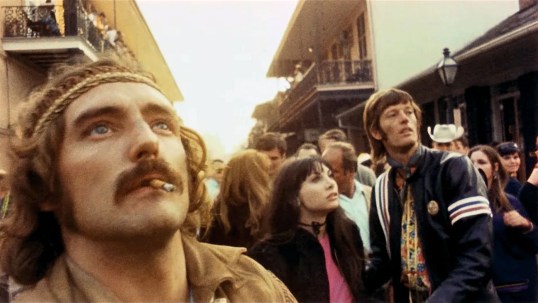
Here is the Mardi Gras sequence from 1969’s Easy Rider. Featuring Peter Fonda, Dennis Hopper, Karen Black, and Toni Basil walking through the streets of New Orleans, this scene was actually filmed during Mardi Gras. Those are real Mardi Gras floats and real Mardi Gras participants staring at the camera. That’s an actual citizen of New Orleans with whom Dennis Hopper appears to have nearly gotten into a fight. Personally, I relate to Toni Basil in this scene. She is having a good time no matter what!
I just love how Toni Basil can’t help but dance, no matter what.
4 (or more) Shots From 4 (or more) Films is just what it says it is, 4 (or more) shots from 4 (or more) of our favorite films. As opposed to the reviews and recaps that we usually post, 4 (or more) Shots From 4 (or more) Films lets the visuals do the talking.
Today, the Shattered Lens pays homage to the greatest of Mardi Gras cities, New Orleans!
4 Shots From 4 New Orleans-Set Films
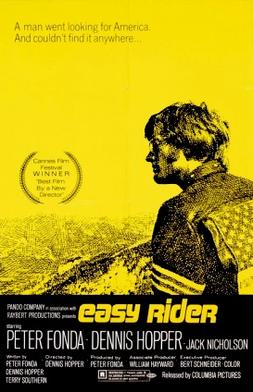
Easy Rider (1969, dir by Dennis Hopper, DP: Laszlo Kovacs)
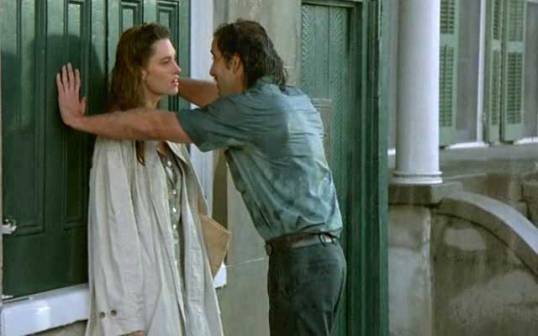
Zandalee (1990, dir by Sam Pillsbury, DP: Walt Lloyd)
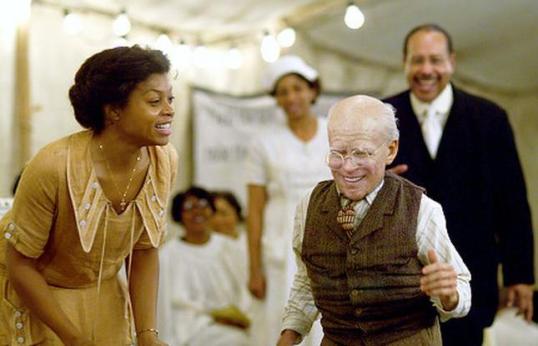
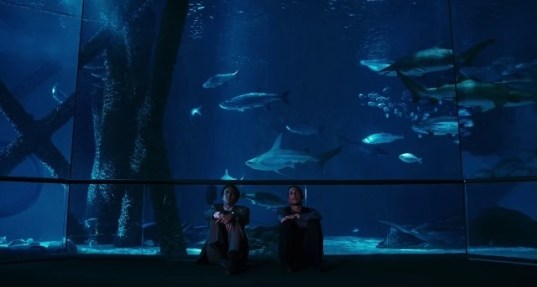
The Curious Case of Benjamin Button (2008, dir by David Fincher, DP: Claudio Miranda)
Bad Lieutenant: Port of Call New Orleans (2009, dir by Werner Herzog, DP: Peter Zieitlinger)
4 (or more) Shots From 4 (or more) Films is just what it says it is, 4 (or more) shots from 4 (or more) of our favorite films. As opposed to the reviews and recaps that we usually post, 4 (or more) Shots From 4 (or more) Films lets the visuals do the talking.
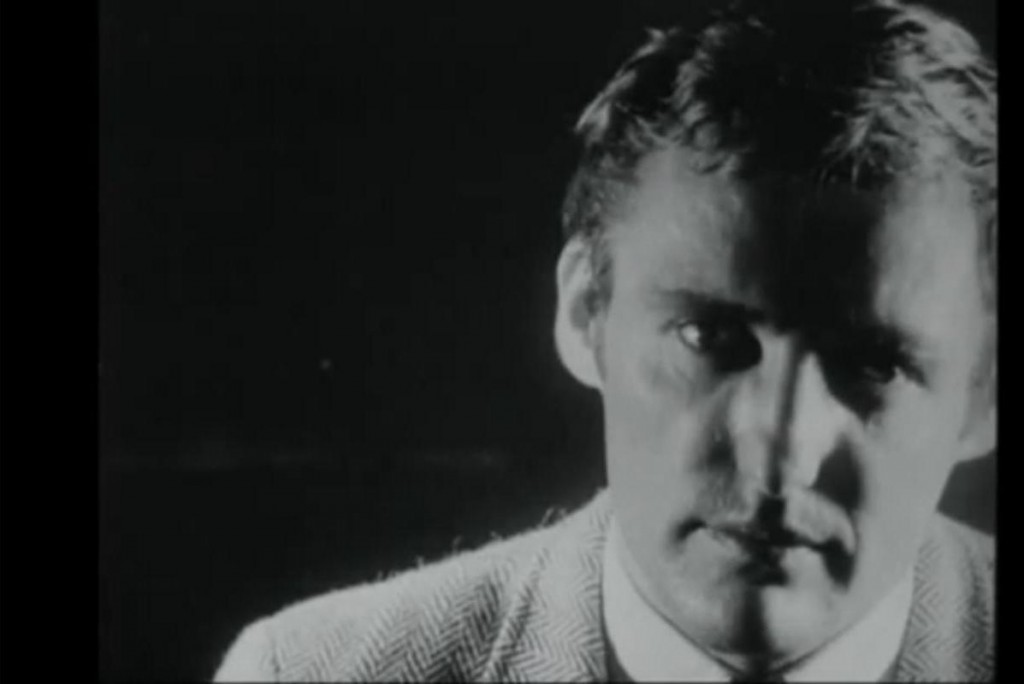
89 years ago, Dennis Hopper was born in Dodge City, Kansas.
It seems rather appropriate that one of America’s greatest cinematic outlaws was born in a town that will be forever associated with the old west. Dennis Hopper was a rebel, back when there were actual consequences for being one. He started out acting in the 50s, appearing in films like Rebel Without A Cause and Giant and developing a reputation for being a disciple of James Dean. He also developed a reputation for eccentricity and for being difficult on set and he probably would have gotten completely kicked out of Hollywood if not for a somewhat improbable friendship with John Wayne. (Wayne thought Hopper was a communist but he liked him anyways. Interestingly enough, Hopper later became a Republican.) Somehow, Hopper managed to survive both a raging drug addiction and an obsession with guns and, after a mid-80s trip to rehab, he eventually became an almost universally beloved and busy character actor.
Hopper, however, always wanted to direct. He made his directorial debut with 1969’s Easy Rider, a film that became a huge success despite being an infamously chaotic shoot. The success of Easy Rider led to the Hollywood studios briefly trying to produce counter-culture films of their own. Hopper was given several million dollars and sent to Peru to make one of them, the somewhat dangerously titled The Last Movie. Unfortunately, The Last Movie, was such a bomb that it not only temporarily derailed Hopper’s career but it also turned Hollywood off of financing counter culture films. Hopper spent a decade in the Hollywood wilderness, giving acclaimed performances in independent films like Tracks and The American Friend, even while continuing to increase his reputation for drug-fueled instability. Hopper would eventually return to directing with his masterpiece, 1980’s Out of the Blue. (Out of the Blue was so controversial that, when it played at Cannes, Canada refused to acknowledge that it was a Canadian production. It played as a film without a country. Out of the Blue, however, is a film that has stood the test of time.) Unfortunately, even after a newly cleaned-up Hopper was re-embraced by the mainstream, his directorial career never really took off. He directed 7 films, of which only Easy Rider and Colors were financially successful. Contemporary critics often didn’t seem to know what to make of Dennis Hopper as a director. In recent years, however, Hopper’s directorial efforts have been reevaluated. Even The Last Movie has won over some new fans.
Today, on his birthday, we honor Dennis Hopper’s directorial career with….
4 Shots From 4 Dennis Hopper Films
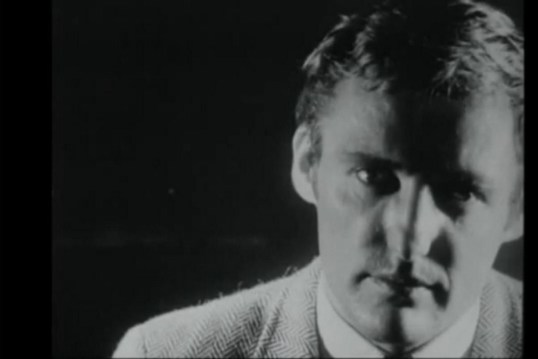
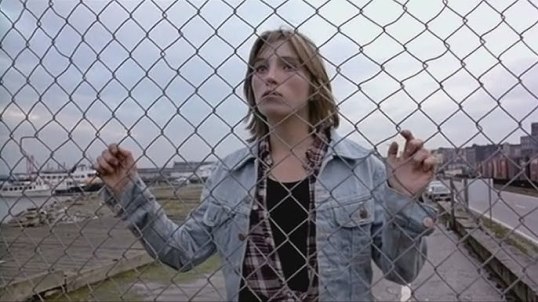
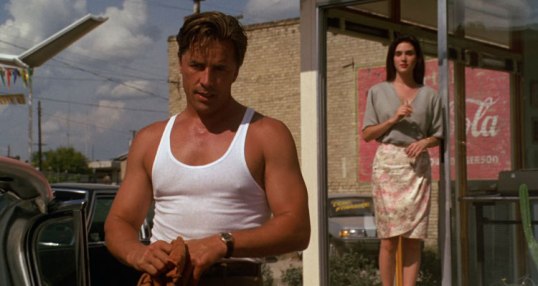
Easy Rider (1969, dir by Dennis Hopper, DP: Laszlo Kovacs)The Last Movie (1971, dir by Dennis Hopper, DP: Laszlo Kovacs)Out of the Blue (1980, dir by Dennis Hopper, DP: Marc Champion)The Hot Spot (1990, dir by Dennis Hopper, DP: Ueli Steiger)
For today’s scene that I love, here is the Mardi Gras sequence from 1969’s Easy Rider. Featuring Peter Fonda, Dennis Hopper, Karen Black, and Toni Basil walking through the streets of New Orleans, this scene was actually filmed during Mardi Gras. Those are real Mardi Gras floats and real Mardi Gras participants staring at the camera. That’s an actual citizen of New Orleans with whom Dennis Hopper appears to have nearly gotten into a fight. Personally, I relate to Toni Basil in this scene. She is having a good time no matter what!
I just love how Toni Basil can’t help but dance, no matter what.
4 (or more) Shots From 4 (or more) Films is just what it says it is, 4 (or more) shots from 4 (or more) of our favorite films. As opposed to the reviews and recaps that we usually post, 4 (or more) Shots From 4 (or more) Films lets the visuals do the talking.
Today, the Shattered Lens pays homage to the greatest of Mardi Gras cities, New Orleans!
4 Shots From 4 New Orleans-Set Films
Easy Rider (1969, dir by Dennis Hopper, DP: Laszlo Kovacs)
Zandalee (1990, dir by Sam Pillsbury, DP: Walt Lloyd)
The Curious Case of Benjamin Button (2008, dir by David Fincher, DP: Claudio Miranda)
Bad Lieutenant: Port of Call New Orleans (2009, dir by Werner Herzog, DP: Peter Zieitlinger)
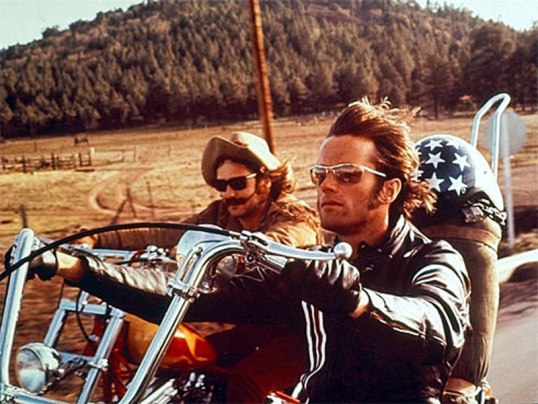
Today would have been the 85th birthday of actor and director Peter Fonda. Today’s scene that I love comes from Fonda’s best-known film, 1969’s Easy Rider. In this scene, Fonda is the epitome of cool as he and Dennis Hopper prepare to ride their bikes across America.
As some of our regular readers undoubtedly know, I am involved in a few weekly live tweets on Twitter and Mastodon. I host #FridayNightFlix every Friday, I co-host #ScarySocial on Saturday, and I am one of the five hosts of #MondayActionMovie! Every week, we get together. We watch a movie. We tweet our way through it.
Tonight, at 10 pm et, #FridayNightFlix has a film that I love and that my Dad loves as well, 1969’s Easy Rider!
If you want to join us this Friday, just hop onto twitter, start the movie at 10 pm et, and use the #FridayNightFlix hashtag! It’s a friendly group and welcoming of newcomers so don’t be shy.
Easy Rider is available on Prime! See you there!
Easy Rider (1969, dir by Dennis Hopper, DP: Laszlo Kovacs)
4 (or more) Shots From 4 (or more) Films is just what it says it is, 4 (or more) shots from 4 (or more) of our favorite films. As opposed to the reviews and recaps that we usually post, 4 (or more) Shots From 4 (or more) Films lets the visuals do the talking.
88 years ago, Dennis Hopper was born in Dodge City, Kansas.
It seems rather appropriate that one of America’s greatest cinematic outlaws was born in a town that will be forever associated with the old west. Dennis Hopper was a rebel, back when there were actual consequences for being one. He started out acting in the 50s, appearing in films like Rebel Without A Cause and Giant and developing a reputation for being a disciple of James Dean. He also developed a reputation for eccentricity and for being difficult on set and he probably would have gotten completely kicked out of Hollywood if not for a somewhat improbable friendship with John Wayne. (Wayne thought Hopper was a communist but he liked him anyways. Interestingly enough, Hopper later became a Republican.) Somehow, Hopper managed to survive both a raging drug addiction and an obsession with guns and, after a mid-80s trip to rehab, he eventually became an almost universally beloved and busy character actor.
Hopper, however, always wanted to direct. He made his directorial debut with 1969’s Easy Rider, a film that became a huge success despite being an infamously chaotic shoot. The success of Easy Rider led to the Hollywood studios briefly trying to produce counter-culture films of their own. Hopper was given several million dollars and sent to Peru to make one of them, the somewhat dangerously titled The Last Movie. Unfortunately, The Last Movie, was such a bomb that it not only temporarily derailed Hopper’s career but it also turned Hollywood off of financing counter culture films. Hopper spent a decade in the Hollywood wilderness, giving acclaimed performances in independent films like Tracks and The American Friend, even while continuing to increase his reputation for drug-fueled instability. Hopper would eventually return to directing with his masterpiece, 1980’s Out of the Blue. (Out of the Blue was so controversial that, when it played at Cannes, Canada refused to acknowledge that it was a Canadian production. It played as a film without a country. Out of the Blue, however, is a film that has stood the test of time.) Unfortunately, even after a newly cleaned-up Hopper was re-embraced by the mainstream, his directorial career never really took off. He directed 7 films, of which only Easy Rider and Colors were financially successful. Contemporary critics often didn’t seem to know what to make of Dennis Hopper as a director. In recent years, however, Hopper’s directorial efforts have been reevaluated. Even The Last Movie has won over some new fans.
Today, on his birthday, we honor Dennis Hopper’s directorial career with….
4 Shots From 4 Dennis Hopper Films
Easy Rider (1969, dir by Dennis Hopper, DP: Laszlo Kovacs)The Last Movie (1971, dir by Dennis Hopper, DP: Laszlo Kovacs)Out of the Blue (1980, dir by Dennis Hopper, DP: Marc Champion)The Hot Spot (1990, dir by Dennis Hopper, DP: Ueli Steiger)
If you can’t get down to New Orleans today (because maybe you have a sprained ankle like me), fear not! Mardi Gras has been immortalized in a number of films. In fact, some have theorized that the whole reason 1969’s Easy Rider was filmed was because Dennis Hopper wanted to go to New Orleans.
The Mardi Gras sequence occurs towards the end of Easy Rider. After a long and eventful journey, Wyatt (Peter Fonda) and Billy (Dennis Hopper) reach New Orleans and experience Mardi Gras with two women that they met at a brothel (Karen Black and Toni Basil). However, the Mardi Gras scenes were actually amongst the first to be shot and Hopper actually filmed several hours of documentary footage of New Orleans’s most famous party. If you watch the footage, you can see bystanders looking directly at the camera. They were not extras hired for the film. They were people on the street who became a part of one of the most important indie films in the history of American cinema. These scenes were shot guerilla style, without permits or, by most reports, any advanced planning.
Hopper also filmed Fonda having an actual bad acid trip. For obvious reasons, Fonda was not happy about being filmed in that condition but he did say, in later interviews, that Hopper made the right decision to include the footage in the film.
For the record, I relate to Toni Basil in this film. She’s having fun and dancing no matter what.
Today is not only the 1st of March. It’s not only Texas Independence Day. It’s not only Zack Snyder’s birthday. It’s not only the day of Texas primaries. It’s not only the day when the State of the Union address is scheduled to be given (yawn!). It’s also Mardi Gras!
What a busy day!
For today’s scene that I love, here is the Mardi Gras/Cemetery sequence from 1969’s Easy Rider. Featuring Peter Fonda, Dennis Hopper, Karen Black, and Toni Basil walking through the streets of New Orleans, this scene was actually filmed during Mardi Gras. Those are real Mardi Gras floats and real Mardi Gras participants staring at the camera. That’s an actual citizen of New Orleans with whom Dennis Hopper appears to have nearly gotten into a fight. And, in the cemetery scene, that was real acid that Peter Fonda took.
Here is today’s scene. The scene is age-restricted so you’ll actually have to click on “watch on YouTube” to see it.
If you don’t want to click on “watch on YouTube,” here is a shorter version that just features the parade without the admittedly disturbing cemetery stuff.
I like how Toni Basil can’t help but dance, no matter what.

 Through the Shattered Lens