In 1971’s The Anderson Tapes, Sean Connery stars as Duke Anderson.
Duke is a career criminal, a safecracker who has just spent ten years in prison. He’s released, alongside Pops (Stan Gottlieb), who spent so much time behind bars that he missed two wars and the Great Depression, and the quirky Kid (Christopher Walken, making his film debut). Duke immediately hooks up with his former girlfriend, Ingrid (Dyan Cannon), and decides to rob the luxury apartment building where Ingrid is now living.
Of course, Duke will have to put together a crew. It’s not a heist film without a quirky crew, is it? Duke recruits the Kid and Pops. (The Kid is happy to be in the game but he’s not a fan of violence. Pops, meanwhile, has none of the skills necessary for living in the “modern” world and would much rather return to prison.) Duke also brings in the flamboyant Tommy Haskins (an overacting Martin Balsam) and driver Edward Spencer (Dick Anthony Williams). Duke goes to the mob for backing and Pat Angelo (Alan King) gives it to him on the condition that he take along a sociopathic racist named Socks (Val Avery) and that Duke kills Socks at some point. Duke reluctantly agrees.
So far, this probably sounds like a conventional heist film. Director Sidney Lumet mixes comedy and drama with uneven results but, overall, he does a good job of ratcheting up the tension and The Anderson Tapes is a good example of one of my favorite mini-genres, the “New Yorkers will be rude to anyone” genre. At first glance, Sean Connery seems to be playing yet another super smooth operator, a confident criminal with a plan that cannot fail. Duke seems like a criminal version of James Bond, However, as the film progresses, we start to suspect that things might be getting away from Duke. When Duke has to go the Mafia for support and is told that killing Socks is now a part of the job, we see that Duke isn’t as in-control of the situation as we originally assumed. This is the rare Sean Connery film where he has someone pushing him around.
(Apparently, Connery took this role as a part of his effort to escape being typecast as Bond. Perhaps that explains why Duke seems like almost a deconstruction of the James Bond archetype.)
Of course, what really lets us know that Duke isn’t as in-charge as he assumes is the fact that four different law enforcement agencies are following his every move. From the minute he gets out of prison, Duke is being watched. The apartment is bugged. Security cameras records his every move. Once the heist begins, we’re treated to flash forwards of breathless news reports. The Anderson Tapes is less a heist film and more a portrait of the early days of the modern Surveillance State. Of course, none of the agencies make any moves to stop Duke because doing so would reveal their own existence. The film really does become a portrait of a government that has gotten so big and intrusive that it’s also lost the ability to actually do anything.
The Anderson Tapes is entertaining, even if it’s not really one of Lumet’s best. Connery is, as always, a fascinating screen presence and it’s always entertaining to see a young Christopher Walken, showing early sings of the quirkiness that would become his signature style. The Anderson Tapes is a portrait of a world where you never know who might be listening.
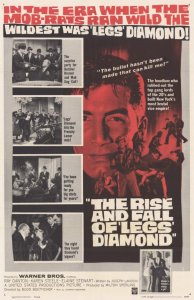 It’s the 1920s. Prohibition is the law of the land and gangsters control the streets of New York City. Jack Diamond (Ray Danton) and his tubercular brother, Eddie (Warren Oates), arrives in town. Jack and Eddie are small-time jewel thieves but Jack has ambitions to be something more. He works with his girlfriend, Alice (Karen Steele), as a dance instructor but he dreams of being the most powerful mobster in the world. His first step is to get a job working as a bodyguard for New York crime lord (and fixer of the 1919 World Series), Arnold Rothstein (Robert Lowery). Though Rothstein never trusts him, Jack works his way into his inner circle and even gets a nickname. Because he is a dancer, he is renamed “Legs” Diamond.
 Through the Shattered Lens