
Dr. Hawley Harvey Crippen
In 1910, a homeopath named Dr. Hawley Harvey Crippen was executed by hanging in the UK.
An American by birth, Dr. Crippen had come to London in 1897 with his second wife. (His first wife died of a stroke and Crippen sent his only son to live with his grandparents.) Cora Crippen was a former music hall singer who hope to continue her career in London and who did manage to make friends with several prominent members of the city’s theatrical community. Dr. Crippen was widely regarded as a meek man who was dominated by his rage-prone wife. Crippen struggled to hold down a regular job and eventually ended up as a manager at the Druet Institute for the Deaf. By at least 1905, Dr. Crippen was having an affair with a young typist named Ethel Le Neve.
Cora disappeared in early 1910. When her friends stopped by the house to ask for her, Dr. Crippen said that his wife had left him for another man and had returned to America. Later, he claimed that Cora had subsequently died in California. When Ethel was spotted wearing Cora’s jewelry, the London police launched their own investigation into Cora’s disappearance. After Crippen was interviewed by the police, he and Ethel fled to Brussels and then boarded an ocean liner heading for Canada. After Crippen and Ethel disappeared, the police searched Crippen’s home and found a torso buried in the basement. It was assumed that the torso was all that was left of Cora.
(As some have pointed out, it didn’t seem to make much sense for Crippen to dispose of Cora’s head, legs, and arms but to keep her torso. Apparently, at that time, it was common for human torsos to show up in the Thames, the result of people jumping in the river and then having their body split apart by the current. As such, the Thames also became a popular place to dump murder victims. One wonders why Crippen wouldn’t have done the same.)
Meanwhile, on the ocean liner heading to Canada, the captain noticed that one passengers looked like a freshly shaven Dr. Crippen and that the “boy” he was traveling with was obviously a young woman in disguise. The captain sent a wireless telegram to London. Chief Inspector Walter Dew boarded a faster liner and actually managed to reach Canada before Crippen. When Crippen and Ethel arrived in Canada, Walter Dew was waiting for them.
Fate simply wasn’t on Crippen’s side. If Crippen had bought third class tickets instead of sailing first class, it’s probable the captain would have never seen him during the voyage. If Crippen had taken a boat to his native United States instead of Canada (which was then still a British dominion), Dew would not have been able to take him back to the UK without an extradition hearing and it’s entirely possible that the evidence would have been ruled insufficient. Instead, Crippen was promptly returned to London and put on trial for murdering his wife.
During the heavily-covered four-day trial, Crippen’s defense was that Cora had returned to America and that there was no way to prove that the torso was Cora’s. Though the jury found Crippen guilty in just 22 minutes and he was hanged a month later, there were many who felt that Crippen was innocent or, at the very least, that his guilt had not been proven. I imagine that one reason why so many people doubted Dr. Crippen’s guilt was because he just didn’t look or act like a murderer. He wasn’t Jack the Ripper, a shadowy figure moving through the night. Instead, he was a short, balding, and rather owlish looking man who wore glasses and who, in most photographs, has a quizzical expression on his face.
In short, Dr. Crippen seems as if he was literally destined to eventually be played by Donald Pleasence.

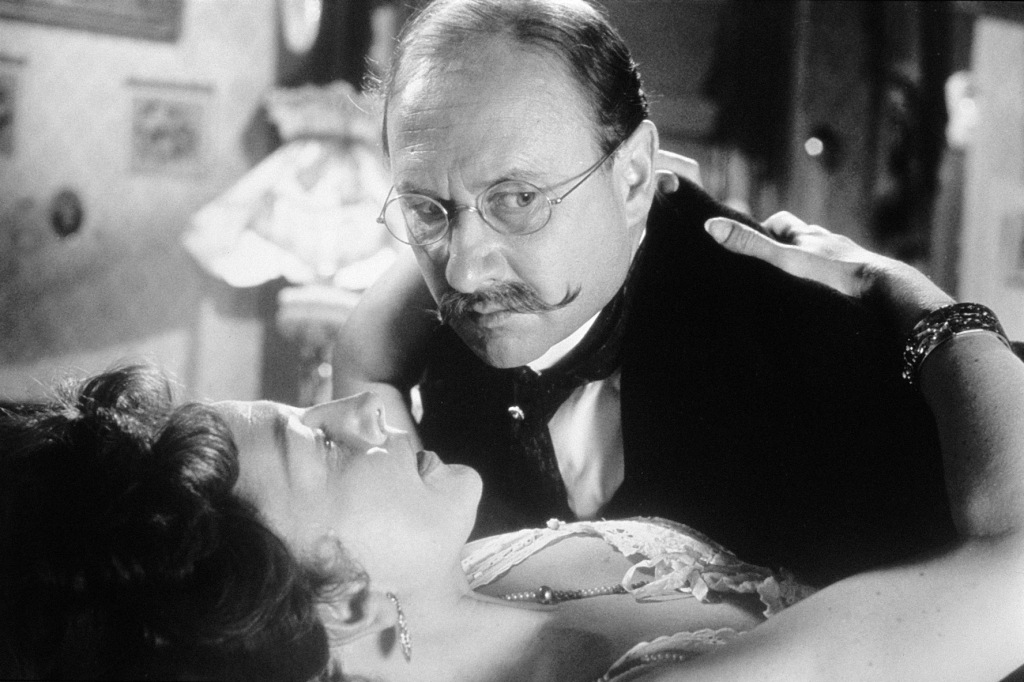
The 1963 film, Dr. Crippen, takes a rather straight-forward approach to telling the story of the doctor. It opens with Crippen (Donald Pleasence, naturally) on trial for the murder of his wife and it largely tells the story through flashbacks. Cora (Coral Browne) is portrayed as being a no-talent narcissist who regularly cuckolds her husband while Ethel Le Neve (Samantha Eggar) is portrayed as being a naive young woman who truly loves Dr. Crippen. The film leaves open the question of whether or not Crippen killed his wife, though it seems to strongly suggest that Crippen was innocent of the crime and the only reason he fled London was because he wanted to be with Ethel. Donald Pleasence is excellent as Dr. Crippen, playing him with just enough ambiguity that the viewer is left to wonder whether he did it or not. Pleasence turns Crippen into a sympathetic figure while still holding back just enough to suggest that emotional darkness that could have led even the meek Dr. Crippen to becoming a murderer. Nicolas Roeg’s black-and-white cinematography captures both the harshness of Crippen’s life in prison and the fleeting romance of his brief time with Ethel.
As for the real life Crippen, both his guilt and his subsequent execution continue to be controversial, with some claiming that DNA testing proved that the torso did not belong to Cora. (Other have quite reasonably pointed out that the sample used had degraded quite a bit over a hundred years.) There have been many attempts to win Dr. Crippen a posthumous pardon but all have failed and will probably continue to fail unless Cora’s remains are somehow discovered in a grave somewhere in California.
Shortly before his execution, in his final letter to Ethel Le Neve, Crippen wrote, “Face to face with God, I believe that facts will be forthcoming to prove my innocence.” After Crippen was hung, Ethel spent three years in Canada before returning to London. She changed her name, worked as a typist, and eventually married and had two children. She died in 1967, fifty-seven years after Dr. Crippen.
 Through the Shattered Lens