Lisa Reviews An Oscar Nominee: On Golden Pond (dir by Mark Rydell)


(With the Oscars scheduled to be awarded on March 4th, I have decided to review at least one Oscar-nominated film a day.  These films could be nominees or they could be winners.  They could be from this year’s Oscars or they could be a previous year’s nominee!  We’ll see how things play out.  Today, I take a look at the 1981 best picture nominee, On Golden Pond!)
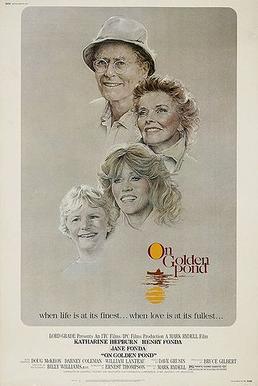
On Golden Pond takes place in a cottage that’s located on a lake called Golden Pond.  Hence, the title.  As far as title’s go, it’s not a bad one.  It’s a film about an elderly couple who spends every summer in that cottage.  They’re in their golden years so I guess it makes sense that they would feel an affinity for Golden Pond.

That said, I think that an even better title for the film would be Everything Annoys Norman.

Norman Thayer, Jr. (Henry Fonda) is a cantankerous old man.  He’s 79 and not particularly looking forward to celebrating his 80th birthday.  He’s a retired college professor.  His wife claims that the last time Norma was really happy was when Franklin Roosevelt was elected president.  Norman likes to fish and still brags about the time he caught a legendary trout named Walter.

What Norman doesn’t like is having to deal with the world.  When he stops to get gas, he loudly complains that, “in his day,” gas only cost eighty-five cents.  When he’s told that there’s another “middle-aged” couple on the lake, he says that, unless he’s going to live to be 150, he’s not middle-aged.  He gets frustrated because his memory isn’t as good as it used to be.  When he goes out for a walk in the woods, he forgets where the path is and he has to return to the house.  Sometimes, he calls people by the wrong name.  At one point, he struggles to use a landline phone.  (I can only imagine how annoyed Norman would be if he was alive today.)  Norman doesn’t like to deal with anyone other than his wife.

Ethel (Katharine Hepburn) is Norman’s wife.  She loves him.  When she hears Norman referred to as being “a son of a bitch,” she replies, “That son of a bitch is my husband.”  Ethel is used to Norman and his ways.  As she puts it, she understands that he’s like a “lion” who has to roar just to remind himself that he still can.  Ethel is … well, basically, she’s Katharine Hepburn.

Ethel has invited their daughter, Chelsea (Jane Fonda), to celebrate Norman’s birthday with them.  Norman and Chelsea have a strained relationship.  It’s implied that Norman was an emotionally distant and overly critical father and that Chelsea has never been able to forgive him.  When she shows up with her new boyfriend, Bill Ray (Dabney Coleman) and his 13 year-old son, Billy Ray (Doug McKeon), Norman barely bothers to acknowledge her.  With Bill and Chelsea planning on vacation in Europe, they ask if Billy can stay at the cottage with Norman and Ethel.  Ethel agrees.  Norman acquiesces.

On Golden Pond is a film that I wanted to like more than I actually did.  After all, the film features two classic actors, Henry Fonda and Katharine Hepburn, appearing in their only film together.  (Both Henry Fonda and Hepburn won Oscars for their work here.)  Henry Fonda gives a good performance as a strong-willed man who is struggling to deal with his own mortality.  As for Hepburn, it’s not a great performance, largely because Ethel is a thinly written role, but she’s Katharine Hepburn so it doesn’t matter.  But almost everything about the film — from the tasteful music to the pretty but not overwhelming cinematography — feels more like something you’d expect to find in a television production instead of a feature film.  On Golden Pond was based on a play and, with almost all of the action set in that cottage, it really doesn’t escape its theatrical origins.  That said, it’s a sweet movie.  The love between Norman and Ethel feels real.  If nothing else, the film gave the great Henry Fonda his only Oscar.

On Golden Pond was nominated for Best Picture but lost to Chariots of Fire.
Embracing the Melodrama Part II #66: Desperate Lives (dir by Robert Michael Lewis)


DL-cov2YouTube, my old friend, you have failed me.

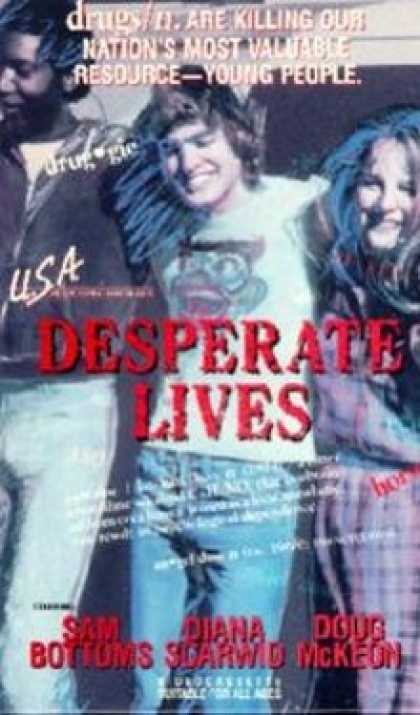
For the longest time, the 1982 anti-drug melodrama Desperate Lives has been available for viewing on YouTube.  I first watched it two years ago, after I read an online article about a scene in which a teenage Helen Hunt takes PCP and jumps through a window.  And, when I watched it, I was stunned.  I knew that the film was going to be over-the-top and silly, largely because it’s hard to imagine how a film featuring a teenage Helen Hunt taking PCP could be anything other than that.  But, even with my experience of watching over the top message movies, nothing could have quite prepared me for Desperate Lives.

So, I figured, for this review, that I’d say a few snarky words about Desperate Lives and then I’d just add something like, “And you can watch it below!”  And then I would embed the entire movie and all of y’all could just click on play and watch a movie on the Lens.

Unfortunately, Desperate Lives has been taken off of YouTube.  I assume the upload violated some sort of copyright thing.  And really, it’s kinda stupid because seriously, Desperate Lives is one of those films that really deserves to be seen for free on YouTube.

Oh well.  You can still watch a video of Helen Hunt jumping through that window.  The video below also features some additional elements from Desperate Lives.

For instance, you get to see Diana Scarwid playing the angriest high school guidance counselor in the world.  Scarwid knows that students like Helen Hunt are using drugs and that her fellow faculty members are turning a blind eye to everything’s that’s happening.  From the minute she first appears on screen, Scarwid is shouting at someone and she doesn’t stop screaming until the film ends.

And you also get to see Doug McKeon, playing Helen Hunt’s brother.  McKeon goes for a drive with his girlfriend, who has just taken PCP herself.  As their car goes flying off a mountain, she says, “Wheeee!”

In the video below, you also get to see that the only reason Helen Hunt used drugs was because her boyfriend begged her to.  That’s a scenario that seems to show up in a lot of high school drug films and it’s strange because it’s something that I’ve never actually seen happen or heard about happening in real life.  In fact, in real life, most users of hard drugs are actually very happy to not share their supply.

Unfortunately, the video below does not feature any scenes of Sam Bottoms as the world’s most charming drug dealer and that’s a shame because he gives the only good performance in the entire film (sorry, Helen!).

Even worse, the video doesn’t include any scenes from the film’s memorably insane conclusion, in which Scarwid searches every single locker in the school and then interrupts a pep rally so she can set everyone’s stash on fire in the middle of the gym.  Making it even better is that all the students are so moved by Scarwid’s final speech that they start tossing all of the drugs that they have on them into the fire.

Which means that the film essentially ends with the entire school getting high off of a huge marijuana bonfire.

No, that scene cannot be found in the video below.  But you can find Helen Hunt jumping through a window so enjoy.

http://www.youtube.com/watch?v=rEpyLzHeozY

Back to School #36: Mischief (dir by Mel Damski)


Mischief

Have you ever noticed how, occasionally, a totally obscure film that was made several decades ago will suddenly show up on either Starz or Encore and, the next thing you know, it’s only like every other day?  That was the case a few months ago when, at times, it seemed as if the only thing playing on cable was a teen comedy from 1985 called Mischief.

After I saw it listed in the guide a few dozen times, I thought to myself, “Somebody at that station must really like that movie.”  So, one night, I actually took the time to watch it and discovered why that mysterious person loved this movie.  Mischief may not be as well-known as some of the other films in this series of Back to School reviews but it’s still a pretty good movie.

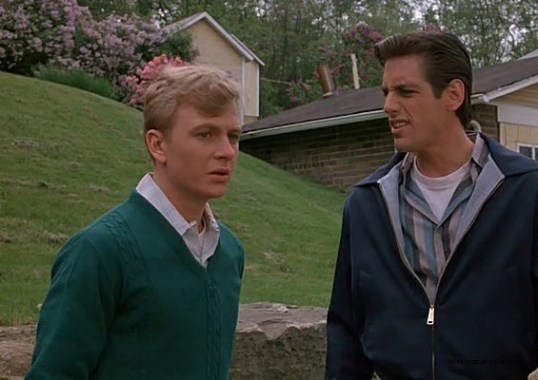
Like so many of the teen films that were released in the 70s and 80s, Mischief takes place in the 1950s.  (I assume that’s because most films about teenagers are made by adults who want to both relive and perhaps change the past.  I suppose that’s one reason why so many films released today are set in the 1990s.  In another ten years or so, all of the new high school films will be set in 2003.)  The very shy and clumsy Jonathan (Doug McKeon) has a crush on the beautiful but unattainable Marilyn (Kelly Preston).  Fortunately, Jonathan is befriended by Gene (Chris Nash) who is the prototypical rebel without a cause.  Gene wears a leather jacket.  Gene rides a motorcycle.  Gene doesn’t get along with his alcoholic, violin-playing father (Terry O’Quinn, in full asshole mode here).  Gene even stands up to the school bully (D.W. Brown) and starts dating the bully’s ex-girlfriend, Bunny (Catherine Mary Stewart).  Most importantly, Gene helps Jonathan finally develop the confidence necessary to ask Marilyn out.

And, for a while, Gene & Bunny and Jonathan & Marilyn make for the perfect foursome.  But, as we all know, perfection can never last in a coming-of-age story.  Jonathan starts to discover that he and Marilyn are not quite as compatible as he originally assumed that they were.  As for Gene, he has to deal with his increasingly violent and drunken father…

That last paragraph probably makes Mischief sound a lot more dramatic than it actually is.  Make no mistake about it — while Mischief does deal with some serious issues — it is primarily a comedy and a pretty good one at that.  McKeon is endearingly clumsy in his initial attempts to get Marilyn to notice him and Nash — even though he’s playing a very familiar character — is likable as well.  Perhaps the smartest thing that Mischief did is that it made Gene cool but it didn’t make him too cool.  The film’s best scenes are the ones where Gene momentarily surrenders his rebel facade and reveals that he’s just as confused as everyone else.  Catherine Mary Stewart and Kelly Preston are well-cast as well, with Preston especially doing a good job at making a potentially unsympathetic character likable.

In many ways, Mischief is a pretty predictable film.  I think it features probably every single cinematic cliché that one would expect to see in a film about the 50s.  But the film itself is so likable and good-natured that it doesn’t matter if it’s predictable.  It’s just a good, enjoyable movie and what’s wrong with that?

(Incidentally, the screenplay for Mischief was written by Noel Black, who also directed the previously reviewed Private School.)

1327550371_1447726