For our final episode of The Veil, we have a look at one of the most infamous real world monsters of all time, Jack the Ripper.
In this atmospheric episode, a London clairvoyant (Niall MacGinnis) is haunted by visions of the Whitechapel murders. Unfortunately, his attempts to help the police only leads to them treating him like a suspect! Each episode of The Veil was usually described as being “based on a true story.” In this case, it’s actually true. A medium named Robert Lees — renamed Walter in this episode — actually did go to the police with claims that he had seen the murders and could identify the killer.
This is the only episode of The Veil in which Boris Karloff acts only as host. That’s because this episode was not originally made for the series. Instead, it was intended for an unrelated British anthology show. The producers of the Veil later bought the episode and tacked on an introduction by Boris Karloff. Of course, because The Veil itself never actually aired on television as a result of the production company running into financial problems, Jack the Ripper never aired in the U.S. It was, however, later included in an anthology film that was put together using four episodes of The Veil.
Enjoy! That’s it for The Veil. Tomorrow, we start a whole new series!
After a rain, a car drives through a puddle and splashes mud on a man’s designer boots. The owner of the boots follows the car back to a country manor and murders everyone inside. (Did he really kill everyone in the house because his boots get muddied? It is never really clear. Before his boots got splashed on, he was looking at violent comic books in a shop. Maybe Wertham was right.) Later, Sarah (Mia Farrow), the niece of the car’s driver, arrives at the house. As the result of a recent horse riding accident, Sarah is blind. She walks through the house, unaware that she is surrounded by dead bodies and unaware that the owner of the boots left behind a bracelet that he will soon be returning to retrieve.
Obviously inspired by Wait Until Dark, See No Evil is a well-done cat-and-mouse game between Sarah and her unseen stalker. Mia Farrow is great as the blind woman and the scenes of her unknowingly walking past the dead bodies of her family while being followed are tense and suspenseful. See No Evil has been overshadowed by Farrow’s other two horror films, Rosemary’s Baby and Full Circle, but it is definitely worth a look.
So, earlier today, I got off work early so I could go to Noon Mass with my sister and we both got our ashes. And I’m sure that will take some people by surprise because I’m not exactly the most faithful or devout of Catholics. But what can I say? I love the ornate ritual of it all.
And, as a part of my own personal ritual, I washed my forehead before I left the church. Erin and I had a great vegetarian lunch at Cafe Brazil and then we came home and I turned on the TV and what should be finishing up on TCM but the 1959 best picture nominee, The Nun’s Story. Fortunately, I had already set the DVR to record The Nun’s Story and so, on this most Catholic of days, I was able to watch this most Catholic of best picture nominees.
The Nun’s Story tells the story of Gaby (Audrey Hepburn), the daughter of a famous Belgian doctor (Dean Jagger). At the start of the film, Gaby has entered a convent because she wants to become a missionary nursing sister in the Belgian Congo. However, before Gaby can go to the Congo, she has to learn to give up her own rebellious streak and individual independence. Taking the name Sister Luke, she excels at her medical training but, because it is felt that she is still too independently minded, she is not sent to the Congo but instead assigned to work in a mental hospital. It’s there that her independent streak nearly gets her killed when she is fooled by a dangerous patient who claims to be the Archangel Gabriel. It is only after she takes her final vows that Sister Luke is finally sent to the Congo and it is there that she’s forced to work with the abrasive agnostic Dr. Fortunati (Peter Finch). Of course, as Sister Luke goes through her own spiritual struggles, the world inches closer and closer to the start of a second world war. When war does break out, Sister Luke finds herself torn between her vow of obedience (which includes remaining political neutral) and the realities of living in a country that’s been occupied by the Nazis.
1959 was apparently a good year for religious films. Not only did Ben-Hur win best picture, but The Nun’s Story also received 8 nominations. Reportedly, The Nun’s Story was the most financially successful film to be released by Warner Bros, up to that point. If Wikipedia is to be believed, it was also Audrey Hepburn’s personal favorite of the many movies that she made.
When seen today, probably the first thing that people notice about The Nun’s Story is that it’s extremely long and occasionally rather slow. The film follows Gaby from the minute she enters the convent to the moment that she makes her final choice about whether to be obedient to herself or to her vows and, during that time, it examines every single detail of her life in glorious Technicolor. A lot of emphasis is put on the rituals that Sister Luke goes through on her way to taking her final vows. Now, if you’re like me, all of the rituals are fascinating to watch and produce a whole host of conflicting emotions. Even as I found myself admiring Sister Luke’s dedication and her sacrifice, I still kept wondering — much as she did — if it was all really worth giving up her independence. But, I also have to admit that I found myself wondering if someone from a Protestant background would feel the same way.
To a certain extent, I really hate to say that you probably have to come from a Catholic background to truly enjoy any film. But I certainly think that’s the case with The Nun’s Story. But, even Protestants and skeptics will appreciate Audrey Hepburn’s wonderful lead performance. She keeps this film grounded and makes her mostly internal conflict of faith compelling. In a career that was full of great performance, this is one of Audrey’s best.

 After a rain, a car drives through a puddle and splashes mud on a man’s designer boots. The owner of the boots follows the car back to a country manor and murders everyone inside. (Did he really kill everyone in the house because his boots get muddied? It is never really clear. Before his boots got splashed on, he was looking at violent comic books in a shop. Maybe Wertham was right.) Later, Sarah (Mia Farrow), the niece of the car’s driver, arrives at the house. As the result of a recent horse riding accident, Sarah is blind. She walks through the house, unaware that she is surrounded by dead bodies and unaware that the owner of the boots left behind a bracelet that he will soon be returning to retrieve.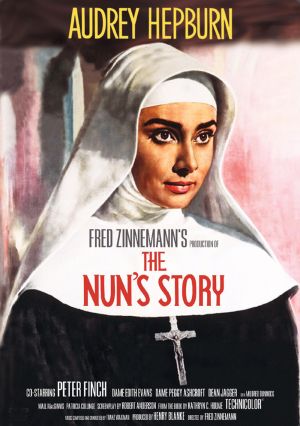
 Through the Shattered Lens