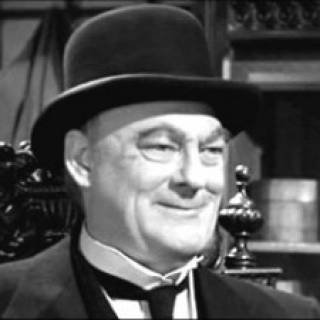
It’s A Wonderful Pottersville!


1775489-banker

It’s that time of year where I share with my loyal readers a hidden treasure! For years, we were kept in the dark of parallel dimension! A Better World! A Brighter World! A world where Mr. Potter prevailed against the forces of evil that sought to undermine good itself! After Good prevailed, David Brinkley interviewed the Great Mr. Potter!!

The following is a re-broadcast of the 1955 interview with David Brinkley and Mayor Potter of the eponymous Pottersville.

David Brinkley:  Ladies and Gentlemen this is a portrait of a town that came back.  The best example of which is the bustling Boffo town of Pottersville.   I am interviewing the man who brought this town back after a factory closing and 1920s financial collapse:  Mr… I mean Mayor Potter.

Mayor Potter:  Thank you, David.

David Brinkley:  Mr. Mayor, your town is synonymous with nightlife and culture.  Now, it is hosting it’s fourth International Film Festival.  It seems to stand out among so many New York factory towns.  What happened?

Mayor Potter:  HRHHPFM! It was a near run thing.

David: How so?

Mayor Potter: We had this flirtation with communism in the 19 teens and 20s.

David: *Gasps*

Mayor Potter:  It’s true.  We had this Bolshevik style building and loan.

David: A building and what?

Mayor Potter:  It was a bank … of sorts.  This guy “Pa” Bailey *Uses air quotes with an eye-roll*  would talk rubes into giving him money to build people homes who were too broke to pay their mortgages.

David: Come again?

Mayor Potter: Get this, when you wanted to make a withdrawal you’d either have to wait 60 days or some jackass would use his personal savings to “loan” you money.

David: *Eyes Widen*

Mayor Potter:  Oh yeah Dave, This commie bank was always screwing with people’s money.  The owner hired his brother Billy – he was this unreformed drunkard and he had a menagerie of unvaccinated feral animals in his office. And, when this Building and Loan would really squander their funds and bills would come due, Billy would knock on people’s doors holding a wicker basket begging for donations all over town.

David: Wicker? What kinds of animals? What?!

Mayor Potter:  UGGHH, Bailey had everything in there… crows, squirrels, probably had a damn bobcat for all we knew.  Bailey’s in a mental ward now.  But, he wasn’t even the worst…

David: Come on..

Mayor Potter:  Try getting a prescription filled back in those days. We had a homicidal druggist poisoning people … Bowser or something or other.  He got locked up and’s he’s dead now …. good riddance.

David: Weren’t there two Bailey sons?

Mayor Potter: The younger Brother was a war hero and now works for DuPont and designed some weed killer Agent Purple or something.

David: Not to turn this into a History of the Baileys.

Mayor Potter: No big deal. George went off to college and married a local girl…Mary. He designs pipelines in Venezuela for Shell Oil. He calls me every now and again. He just got back from Europe with Mary- He goes at least once a year. Could you imagine if George had tried to keep his Dad’s commie bank going? He would’ve wished he’d never been born!

David: Back to the town, what changed?

Mayor Potter: Well, Pa Bailey died and then the Crash.

David: How did your recover from the crash?

Mayor Potter: Recover?!  The Crash helped us! I bought up the failing businesses and turned this town around.  We needed new revenue from new sources.

David: About that, after the war, Pottersville was criticized for what some called a seamy downtown.

Mayor Potter:  *Shrugs* You’re a veteran.  After the war, people wanted to blow off some steam and that means dancing, music, and booze.  Our downtown is different now.  Even then, it was still better than the boring Bedford Falls anytown USA….Bleh! We’re the only Right To Work county in New York!  What did that bring? Headquarters and more business than Buffalo or Detroit combined!  We have 12 museums, 200 restaurants, a financial center, a subway, and a Theater district second only to New York City!  Besides, nightlife and culture is what brings people to cities.  “Honey, let’s splurge and visit Des Moines… Said no one ever!”

David: You have a point.  This is truly a magnificent achievement.

Mayor Potter:  Thank you.

David: That’s all.  Good luck and good night.

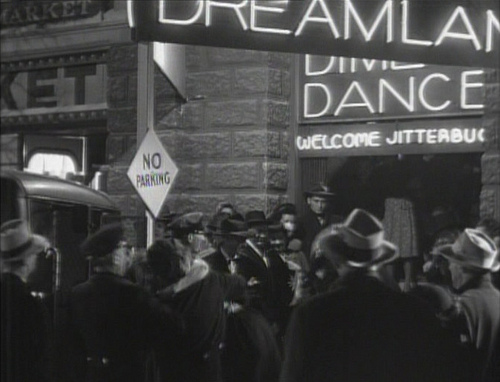
Pottersville Circa: 1947
3660685485_e6d23a1166.jpg

Pottersville: Current Day

874f422901ebda09c258f1d6d8fec211

Horror Film Review: The Picture of Dorian Gray (dir by Albert Lewin)


picture-of-dorian-gray-32

Hello and welcome to the start of TSL’s annual October horrorthon!  All through the month of October, our focus will be on horror.  We will be sharing reviews and thoughts on some of the best (and worst) horror films ever made!  I have to admit that this is my favorite time of the year.  I love horror … like all good people!

I want to start things off by taking a look at a film from 1945.  The Picture of Dorian Gray is based on the famous novel by Oscar Wilde (a novel that some people think was inspired by the Jack the Ripper murders).  Dorian Gray (played by Hurd Hatfield) is a young and handsome aristocrat who lives in 19th century London.  When we first meet him, Dorian is intelligent, kind and virtuous.  He’s also more than a little boring.  He is the bland face of the establishment, a man destined to be celebrated for his position in society and largely forgotten after his death.

Dorian is posing for a painting that’s being done by his friend, an artist named Basil Hallward (Lowell Gilmore).  One day, Lord Henry Wotton (George Sanders) stops by the studio while Basil is painting Dorian.  Lord Henry is everything that Dorian Gray is not.  He’s a worldly and cynical man and he is very proud to live a life devoted to complete and total hedonistic pleasure.  He immediately sets out to corrupt Dorian and it turns out to be a lot easier than he was expecting.  Henry convinces Dorian that he can have everything that he wants as long as he’s young and handsome.  Dorian announces that he wishes the painting could age instead of him…

Now, here’s where the film takes a huge departure from Wilde’s novel.  In the novel, the painting ages while Dorian stay young.  No specific reason is given.  Instead, it’s just something that happens.  In the film, it turns out that Basil owns an ancient Egyptian statue and that the statue has mystical powers.  Dorian makes his wish in front of the statue and that’s why the painting starts to age.  Personally, I think the bit with the Egyptian statue is unnecessary and a little bit silly.  To me, the story is a lot more effective if the painting starts to age without an explanation.  The filmmakers obviously disagreed.

But no matter!  In the end, the Egyptian statue isn’t that important.  What is important that, freed from getting old or physically suffering for his actions, Dorian transforms into a different person.  Soon, he’s even more hedonistic than Lord Henry.  When he breaks the heart of a tragic singer named Sybil Vane (Angela Lansbury, in a poignant and Oscar-nominated performance), Dorian sees that the painting is now cruelly smirking while his own face remains innocent and untouched.  When Dorian eventually commits a murder to keep his secret from getting out, the blood appears on the painting’s hands while his own remain clean.

And the years pass.  Dorian finds himself both being hunted by Sybil’s brother (Richard Fraser) and falling in love with the niece (Donna Reed) of a man that he earlier murdered.  Dorian never ages but his portrait becomes more and more twisted.  What’s particularly interesting is that we see little of Dorian’s evil actions.  Instead, we watch and listen as other characters whisper about the horrific things that he’s done.  Physically, Dorian remains an innocent and young aristocrat.  But all we have to do is look at the picture and we can see what a monster Dorian has become…

The Picture of Dorian Gray is an absolutely gorgeous film, one that is full of elaborate sets that are often cast in shadow.  (It’s interesting to note that the more corrupt Dorian becomes, the darker and more shadowy his estate becomes.)  The film is in black-and-white, with the exception of three scenes in which the portrait is revealed in all of its Technicolor glory.  If that sounds like a gimmick … well, it is.  But it’s an amazingly effective gimmick.

The Picture of Dorian Gray is a classic exercise in psychological horror.  See it the next chance you get!

portrait-de-dorian-gray-1945-01-g

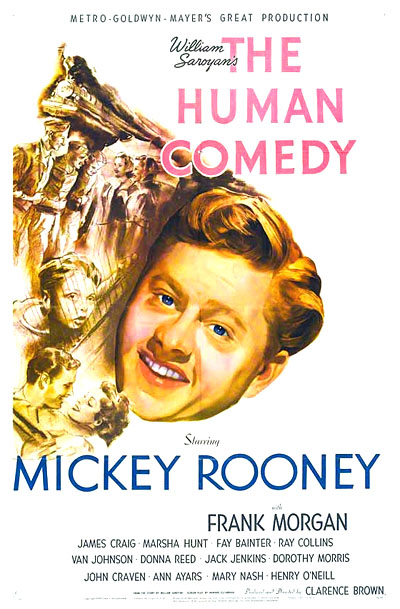
Lisa Reviews An Oscar Nominee: The Human Comedy (dir by Clarence Brown)


The-human-comedy-1943Thanks to TCM’s 31 Days of Oscar, I now have several movies on my DVR that I need to watch over the upcoming month.  Don’t get me wrong — I’m not complaining.  I’m always happy to have any reason to discover (or perhaps even rediscover) a movie.  And, being an Oscar junkie, I especially enjoy the opportunity to watch the movies that were nominated in the past and compare them to the movies that have been nominated more recently.

For instance, tonight, I watched The Human Comedy, a film from 1943.  Along with being a considerable box office success, The Human Comedy won on Oscar (for Best Story) and was nominated for four others: picture, director (Clarence Brown), actor (Mickey Rooney), and black-and-white cinematography.  The Human Comedy was quite a success in 1943 but I imagine that, if it were released today, it would probably be dismissed as being too sentimental.  Watching The Human Comedy today is something of a strange experience because it is a film without a hint of cynicism.  It deals with serious issues but it does so in such a positive and optimistic manner that, for those of us who are used to films like The Big Short and Spotlight, a bit of an attitude adjustment is necessary before watching.

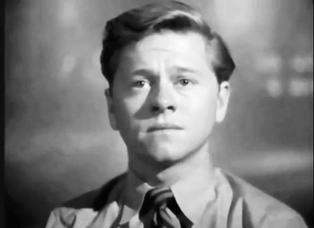
And yet that doesn’t mean that The Human Comedy is a bad film.  In fact, I quite enjoyed it.  The Human Comedy is a time capsule, a chance to look into the past.  It also features a great central performance, one that was quite rightfully nominated for an Oscar.  As I watched Mickey Rooney in this film, I started to feel guilty for some of the comments I made when I reviewed Mickey in The Manipulator last October.

2Mickey Rooney in The Human Comedy

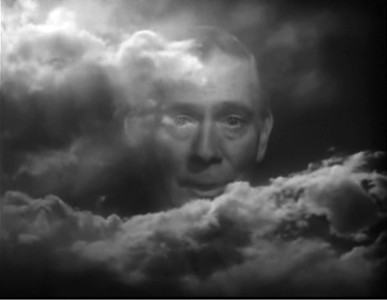
The Human Comedy opens with an overhead shot of the small town of Ithaca, California.  The face of Mr. McCauley (Ray Collins, who you’ll recognize immediately as Boss Jim Gettys from Citizen Kane) suddenly appears in the clouds.  Mr. McCauley explains that he’s dead and he’s been dead for quite some time.  But he loves Ithaca so much that his spirit still hangs around the town and keeps an eye on his family.  Somehow, the use of dead Mr. McCauley as the film’s narrator comes across as being both creepy and silly.

Matthew-clouds-400-387x300

But no sooner has Mr. McCauley stopped extolling the virtues of small town life than we see his youngest song, 7 year-old Ulysseus (Jack Jenkins), standing beside a railroad track and watching a train as it rumbles by.  Sitting on the cars are a combination of soldiers and hobos.  Ulysseus waves at some of the soldiers but none of them wave back.  Finally, one man waves back at Ulysseus and calls out, “Going home, I’m going home!”  It’s a beautifully shot scene, one that verges on the surreal.

That opening pretty much epitomizes the experience of watching The Human Comedy.  For every overly sentimental moment, there will be an effective one that will take you by surprise.  The end result may be uneven but it’s still undeniably effective.

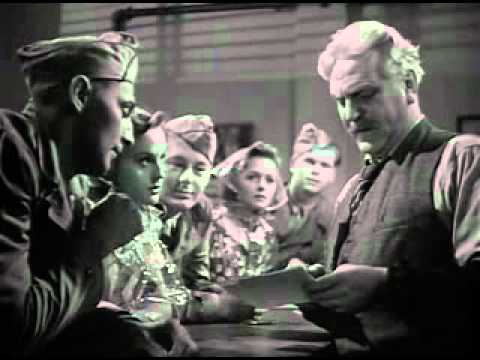
The majority of the film deals with Homer McCauley (Mickey Rooney).  Homer may still be in high school but, with his older brother, Marcus (Van Johnson), serving overseas and his father dead, Homer is also the man of the house.  Homer not only serves as a role model for Ulysseus but he’s also protector for his sister, Bess (Donna Reed).   (At one point in the film, she gets hit on by three soldiers on leave.  One of them is played by none other than Robert Mitchum.)  In order to bring in extra money for the household, Homer gets a job delivering telegrams.

hqdefault

In between scenes of Homer in Ithaca, we get oddly dream-like scenes of Marcus and his army buddies hanging out.  Marcus spends all of his time talking about how much he loves Ithaca and how he can’t wait for the war to be over so he can return home.  One of his fellow soldiers says, “I almost feel like Ithaca is my hometown, too.”  Marcus promises him that they’ll all visit Ithaca.  As soon as the war is over…

With World War II raging, Homer’s job largely consists of delivering death notices (and the occasional singing telegram, as well).  Telegraph operator Willie Grogan (Frank Morgan) deals with the burden of having to transcribe bad news by drinking.  Homer, meanwhile, tries to do his job with compassion and dignity but one day, he has to deliver a telegram to his own house…

The Human Comedy is an episodic film, full of vignettes of life in Ithaca and Homer growing up.  There’s quite a few subplots (along with a lot of speeches about how America is the best country in the world) but, for the most part, the film works best when it concentrates on Homer and Mickey Rooney’s surprisingly subdued lead performance.  By today’s standards, it may seem a bit predictable and overly sentimental but it’s also so achingly sincere that you can’t help but appreciate it.

The Human Comedy was nominated for best picture but it lost to a somewhat more cynical film about life during World War II, Casablanca.

Ghosts of Christmas Past #24: It’s a Wonderful Life


Just in case you somehow missed your chance to see one of the greatest films ever made, here’s Frank Capra’s classic It’s A Wonderful Life.  I’ve seen this movie a countless number of times.  I can recite every line by memory.  And yet, every time I watch it, I still get tears in my eyes.  If you missed it on TV this year, please feel free to watch it below.

Incidentally, I always related to Violet.

Dance Scenes That I Love: It’s A Wonderful Life


So, this year, the toadsuckers at NBC (the same people who put Whitney on the air and who fired Dan Harmon from Community) decided to bump the annual showing of It’s A Wonderful Life on December 14th so that they could re-air the Carrie Underwood version of The Sound of Music.

Really, NBC?  The remake of The Sound of Music may have gotten great rating when it first aired but it wasn’t that good.  In fact, it was downright annoying at times.  Meanwhile, nearly 70 years after it was first released, It’s A Wonderful Life remains a classic.

With that in mind, here’s one of my favorite scenes from one of my favorite movies.  And yes, it is a dance scene.

NBC will air It’s A Wonderful Life on December 20th.