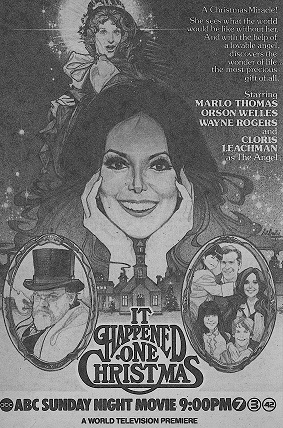
The 1977 made-for-TV movie, It Happened One Christmas, opens in Heaven. We hear the voice of Joseph (Charles Grodin), one of the top angels. Joseph has noticed that, in the town of Bedford Falls, a lot of people seem to be praying and all of their prayers concern one person. They are all worried about Mary Bailey Hatch (Marlo Thomas).
He requests that an angel be sent down to Earth to help Mary with her problems. Unfortunately, the only angel available is Clara (Cloris Leachman) and Clara, despite her optimistic outlook and upbeat personality, is not considered to be a particularly smart angel. She hasn’t even gotten her wings yet! However, Joseph promises her that, should she convince Mary Hatch not to toss away her life on Christmas Eve, Clara will get her wings.
But first, Joseph shows Clara all of the important events in Mary’s life. Clara watches as young Mary saves the life of her brother, Harry. A few weeks later, Mary manages to keep Dr. Gower from accidentally poisoning a patient. Though Mary dreams of leaving Bedford Falls and pursuing a career as a writer, she instead ends up taking over her late father’s old Building and Loan company. With the help of her husband, George (Wayne Rogers), she helps hundreds of people move into affordable housing. She is also one of the few people in town willing to stand up to Old Man Potter (Orson Welles)….
What was that?
Yeah, I know. Just hold on. I’m getting to that.
Anyway, everything is going great in Mary’s life until her irresponsible Uncle Willie (Barney Martin) accidentally loses a deposit on Christmas Eve. Facing embezzlement charges and having yelled at her family, Mary considers jumping off a bridge. Fortunately, Clara is there to show her what her life would be like if she had never been born….
Excuse me? Did you say that this sounds familiar?
Yes, It Happened One Christmas is a remake of It’s A Wonderful Life. The main difference is that the genders are swapped. Jimmy Stewart’s role is played by Marlo Thomas. Wayne Rogers plays the Donna Reed role. This leads to a few changes in the story. For instance, Mary still yells at ZuZu’s teacher but she doesn’t get sucker punched as a result. Whereas the original Mr. Potter treated George Bailey with outright hostility, the remake’s Mr. Potter tends to use a tone of condescending concern when talking to Mary. Since George Hatch doesn’t lose his hearing in one ear, he’s able to serve in World War II and he returns on crutches. In the world where Mary was never born, George still never marries but, instead of working at the library, he becomes a boorish auto mechanic. Violet is no longer an important character and Mary never tries to blame her visions of Pottersville on “bad liquor.” These are cosmetic differences but, otherwise, it’s pretty much the exact same story.
To be honest, it probably sounds more interesting than it actually is. It’s not that It Happened One Christmas is a poorly made or a badly acted film. It’s fine, really! But it’s not It’s A Wonderful Life. Marlo Thomas plays her role with a lot of energy but she’s still no Jimmy Stewart. Stewart, who was still dealing with his own World War II experiences, played up the haunting sadness behind George’s mild-mannered facade and that’s something that Thomas never accomplishes. If Stewart’s George seems like he’s been beaten down by one lost dream after another, Marlo Thomas’s Mary just seems like she’s having a really bad night. By that same token, Wayne Rogers is likable a the love of Mary’s life but he’s no Donna Reed. Even the great Orson Welles can’t escape the shadow of Lionel Barrymore. Barrymore’s Mr. Potter was a pure misanthrope who was at his happiest mocking the dead and approving men for the draft. Oddly, Orson Welles brings an almost avuncular style to Mr. Potter. One gets the feeling that Welles simply couldn’t resist winking at the audience and assuring them that he was still the bigger-than-life showman that they had grown up with.
So, you may be wondering ….. why remake It’s A Wonderful Life in the first place? I was wondering about that so I did a little research and thanks to an obscure web site called Wikipedia (not many people have heard of it), I discovered that It Happened One Christmas was actually made before It’s A Wonderful Life started to regularly air during the holidays. At the time it was made, it was aactually remake of a classic film that was no longer regularly watched. Frank Capra angrily denounced It Happened One Christmas as being “plagarism” but, in 1977, it was enough of ratings success that it was re-aired in both 1978 and 1979. But, by that time, It’s A Wonderful Life had started to regularly air during the holiday season and was being rediscovered by audiences young and old. As a result, the okay remake was soon overshadowed by the vastly superior original.
And really, that’s the way it should be. It Happened One Christmas isn’t a bad movie but it just no replacement for Capra’s Wonderful film.
 Through the Shattered Lens