Late Night Retro Television Review: 1st & Ten 3.6 “The Bulls Change Hands”


Welcome to Late Night Retro Television Reviews, a feature where we review some of our favorite and least favorite shows of the past! On Wednesdays, I will be reviewing 1st and Ten, which aired in syndication from 1984 to 1991. The entire series is streaming on Tubi.
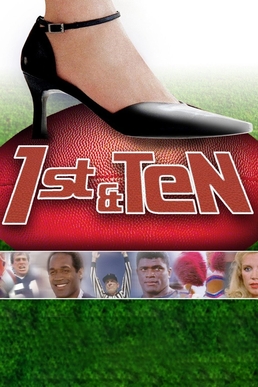
This episode was confusing.  Is syndication to blame?

Episode 3.6 “The Bulls Change Hands”

(Dir by Stan Lathan, originally aired on September 9th, 1987)

Diana no longer owns the Bulls!

That was the main plot development to be found in this cluttered episode of 1st & Ten.  As I’ve mentioned before, the episodes of 1st & Ten that are available on Tubi are the heavily edited versions that were sold into syndication as opposed to the original, R-rated versions that appeared on HBO.  With quite a few of these episodes, it’s obvious that entire plotlines have been pretty much chopped out.  That certainly feels like the case here because, despite having watched the episode, I’m still not totally sure how Diane lost the Bulls in the first place.

What I do know is that she threatened to expose Teddy’s insider trading.  Teddy responded by leaving the country but, before he left, he gave his ownership shares to his daughter, Jill (Leah Ayres).  Teddy explains that this makes Jill the owner of the Bulls.  But my understanding was that Teddy only owned half the team so it seems like that would mean Jill and Diane would now be co-owners.  Perhaps I missed something in an earlier episode or maybe some line of dialogue was cut out for syndication, I’m not sure.  What I do know is that Jill now owns the Bulls.  The first thing she does is break up with Yinessa because she can’t be both his boss and his girlfriend.

In her final locker room speech, Diane orders the Bulls to win because Diane is taking Jill to court and she wants the team to be in the playoffs once she returns as the owner.  It’s not a bad speech but again, I thought Diane still owned at least half of the team.

Meanwhile, Yinessa is back as quarterback.  And he leads the Bulls to their first victory of the season.  His new wide receiver, Billy Cooper (Michael Toland) catches the game-winning pass.  At the same time that Billy is scoring, some guy who we’ve never seen before is shooting at him from the roof of the stadium.  The police arrest the guy and Billy later discovers a bullet lodged in his helmet.

Bubba’s sex therapist (Penny Johnson) is now obsessed with him, despite Bubba’s attempts to set her up with with Jethro.  I have a feeling that the Jethro/Bubba storylines were the ones that really got left on the cutting room floor when it came to editing these episodes for syndication.  Jethro and Bubba have been with the show since the beginning and they’ve got prominent billing in the opening credits but, when it comes to their roles in the episodes themselves, it seems like the only thing that happens is Bubba says that he needs to get laid and then the two of them disappear for several weeks.  When they do finally reappear, Bubba is always in some sort of new trouble with his wife.

Speaking of marriage, in this episode, TD Parker finally confesses to his wife that he’s been having an affair.
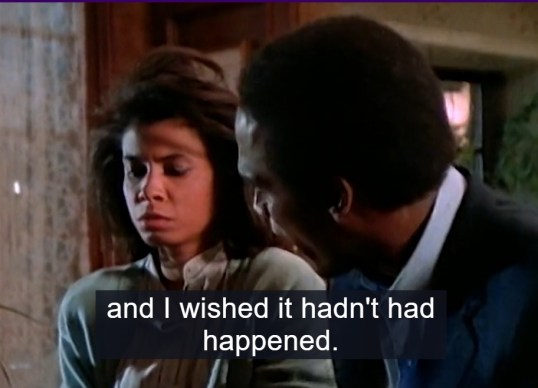
TD apologizes.  His wife tells him to get out.  Agck!  I can see where this storyline is heading but OJ Simpson fighting with his wife still lands differently in 2026 than it probably did in 1987.

This episode was a mess but I guess Jill is the owner of the Bulls now and Teddy’s fled to South America.  Can’t the Bull just concentrate on playing football and earning their paycheck?
The TSL Horror Grindhouse: The Toolbox Murders (dir by Dennis Donnelly)


In 1979’s The Toolbox Murders, someone is murdering the female tenants of a building in Los Angeles.  The killer, who wears a mask and a leather jacket, uses tools.  One woman is killed by a hammer to the head.  Another is skewered by a power drill.  One is stabbed with a screwdriver.  Another is shot with a nail gun.  The identity of the killer would be a total mystery if not for the fact that we’ve already seen Cameron Mitchell’s name in the cast list.

Indeed, it’s a bit pointless to cast Cameron Mitchell in any sort of whodunit-type of film.  Nine times out of ten, Mitchell being in a movie means that that Mitchell (who, in the early days of his career, originated the role of Death of a Salesman‘s Happy Loman on Broadway) is going to be revealed as the murderer.  In this case, Mitchell plays Vance Kingsley, the owner of the building.  Vance has never recovered from the death of his daughter so he’s punishing women who he considered to be sinful.

The actual toolbox murders are pretty much finished after the first twenty minutes of the film.  The rest of the movie deals with Laurie (Pamelyn Ferdin), a 15 year-old girl who is kidnapped by Vance and his nephew, Kent (Wesley Eure).  Joey (Nicholas Beauvy), who is Laurie’s brother, attempts to find and then rescue his sister and turns out to very much not up to the task.  The film itself ends on a rather sick note, one that is followed by a title card that informs us that the film is based on a true story.  Yeah, sure, it was.

The Toolbox Murders has somehow earned a reputation for being a gory and shocking grindhouse film.  It was among the films that was banned in the UK for several years.  It’s actually not that gory and the use of tools to commit the murders is not quite as clever as the film seems to think it is.  Even the nail gun murder (which is the film’s best known moment) feels rather awkward as the victim (Kelly Nichols) never really makes a run for it despite the fact that Vance has to stop to reload after every nail that he fires.

The scenes with Laurie being held hostage are far more disturbing and weird, largely due to Mitchell’s characteristically over-the-top portrayal of Vance’s psychosis.  When you watch a movie called The Toolbox Murders, you’re probably not expecting a lengthy scene where Laurie — pretending to be Vance’s dead daughter — tells a long story about what it’s like in the afterlife.  In the role of Vance’s nephew, Wesley Eure is even more disturbing than Mitchell.  As opposed to the sinister-looking Mitchell, Eure actually has the look of a nice, young community college student and that makes his actions at the end of the film all the more icky to watch.

The Toolbox Murders doesn’t quite live up to its bloody reputation but it’s still a disturbing film nonetheless.  Did you know that Heaven smells like lollipops?  After this film, you’ll never forget.

Retro Television Review: The Judge and Jake Wyler (dir by David Lowell Rich)


Welcome to Retro Television Reviews, a feature where we review some of our favorite and least favorite shows of the past!  On Sundays, I will be reviewing the made-for-television movies that used to be a primetime mainstay.  Today’s film is 1972’s The Judge and Jake Wyler!  It  can be viewed on YouTube.

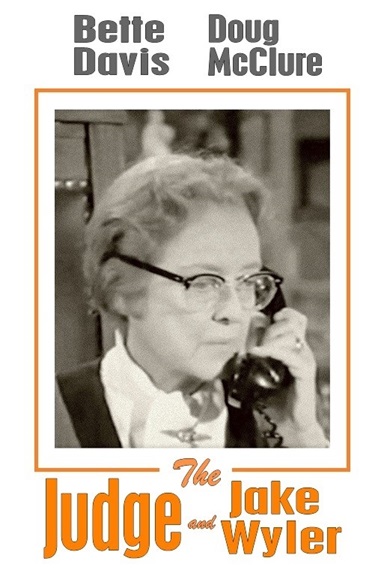
Judge Meredith (Bette Davis) is a retired criminal court judge who has developed a severe case of hypochondria.  She lives in a mansion that she never leaves.  Anyone who comes to see her must be personally vacuumed by her butler before they can be allowed to stand in her presence.  She hates people who take too long to get to the point and she also has little use for people who are rude on the phone.  She especially dislikes cigarettes and refuses to have even an unlit one in her presence.

Jake Wyler (Doug McClure) is an ex-con who is currently on supervised probation.  Despite his criminal past, he’s a likable and amiable guy and, every morning, he wakes up with a new woman in his bed.  Jake enjoys tweaking authority and he always has a pack of cigarettes on him somewhere.

Together, they solve crimes!

They actually do!  The judge is dealing with retirement by running her own detective agency, one that is exclusively staffed by people that she previously sentenced to prison.  Jake does most of the leg work as far as the agency is concerned.  The Judge calls him every morning and demands to know why he’s not working harder.  Jake would rather just sleep-in but working for the judge is a part of his parole.  She could easily send him and everyone else working for her back to prison.  This sounds like a pretty unfair situation to me and the Judge is so demanding that I think it could be argued that she’s an abusive boss.  But, because this is a pilot for a TV show and the Judge is played by Bette Davis, everyone is very loyal to her.

At the start of the film, Jake reveals to Robert Dodd (Kent Smith) that his wife, Caroline (Lisabeth Hush), has been cheating on him with Frank Morrison (Gary Conway).  When Robert is later found dead in a hospital room, the official verdict is that he committed suicide.  However, his daughter, Alicia (Joan Van Ark), claims that her father was murdered.  At first, both Jake and the Judge suspect that Alicia just wants to collect a bigger life insurance settlement but it turns out that Dodd’s beneficiary wasn’t even Alicia.  The money is going to his second wife, the one who was cheating on him.  While the Judge yells at people on the phone, Jake investigates the death of Robert Dodd.

The Judge and Jake Wyler is a mix of comedy and mystery.  Jake has a way with a quip and the majority of the suspects, including John Randolph and Eric Braeden, all have their own eccentricities.  Director David Lowell Rich does a good job of keeping the action moving and the mystery itself is actually pretty interesting.  Surprisingly, the show’s only real flaw is Bette Davis, who seems to be rather bored in the role of Judge Meredith.  Even though the character seems to have been specifically written for her trademark caustic line delivery, Davis delivers her lines with little enthusiasm.  One gets the feeling that she wasn’t particularly happy about the idea of having to do a television pilot.

Davis need not have worried.  The Judge and Jake Wyler did not turn into a series.  That said, the movie is an entertaining and diverting murder mystery.