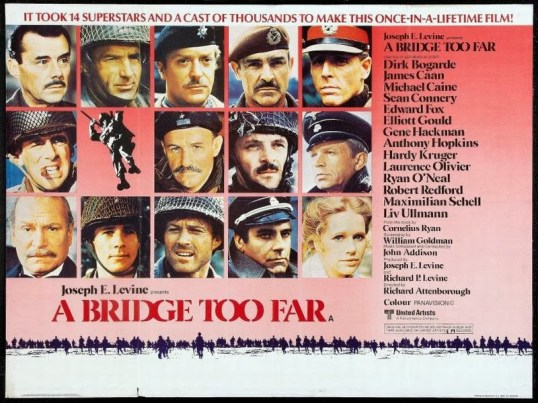
“Well, as you know, I always felt we tried to go a bridge too far” — Lt. Gen. Frederick Browning
With the recent passing of Sir Richard Attenborough I decided to bring up one of the films which first brought his name to my attention. I was quite the young lad when I first saw Attenborough’s epic war film A Bridge Too Far. I would say that it was one of my earlier memories of watching a film with my father who was a major fan of war films. One could say that I got my appreciation and love for the genre from him.
A Bridge Too Far was adapted from the Cornelius Ryan book of the same name which depicted from start to finish the disastrous World War II battle known as Operation Market Garden. The film states that the Allied landings at Normandy, France in the summer of 1944 had the German forces reeling and on the verge of collapse. With Eisenhower having to choose between competing plans to chase Hitler’s forces right into Berlin from his two best generals in George S. Patton and Bernard Montgomery, the film already lays down something that’s become synonymous with military disasters throughout history. Political expediency and pressure on Eisenhower led to an operation that was never attempted in military history and one which required every aspect of the operation to go according to plan for it to work. As the film would show this was not meant to be.
The film begins with the operation’s early days as Allied commanders rush to put Montgomery’s plan to drop 35,000 paratroopers behind German lines in occupied-Netherlands in order to capture and hold key bridges until Allied armored forces arrived to reinforce them. It’s a daring plan that the Attenborough films with a obvious confidence and enthusiasm, but also one that already showed some nagging doubts from field commanders who would be in the thick of the fighting if intelligence reports were inaccurate. One could almost say that Attenborough was making the film a sort of anti-war message which was a rarity when it came to Hollywood and and film industry depicting the events of World War II at the time.
While the film does explore that very anti-war theme throughout it’s really a by-product of how the battle itself unfolds and shown to the viewers that might give one such an idea. Yet, in the end A Bridge Too Far was a much more complicated film to just be labeled as an anti-war film. Yes, the battle itself was a disaster for the Allied forces of American, British and Polish soldiers involved, but despite the political bumbling and military arrogance of those who command from behind a desk, the film actually does a great job of showing that bond soldiers earn when confronted with the horrors of battle.
Attenborough and producer Joseph E. Levine pulls together an all-star cast for the film with names such as Sean Connery, Edward Fox, Robert Redford, Michael Caine and Laurence Olivier just to name a few. Films such as A Bridge Too Far rarely get made anymore in this day and age. The cast itself is part of the reason why the film still holds up to scrutiny decades after it’s release. While all-star casts such as this seemed to have been common place before the 1980’s it still looked like a daunting task for Attenborough to manage so many Hollywood stars and veteran British actors. Every character from Hopkin’s Col. Frost, Connery’s Gen. Urquhart and Redford’s Maj. Cook get to shine in their sections of the film as their individual stories about the battle all tie-in together to show just how complicated the events that they were filming truly turned out to be.
At times, one almost could feel overwhelmed by the amount of recognizable names and faces that come across the screen, yet Attenborough and producer Levine were able to juggle not just the logistics of the film’s screenplay, but the egos and reputation of the very stars who would become the backbone of the film.I think in a lesser filmmaker A Bridge Too Far could easily have turned into the very Operation Market Garden it was trying to depict.
It’s a film that never celebrates the concept of war itself, but actually shows that war remains a bloody and chaotic affair that relies not just on planning and execution but on the whims of lady luck. While Attenborough’s film never reached the sort of iconic status that another Cornelius Ryan adapted film has attained in The Longest Day, it does remain the more powerful of the two as it doesn’t just explore the historical event as a sort of academic exercise, but as an exploration of that old military adage of “No plan survives contact with the enemy”.
So, in the end I recommend that those looking to watch and experience the earlier directorial works of Sir Richard Attenborough should check out A Bridge Too Far. It remains to this day one of his more underappreciated films especially when compared to his later more acclaimed films like Gandhi, Chaplin and Shadowlands.

 Through the Shattered Lens