Lisa Marie Reviews An Oscar Nominee: Nebraska (dir by Alexander Payne)


As Brad mentioned earlier, today is Bruce Dern’s birthday!

Bruce Dern is a favorite actor of mine.  He’s one of those performers who, over the course of his very long career, has appeared in all sorts of different and occasionally odd films, sometimes as a lead but most often as a character actor.  He appeared in biker films, westerns, literary adaptations, and Oscar-winners.  He killed John Wayne in The Cowboys.  He introduced Peter Fonda to acid in The Trip (Dern, for his part, has said that he the only person on the set of that film who has never done acid.)  He captured the trauma of Vietnam in Coming Home.  He played one of the great hyperactive cops in The Driver.  He came close to playing Tom Hagen in The Godfather and was the original choice for the attorney who was eventually played by Jack Nicholson in Easy Rider.

In 2013’s Nebraska, he broke my heart.

In Nebraska, Dern plays Woody Grant, an elderly man who is convinced that he’s won a million-dollar sweepstakes.  Everyone around him, including his wife (June Squibb) and his oldest son (Bob Odenkirk), realizes that the sweepstakes is a scam and that Woody has actually won nothing.  But Woody is convinced that a million dollars is waiting for him.  All he has to do is somehow make it from Montana to Nebraska.  At first, Woody attempts to walk along the interstate.  When that doesn’t work and the police end up arresting him and sending him home, his youngest son, David (Will Forte), agrees to drive Woody down to Lincoln, Nebraska.  David knows that there’s not any money waiting for Woody but, unlike his mother and his older brother, David hasn’t given up on the idea of connecting with his father.

Nebraska is a road movie, with the majority of the film following David and Woody as the drive through rural and smalltown America.  They stop off in Woody’s former hometown, where they meet Woody’s brother (Rance Howard) and also Woody’s former business partner, a bully named Ed (Stacy Keach).  Ed is convinced that Woody stole money from him.  Woody blames Ed for the loss of his air compressor.  Their anger has simmered for years and, at first, it’s tempting to assume that it’s simply one of those grudge matches that old men seem to have a weakness for.  But Ed turns out to truly be a rotten human being and Woody …. well, Woody his own problems but at least he’s not as bad as Ed.

Before I say anything else, I want to praise the entire cast.  June Squibb, Bob Odernkirk, Stacy Keach, Rance Howard, Melinda Simonsen (who has a small role as a receptionist in Lincoln), they all bring their characters to memorable life.  Will Forte is the heart of the film, trying to keep his family together and standing up for his father when it matters.  If you only know Will Forte as MacGruber, you need to see Nebraska.  That said, this film is dominated by Bruce Dern’s poignant, sad, and often very funny performance as Woody Grant.  Woody is a flawed character and Dern wisely doesn’t try to sentimentalize or downplay any of those flaws.  He drinks too much, he neglected his family when he was younger, he holds a grudge, and he’s incredibly stubborn.  But, as played by Dern, you just can’t help but like Woody and hope that he finds some sort of happiness.  Even though the viewer, like everyone else in Woody’s life, knows that the sweepstakes is a scam, it’s still hard not to spend the film hoping that Woody will prove everyone wrong when he makes it to Nebraska.

Nebraska was nominated for Best Picture while both Bruce Dern and June Squibb picked up acting nominations.  That year, the Best Picture race was dominated by 12 Years A Slave.  Matthew McConaughey won Best Actor for Dallas Buyers Club while Lupita Nyong’o won Best Supporting Actress for 12 Years A Slave.  Alexander Payne lost Best Director to Gravity’s Alfonso Cuaron.  Gravity also won the Oscar for Best Cinematography, defeating Nebraska’s gorgeous black-and-white imagery.

Oscars or not, Nebraska is a wonderful, late career showcase for the great Bruce Dern.

Film Review: KIMI (dir by Steven Soderbergh)


KIMI, the latest addition to Steven Soderbergh’s interesting but frustratingly inconsistent filmography, stars Zoe Kravitz as Angela Childs.  Angela is an agoraphobic tech worker who is living in Seattle during the COVID pandemic.  A sexual assault survivor, Angela spends her days and nights safely locked away in her apartment.  She works from home.  She always keeps her mask some place near.  Occasionally, she’ll have a video session with her therapist.  Her mom calls and scolds her for not going outside.  She exchanges texts and occasionally more with Terry Hughes (Byron Bowers), an attorney who lives across the street.

And, she’s watched by Kevin (Devin Ratray).  Kevin also lives across the street and, throughout the film, he’s occasionally seen watching her from his top floor apartment.  It’s creepy but it’s not surprising.  KIMI is a film in which everyone is being watched by someone else.  Sometimes, they realize it and often they don’t.  Welcome to the Surveillance State, where privacy is the ultimate illusion.

Angela works for the Amygdala Corporation.  Under the leadership of CEO Bradley Hasling (Derek DelGuado), Amygdala has created KIMI, the virtual assistant that is superior to Alexa because all of KIMI’s errors are corrected not by a pre-programmed algorithm but instead by human workers who are constantly listening to KIMI’s data stream and correcting errors.  Angela is one of those engineers.  Usually, her job consists of programming KIMIs to play individual Taylor Swift songs as opposed to building Taylor Swift playlists.  When one owner calls KIMI a peckerwood, Angela programs the KIMI to understand that peckerwood is an “insult; vulgar.”  However, one data stream contains the sounds of what Angela believes to be a sexual assault and a subsequent murder.

Uniquely, for a film like this, Angela’s struggle is not to get people to believe that she heard what she heard.  Instead, her struggle is to get the evidence to the people who need to hear it for themselves.  Angela is terrified of leaving her apartment and, once she finally does, the outside world confirms all of her fears.  KIMI is a film about paranoia, a portrait of a world where everyone can be tracked and no one — from Angela’s too-helpful boss (Rita Wilson) to the man who casually walks by with an umbrella — can be trusted.

As I’ve said in the past, Steven Soderbergh has always been hit and miss for me.  It’s remarkable how many Soderbergh films that I love but it’s equally remarkable just how many Soderbergh films I absolutely loathe.  At his best, he can be a clever stylist and, at his worst, he can be painfully pretentious.  And yet, regardless of anything else, you do have to respect Soderbergh’s willingness to experiment with different genres and styles.  Soderbergh never stops working, despite the fact that he announced his retirement years ago.  Despite getting off to a slow start, KIMI is one of Soderbergh’s more entertaining thrillers, one that does a great job creating an atmosphere of paranoia and one that is also blessed with excellent performances from Zoe Kravitz and Rita Wilson, who makes good use of her limited screen time.  KIMI is a well-made Hitchcockian thriller and, along with No Sudden Move, it’s a return to form for Soderbergh after the two terrible movies that he made with Meryl Streep, The Laundromat and Let Them All Talk.  Yes, Soderbergh can be inconsistent but when he’s good …. he’s very, very good.  (Sometimes, he’s even brilliant.)  Narratively, KIMI may be a relatively simple film by Soderbergh standards but it’s undeniably effective.

Along with being a portrait of our paranoid age, KIMI is very much a pandemic thriller.  Angela mentions that her relationship with Terry started during the lockdowns, a time when no one found it strange that someone would be unwilling to leave their apartment.  When Angela does finally step out of her apartment, she is, of course, fully masked up and her paranoia about being followed severs as a metaphor for the paranoia that many people felt (and continue to feel) during the pandemic.  KIMI is not the first pandemic thriller and it certainly won’t be the last.  Still, what’s interesting to me that the pandemic subtext will probably be more noticeable to those who lived in states with mask mandates and aggressively regulated lockdowns than it will be for those of us who live in states that never had mandates and which, for lack of a better term, re-opened last year.  Half the people viewing KIMI will nod in recognition as Angela grabs her mask before walking up to her front door and as she quickly dashes down the street, careful not get too close to anyone else.  The other half will feel as if they’re watching some sort of dystopian science fiction film.  It all depends on where you’ve lived for the past two years.

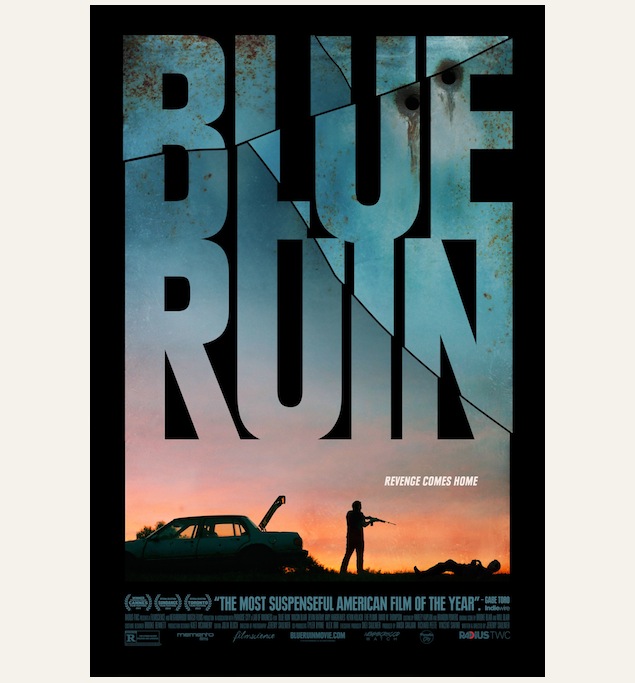
Embracing the Melodrama #60: Blue Ruin (dir by Jeremy Saulnier)


Blue Ruin

Well, all good things must come to an end and here it is.  This is the final entry in a little series that I like to call Embracing the Melodrama.  For the past two weeks, I’ve been reviewing, in chronological order, 60 of the most and least memorable melodramas ever filmed.  We’ve looked at everything from films that were nominated for (and occasionally won) Oscars to films that played in a few grindhouses and drive-ins before disappearing into obscurity.  We’ve reviewed big budget spectaculars and movies that were apparently filmed for less money than I typically spend during a weekend shopping spree.  I hope that you’ve enjoyed reading these reviews as much as I’ve enjoyed writing them.  If I’ve introduced you to a film you previously did not know or if I’ve inspired you to track down and watch an old classic, then I’ve accomplished what I set out to do and I’m happy.  We started this series by looking at a film from 1916 and now, we end it with a movie that was released into theaters just a few months ago.

That film is Blue Ruin and, if you haven’t seen it yet, you really should.

Now, I want to be careful just how much I tell you about Blue Ruin‘s story because, much like the thematically similar Cold In July, Blue Ruin may start out like a standard thriller but it soon moves in unexpected and surprising directions.  It’s not so much that the film’s plot is unpredictable (in fact, one of the film’s strengths is that the story told is essentially a simple one) as much as it’s the fact that the film adds an element of ambiguity to that plot that forces you to reconsider all of your preconceived notions.  Blue Ruin is a revenge film for people who like to think.

Blue Ruin opens with the bearded and clearly unstable Dwight (Macon Blair) going through trash cans and dumpsters in search of food.  Dwight lives in his filthy car and it quickly becomes obvious that, despite Dwight’s disheveled appearance, he’s not really much of a threat to anyone.  Instead, he simply wants to be left alone.  However, one day, Dwight is approached by a friendly police officer who tells him that a man named Wade Cleland has been replaced from prison.  The suddenly motivated Dwight responds by driving his car to the prison and watching as Wade is released.  Dwight than manages to get a knife (after first trying to steal a gun and failing so completely that you can’t help but feel sorry for him) and goes to the small country bar where Wade and his family are celebrating his freedom.  Dwight manages to get into the club and, after a brutal fight, fatally stabs Wade in the temple.

Macon Blair in Blue Ruin

Macon Blair in Blue Ruin

The rest of the film deals with both the reasons behind and the consequences of Dwight’s actions and it would not be right for me to spoil the film any more than I already have.  Let’s just say that neither Dwight nor the Clelands turn out to be quite who we believed them to be.  The crimes of the past aren’t quite as clear-cut as either Dwight or the Clelands initially assumed.  All that is clear is that now that Dwight has taken his revenge, the Clelands now feel the need to take their own revenge.  It’s an endless cycle that’s made all the more complicated by the fact that neither Dwight nor the Clelands are as good at this whole revenge thing as they think.

Chances are that you’ve never heard of Macon Blair.  I hadn’t heard of him until I saw him in this movie.  But, obscure or not, that doesn’t change the fact that, in the role of Dwight, Macon Blair gives one of the best performances of the year so far.  He turns Dwight into a sort of mentally unstable everyman and, as a result, Dwight is a truly memorable and unexpectedly poignant lead character.

It’s interesting that 2014 has seen the release of several films that feature unlikely and morally ambiguous protagonists dealing with violence, revenge, and secrets in the South.  Blue Ruin joins Cold In July and Joe as one of the best films of 2014.  And it also provides a high note for which to close out Embracing the Melodrama.

Blue Ruin 2