Horror Film Review: The Tomb of Ligeia (dir by Roger Corman)


Did Roger Corman have an issue with cats?

That’s the question I asked myself as I watched 1964’s The Tomb of Ligeia.  Loosely based on a short story by Edgar Allan Poe, The Tomb of Ligeia tells the story of Verden Fell (Vincent Price).  Fell’s wife, Ligeia, has recently died but Fell worries that her spirit is still haunting and watching him.  One gets the feeling that Fell hated his late wife but, at the same time, was obsessed with her.  Fell has an eye condition which causes him to wear dark glasses on the rare occassions that he leaves his manor.  He’s definitely a creepy guy but that doesn’t stop Rowena (Elizabeth Shepherd) from falling in love with him and leaving her fiancé, Christopher Gough (John Westbrook), to marry him.  Unfortunately, Rowena is soon feeling the spirt of Ligeia as well, in the form of a black cat who keeps attacking Rowena.

Now, in all honesty, I doubt that Roger Corman specifically had an issue with cats.  It’s possible the Edgar Allan Poe had an issue with cats, as he lived at a time when cats were rarely kept as pets and were instead just used to catch and kill mice and rats.  (And, in fairness to the 19th century, that was a very important job in those days of bad hygiene and outhouses.)  There’s no cats to be found in Poe’s short story about Ligeia but there was one very prominently featured in The Black Cat.  As Ligeia was not exactly one of Poe’s most detailed stories, it’s probable that Corman and screenwriter Robert Towne just included the evil black cat because that story was one of Poe’s best-known.

That said, for me, it was difficult to watch an entire movie about people hating and attempting to destroy a cat.  It’s certainly not the cat’s fault that it’s been possessed by the spirit of Ligeia.  As I watched the film, it occurred to me that cats may not have been as popular in the 1960s as they are today.  I mean, there was no internet when this film was made and, as a result, people weren’t constantly being bombarded by cute cat pictures.  Instead, people probably just knew cats for their habit of hissing at people and scratching their owners.  Today, we find that behavior to be cute.  Perhaps back in 1964, people felt differently.

If I seem to be rambling on about the cat, that’s because there’s not really a lot to be said about The Tomb of Ligeia.  It was the last of Corman’s Poe films and neither Corman nor Price seem to be particularly invested in the material.  Price is actually rather miscast as Verden Fell.  Fell is meant to be a mysterious aristocrat, in the spirit of Maxim de Winter from Rebecca.  But Vincent Price is …. well, he’s Vincent Price.  Vincent Price was a wonderful actor and personality but he wasn’t particularly enigmatic.  From the first minute we see Price, we know that he’s being haunted by his dead wife because he’s Vincent Price and the same thing happened to him in several other films.

The Tomb of Ligeia is full of the ornate sets and beautiful costumes that were featured in all of Corman’s Poe films.  And even a miscast Vincent Price is still fun to watch.  But, when compared to the other films in the Poe Cycle, this one falls flat.

The TSL’s Horror Grindhouse: Rasputin, The Mad Monk (dir by Don Sharp)


In turn of the century Russia, there lived a man named Grigori Rasputin.

He was a monk, though some considered him to be more a servant of the devil than of God.  Legend has it that he was a man who rarely bathed and who made it a point to live in the wild, a part of nature.  His hair was long and unkempt and he was known for his wild eyes.  Depending on who is telling the story, Rasputin’s stare is described as either being seductive or frightening.  Rasputin had a reputation for being a great healer, as well as a great seducer.  (It is said that Rasputin offered up as his defense that it was necessary to sin so that he could be forgiven by God.)

Despite being a controversial figure (and, in the eyes of same, an instrument of the devil), the charismatic Rasputin became well-known in Russian social circles.  In fact, the stories of his powers as a healer eventually reached the household the Tsar.  The Tsar’s son suffered from hemophilia and was frequently ill.  Rasputin was brought into the royal palace to cure him and, according to contemporary accounts, he was somehow able to do just that.  It was said that only Rasputin could stop the boy’s bleeding.

It was also said that Rasputin grow to have a good deal of influence over the Tsarina.  In fact, he was seen as having so much influence that certain members of the royal court started to view him as being a threat to their own power.  On December 30th, 1916, Rasputin was murdered.  There are many stories about how Rasputin was murdered but it’s generally agreed that the conspirators first tried to poison him, just to discover that Rasputin was apparently immune to cyanide!  Eventually, Rasputin was shot twice and then dumped in the Malaya Nevka River.  Stories about how difficult it had been to kill Rasputin only added to his legend.

After his death (and the subsequent communist revolution that led to the murders of the Tsar and his family), Rasputin became a legendary figure.  Because of his connection to the occult, it’s perhaps not surprising that he’s also been the subject of a number of biopics.  Everyone from Klaus Kinski to Lionel Barrymore to Alan Rickman has played the mad monk.  (Apparently, Leonardo DiCaprio has been attached to an up coming film about Rasputin.)

And then there’s Christopher Lee.  Christopher Lee played Rasputin in the 1966 Hammer Film, Rasputin, The Mad Monk.  It’s probably one of Lee’s best performances, as well as one of his most lively.  Lee plays Rasputin as being a cunning charlatan, one who may act like a madman but who always know exactly what he’s doing.  The film makes perfect use of Lee’s imposing physical presence and, when Rasputin uses his powers of hypnotism, Lee stares with such intensity that you never doubt that he’s a man who knows how to get exactly what he wants.  Lee makes you believe that, through sheer willpower, Grigori Rasputin very well could have become one of the most important men in Russia.

As for the film itself, it’s a briskly paced retelling of Rasputin’s final years, hitting all of the expected points without ever digging too far beneath the surface.  Rasputin cures the sick and seduces their mothers, wives, and sisters and uses his powers of hypnotism to hold most of St. Petersburg under his control.  Many of the usual Hammer performers (including Barbara Shelley, as the Tsarina’s servant and Joss Ackland as a bishop) make an appearance and the fact that no one makes the least bit of effort to sound Russian just adds to the film’s charm.  It’s an entertaining look at a fascinating historical story and, most importantly, it features Christopher Lee at his chilling best.

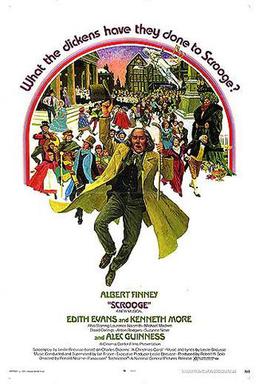
A Christmas Film Review: Scrooge (dir by Ronald Neame)


There have been many good film versions of the Charles Dickens novella, A Christmas Carol.  Several of them could even be called classics.  Everyone from Bill Murray to James Earl Jones to Tori Spelling to Fredric March has taken a turn at playing a version of the famous miser who, after being visited by three ghosts on Christmas Eve, changes his ways and becomes the most generous man in London.  This holiday season, I watched quite a few old TV shows and I was somewhat surprised to discover just how many sitcoms have featured an episode where one of the characters has A Christmas Carol-like experience.

Though actually, I shouldn’t have been surprised.  A Christmas Carol is a universal tale and it’s one that continues to be appealing 174 years after it was originally written.  You don’t have to be rich, British, greedy, or even a man to relate to what Ebenezer Scrooge goes through.  We’ve all be haunted by the past.  We’ve all wondered what we’re missing out on in the present.  And we all fear how we’ll be remembered in the future.  In fact, I would say that A Christmas Carol is probably as close to perfect you can get.  The only problem is that Bob Cratchit’s son is named Tiny Tim and any work of fiction that features a character named Tiny has to be docked a few points.

With all that said, my favorite film version of A Christmas Carol is the 1970 musical, Scrooge.

http://www.youtube.com/watch?v=g7xb1uSDxZ4

Scrooge sticks to the original details of the story.  Ebenezer Scrooge is played by Albert Finney.  (Finney was only 34 when he made Scrooge but was made up so that he looked closer to 120.)  The men, women, and spirits in Scrooge’s life are all played by a collection of distinguished British thespians.  Edith Evans is the stately Ghost of Christmas Past.  Kenneth More is the Ghost of Christmas Present, a decadent figure who drinks wine and travels around with two frightening-looking children.  Alec Guinness is a heavily chained Jacob Marley and he plays the role with just the right combination of sarcasm and concern.  (“No one else wanted to come,” Marley says when he greets Scrooge at the entrance of Hell.)  An actor named Paddy Stone is credited as playing the silent and shrouded Ghost of Christmas Future.  Let me just say that the Ghost of Christmas Future always scares me to death whenever I watch Scrooge.  I imagine little children in the 70s were traumatized by his skeletal visage.

What sets Scrooge apart is that it has singing and dancing!  That’s right, this is a musical version of A Christmas Carol, featuring songs composed by Leslie Bricusse.  Now, the overall quality of the songs is open to debate.  There’s 11 of them and really, only three of the songs are particularly memorable.  (Those songs are: I Like Life, I Hate People, and the Oscar-nominated Thank You Very Much.)  But, honestly, who cares?  The cast performs them with so much energy and enthusiasm that it’s impossible not to get swept up in it all.

(Admittedly, Albert Finney doesn’t really sing.  He just kinda growls the lyrics.  But that’s appropriate for the character of Scrooge.)

Scrooge is an outstanding production of a timeless tale.  It came on TV at least four different times this holiday season and I watched each time.  And I’ll do the same next year!

And as Tiny Tim, who did not die, said, “A Merry Christmas to all!  God Bless us, everyone!”

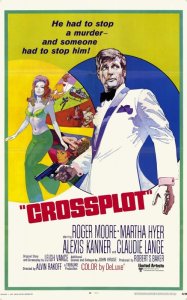
A Movie A Day #215: Crossplot (1969, directed by Alvin Rakoff)


In swinging London, Roger Moore is ordered by Bernard Lee to track down a model  who is connected to an international conspiracy.

If you think that sounds like a James Bond movie, you’re close.  In Crossplot, which was released four years before Roger Moore took over the role of 007 in Live and Let Die, Moore plays Gary Fenn and Bernard Lee is Mr. Chilmore.  Gary is a playboy and an advertising executive while Mr. Chilmore is his latest client.  Mr. Chilmore has ordered Gary to find a model who can serve as the new “Miss Swing,” but actually, the bad guys are using Gary to try track down a beautiful Hungarian named Marla Kugash (Claudie Lange).  Kugash, the ex-girlfriend of a radical political activist, has knowledge about a conspiracy to assassinate a visiting African president.  It leads to car chases, shoot outs, and a wedding that is ruined when Gary and Marla take refuge in a church.

Crossplot was an obvious attempt to cash in on the popularity of the James Bond films.  At the time that Crossplot came out, Moore was best known for playing The Saint on television.  Crossplot was the first film that Moore made after signing a three-movie contract with United Artists and, had the film been a success, Moore would have returned in the role of Gary Fenn and it is totally possible that he would not have been available to step into Sean Connery’s shoes when Connery announced that he was finished with the role of James Bond.

However, Crossplot was not a success and it is easy to see why.  The plot was overly convoluted and it’s emphasis on “swinging” London (complete with wacky hippies) probably made Crossplot seem dated before it was even released.  It is interesting today mostly as Moore’s “audition” for the role of Bond.  Moore gives a very Bondish performance, complete with arched eyebrows and one liners.  Moore is the best thing about the movie but it is also interesting to see Bernard Lee playing a character far less savory than M.  This was also one of the many 60s Bond rip-offs to feature the beautiful Claudie Lange.  Lange, who would have made a great Bond girl if she’d been given the opportunity, retired from acting in 1973, the same year that Moore appeared in Live and Let Die.