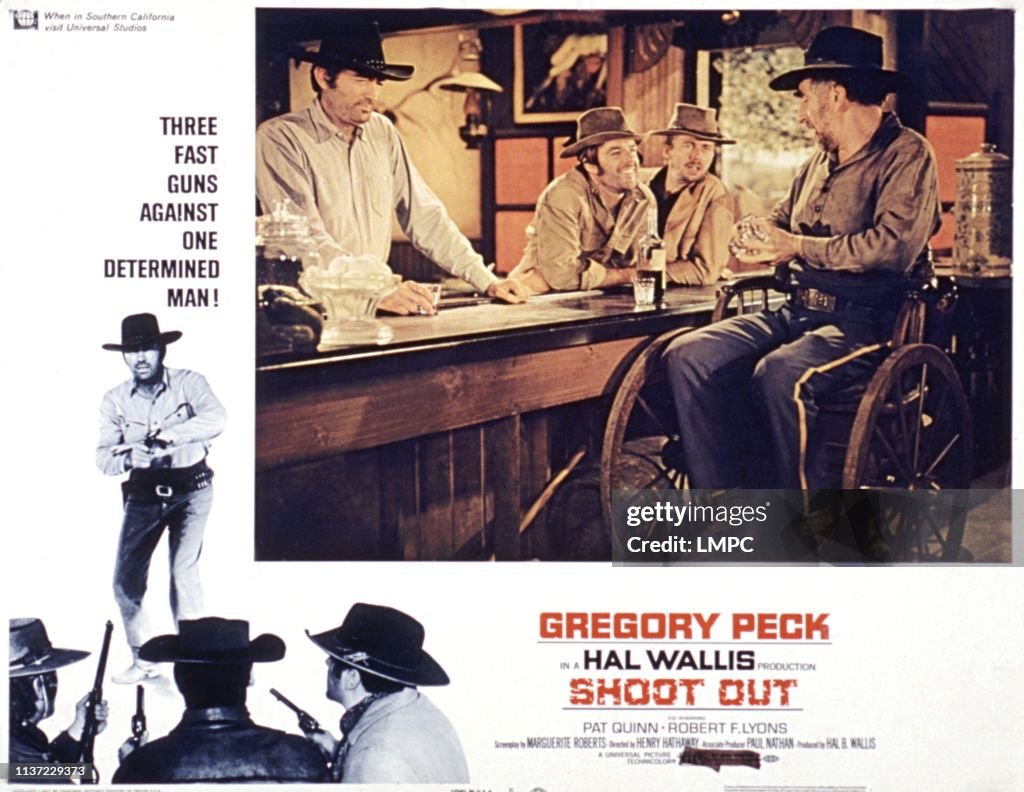
Brad reviews SHOOT OUT (1971), starring Gregory Peck & Robert F. Lyons! 


After serving a stretch at the Canon City penitentiary, Clay Lomax (Gregory Peck) gets out with only one thing on his mind… revenge on his former partner Sam Foley (James Gregory), who shot him in the back during a bank robbery, leaving him to take the rap. Foley isn’t a fool, though, so he’s hired a trio of young punks, Bobby Jay (Robert F. Lyons), Skeeter (John Davis Chandler), and Pepe (Pepe Serna) to surveil Lomax and let him know if he’s heading to his home in Gun Hill with payback on his mind. These guys are about as crazy as it gets, and they make two major mistakes. First, they kill Lomax’s friend Trooper (Jeff Corey) who lets him know where Foley is with his dying breath. Second, they kidnap the prostitute Alma (Susan Tyrell) just because they want to treat her like crap and have fun with her, which turns out to be a dumb move. Interrupting Lomax’s quest for revenge, he finds himself being forced to care for a young child named Decky (Dawn Lyn), who just may be his daughter with a lady back in Kansas City who used to be his “friend.” Looking after Decky, and then meeting and falling for the widow Juliana Farrell (Patricia Quinn), Lomax is soon facing off against his most dangerous foe, the crazed Bobby Joe, as he attempts to protect all these new people that he loves so he can move on with his life. But is it all too late?!!

I love westerns, but I must admit that I’m not the biggest fan of director Henry Hathaway’s SHOOT OUT. Hathaway has directed some of my favorite actors and movies, like Charles Bronson’s debut film with Gary Cooper, YOU’RE IN THE NAVY NOW (1951), along with the Jimmy Stewart film CALL NORTHSIDE 777 (1948) and John Wayne’s Oscar winning TRUE GRIT (1969). Unfortunately, it seems his best years are behind him, and he would only direct one more film after this, the less than excellent black action film HANGUP (1974). This isn’t exactly Gregory Peck’s best work either. Coming nine years after his Oscar winning performance in TO KILL A MOCKINGBIRD (1962), this is definitely not even close to that kind of level. Don’t get me wrong, I do enjoy his turn as Lomax when he’s the wronged outlaw looking for revenge, but I don’t really care at all for his part as the reluctant father figure trying to deal with the six-year-old Decky. I found Dawn Lyn to be more annoying than cute in the role, and this storyline distracted me from the revenge plot that I actually enjoyed. As a co-host of the “This Week in Charles Bronson Podcast,” we had the opportunity to interview Robert F. Lyons, who plays the bad guy, Bobby Jay Jones. I specifically asked him about this film and what it was like working with Gregory Peck. While he enjoyed working with Peck, his response about the film itself was telling…. “The work in there is not my work.” If you’ve watched much of the excellent actor’s work before, you can immediately understand what he means. Lyons goes so over-the-top as the spying outlaw Bobby Jay Jones, that his performance is inconsistent with the bulk of his career. Lyons told us that his performance was orchestrated by Hathaway in a way that he disagreed with, and he essentially disowns his work in the film. You can see a similar vibe with his “gang” that includes the actors John Davis Chandler and Pepe Serna. 

While I’m not a huge fan of the overall direction of the storyline or the focus of some of the main performances in SHOOT OUT, I am appreciative of the genre and the classic western stars that Hathaway cast in supporting roles. I especially enjoy seeing Jeff Corey in the small but pivotal role as the wheelchair bound Trooper, Paul Fix as the train brakeman who delivers Decky and a stack of cash to Lomax, and Arthur Hunnicutt as the ranch owner who barters with Lomax over the price of a pony. Hunnicutt is a particular favorite of mine although his role here is very small. Nominated for an Oscar for his performance in Howard Hawks’ THE BIG SKY (1952), Hunnicutt is from the small town of Gravelly, Arkansas, which is not far from where my own family is from. He even attended the same college that I graduated from, the University of Central Arkansas, which was known as the Arkansas State Teachers College when he (and my dad) went there. And then there is the setup of the revenge scenario at the beginning and the final showdown at the end, classic staples of the western genre. These are enjoyable and satisfying moments as Lomax settles his scores and the bad guys get their comeuppance.

Overall, SHOOT OUT is best enjoyed by fans of old school westerns and star Gregory Peck. It veers aways from the best storylines of the genre and wastes a lot of time with uninteresting melodrama, but it does offer us another chance to see some of our great character actors doing what they do. That means something to me. 

I’ve included our podcast episode with Robert F. Lyons below. He discusses SHOOT OUT at around the 1:00:30 mark.

The Daily Horror Grindhouse: The Devil Times Five (dir by Sean MacGregor and David Sheldon)


dt5

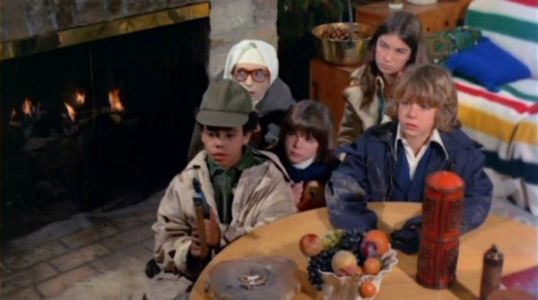
Initially released in 1974 and also known as Peopletoys, Tantrums, and The Horrible House on the Hill, Devil Times Five is one of a handful of films made about murderous children targeting and killing adults.  In the case of Devil Times Five, the children are five escapees from a mental hospital and the adults are a group of largely unlikable people who have gotten snowed in at a ski lodge.

(In a film like this, it helps that the victims are all too unlikable to really care about.)

When watching Devil Times Five, it helps to know a little something about what went on behind the scenes.  Apparently, original director Sean McGregor was fired when it turned out that, after several weeks of filming, he only had 38 minutes of usable footage.  Several weeks later, a second director, David Sheldon, was brought in to reshoot a good deal of the movie.  Unfortunately, by the time that Sheldon arrived, the majority of the cast had moved onto other projects and the main killer kid (Leif Garrett) had gotten his hair cut for another movie, meaning that he had to wear an ill-fitting wig for the reshoots.

And the end result is a truly weird movie, one that is full of odd continuity errors and strange scenes that were obviously only included to pad out the film’s running time.  Among the most obvious of the continuity errors is the insistence that the characters are snowed in despite the fact that there appears to be hardly any snow on the ground outside.  (This, of course, was largely due to the fact that the reshoots were done in sunny California.)  As for the padding, perhaps the most infamous example is the scene where the five children attack and beat to death their doctor.  This entire scene is shown in slow motion.  It lasts five minutes.

Seriously — and if you doubt me on this, be sure to read Stacie Ponder’s review of the film over on Final Girl — five minutes is a really long time.  It’s certainly a long time to watch someone get beat to death, especially when the scene is underlit and sepia-toned.  It starts out as disturbing but, after the 2nd minute or so, it just gets boring.  And then about 4 minutes in, you start to laugh because you’re just like, “How much longer can this crap go on?”  And then, at the 4:30 mark, you start to get bored again.  Around the 4:55 mark, I realized that I had forgotten who they were killing or why.  And then it was finally over.  Yay!

Incidentally, this is one of those films where, whenever one of the kids is going to kill someone, the kid suddenly starts moving in slow motion.  It was kind of like the music in Jaws.  If the kid picked up an axe but was still moving at normal speed, you knew not to worry.  But the minute that slow-mo started, you knew someone was about to die.

Of course, it takes a while to get around to the killings.  Devil Times Five clocked in at about 88 minutes.  I would guess that roughly 65 of those minutes were pure filler.  We spend a lot of time getting to know the adults at that ski lodge and, for the most part, they’re loathsome.  The oldest and grumpiest of them is even called Papa Doc, perhaps after the infamous Haitian dictator. (And let’s not even start on the film’s nominal hero, Rick, who has a pornstache, a comb over, and an extended nude scene.)  All of the adults spend a lot of time talking about their crumbling marriages and their dying dreams and it’s all very angsty for slasher film about a bunch of killer kids.  There’s even an extended cat fight between Julie (Joan McCall) and Lovely (Carolyn Staller), which involves a lot of rolling around on the floor while the 70s “wah wah” soundtrack plays in the background.

Once the killings do start, however, Devil Times Five actually starts to live up to its potential.  These are some mean little kids!  Once they start their rampage, we get axes in the back, spears to the throat, immolation, death by swing, and one really disturbing scene involving a bunch of bear traps. However, Devil Times Five is probably best known for the piranha scene.  You can legitimately wonder why someone would keep piranhas at a ski lodge but there’s still no denying that you don’t want to take a bath with them.

(Making the piranha scene all the more icky that the victim in the bathtub is played by the mother of two of the actors who played the killers.)

Devil Times Five makes for a strange viewing experience.  It starts out as nothing but filler and then suddenly, almost out of nowhere, the entire film goes batshit crazy.  Devil Times Five has slipped into the public domain, so you can watch it for free on YouTube if you want.  But I suggest tracking down the Code Red DVD, which comes with a fascinating commentary track and an entertaining and candid interview with several members of the cast.

DevilTimesFive3

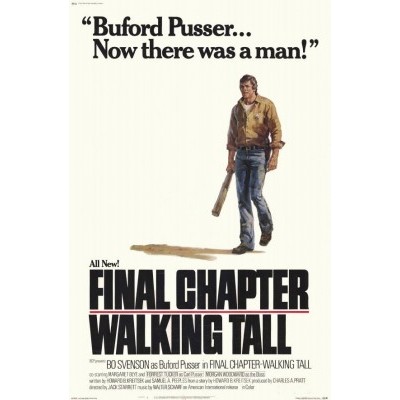
Embracing the Melodrama Part II #56: Walking Tall: Final Chapter (dir by Jack Starrett)


sq_final_chapter_walking_tallFor one last time, Buford Pusser is back!  The 1977 film Walking Tall: Final Chapter ends the story that was begun in Walking Tall and continued in Walking Tall Part II.  And it turns out that the final chapter is pretty much just like the previous two chapters.  In fact, I’m tempted to just tell you go reread my review of Walking Tall Part II because that review works just as well for most of the Final Chapter.

Final Chapter starts with footage from the first Walking Tall, with Bo Svenson awkwardly inserted in place of Joe Don Baker.  Once again, we watch as Elizabeth Hartman is shot in the back of the head and Svenson — in the role of Buford Pusser — is shot in the face.  Oh my God, we think, how many times can the exact same thing happen to the exact same character!?

Oh wait — it turns out that Buford is just remembering the death of his wife.  Buford is still haunted by that day and he’s still out for vengeance.  For the next hour or so, we follow Buford as he and his deputies blow up moonshiners across Tennessee.  After each arrest, an attorney shows up and yells at Buford for violating everyone’s civil rights.  In response, Buford smirks until the attorney gets so mad that he decides to run for sheriff himself.

Buford doesn’t give his opponent much of a chance.  As one of his deputies puts it, this guy is just a “bleeding heart liberal.”  (But if he’s so liberal, what’s he doing in Tennessee?  Off with you, sir — return to Vermont!)  Instead of campaigning, Buford spends his time hunting down more moonshiners.  When he discovers that one moonshiner is also an abusive father, he personally drives the man’s son down to the local orphanage.  Oddly enough, Buford does not offer to adopt the kid himself.

Anyway, to the shock of everyone, Buford is not reelected.  No longer sheriff, he struggles to find a full-time job and makes plans to run in the next election.  One of the moonshiners shows up and taunts Buford until Buford is forced to beat him up in the middle of the street.  The new sheriff show up and demands to know what happened.  None of the townspeople are willing to snitch on Buford.  Good for them!

After about an hour and a half of this, something interesting actually happens.  A film producer drives up to the Pusser Farm and tells Buford that he wants to make a movie out of his life.  “We’re going to tell the story exactly how it happened!” the producer assures him.  In the next scene, Buford is advising the director of Walking Tall on how to properly film a car chase.

And you know what?  These scenes of Buford watching his life story be filmed are actually rather charming.  For the only time in the series, Bo Svenson actually appears to be having fun in these scenes.  And, when Buford runs from a theater while watching the recreation of his wife’s murder, it’s actually a very effective moment.

Anyway, there’s not much running time left after all of that.  We see Buford sign a contract to play himself in the sequel and, by this point, we all know what happened afterward.  Buford was killed in a mysterious car accident.  But fear not!  The film opens with a heavenly choir and Svenson’s voice booming from the heavens so we all know that Buford Pusser is arresting moonshiners in Heaven.

And good for him!

Peace be with you, Buford Pusser.