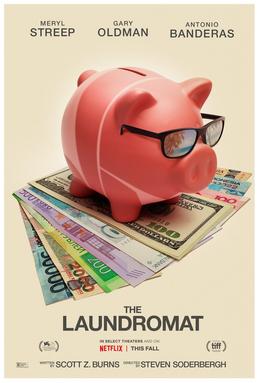
To say that Meryl Streep gives a bad performance in The Laundromat actually does a disservice to your average, run-of-the-mill bad performance.
Meryl Streep instead gives an absolutely terrible performance in The Laundromat, playing not one, not two, but three characters. One of the characters is Ellen Martin, a middle-class widow from Michigan whose attempts to collect a fair settlement after the death of her husband provides a portal in the world of shady con men and corrupt financial institutions. One of the characters is a secret, which means that Meryl wears a lot of make-up and frumpy clothes. That said, from the minute the character appeared on screen, I went, “Oh, there’s Meryl again.” Then, in her third role, Meryl plays herself, demanding campaign finance reform and striking a Statue of Liberty pose while holding a hairbrush instead of a torch.
Really, it’s the type of horrendous performance that could only be delivered by a truly great actress. (If Meryl Streep is the modern Norma Shearer, this is her Romeo and Juliet.) Watching Meryl Streep play the role of Ellen, It occurred to me that Meryl is one of those actresses who is incapable of being authentic but who can certainly act the Hell out of pretending to be authentic. You never forget that Meryl Streep is acting and that’s one reason why her best performances are usually the ones where she’s playing theatrical characters, whether they’re politicians like Margaret Thatcher, celebrities like Julia Child, or the Witch in Into the Woods. But when you cast Meryl as someone who is basically supposed to be a member of the “common people,” it just doesn’t work. Laura Dern, Laurie Metcalf, Allison Janney, even Annette Bening probably could have done a decent job playing Ellen Martin but Meryl is just too Meryl. As for her other two performances in The Laundromat, they don’t work because one is meant to be a joke on the audience and the other is just a retread of her standard “I’m just a middle class woman from New Jersey and I love the little people” awards show speech.
Of course, The Laundromat itself is a remarkably bad film. Again, it takes a lot of talent to make a film this bad. Watching the film, I found myself wondering why, at this point in his celebrated career, Steven Soderbergh would decide to become a second-rate Adam McKay, especially when McKay himself is just a third-rate Jean-Luc Godard? The film is structured so that, while Ellen is obsessing on why she’s getting screwed over by the insurance companies, we’re also treated to scenes of Gary Oldman and Antonio Banderas talking directly to the camera and explaining to use why the poor are always going to get screwed over by the rich. That’s probably true but the film gets so heavy-handed in its execution that the resulting migraine is going to be due less to outrage and more due to the sledgehammer that Soderbergh takes to your head.
Along with Ellen’s story, we also get to see several other stories featuring people and their money. Jeffrey Wright is a crooked accountant who has two families. And then there’s an African businessman who bribes his wife and daughter with shares in a non-existent company and then we take a trip to China, where we learn about cyanide and organ harvesting. And yes, I get it. It shows how a crime committed in China is ultimately felt by a widow living in Michigan. But one can’t help but wish that Soderbergh had just focuses on one story, instead of trying to imitate the worst moments of The Big Short.
Gary Oldman and Antonio Banderas are technically playing the film’s villains but they’re both so charming that The Laundromat at times seems like more of a recruiting film for aspiring money launderers than anything else. (To continue the Adam McKay comparison, it’s a bit like how Vice actually left audiences feeling sympathy for Dick Cheney as opposed to writing petitions to send to The Hague.) It desperately wants to leave us outraged but Soderbegh gets so caught up in his own cutesy storytelling techniques that it just leaves us feeling somewhat annoyed. Watching the film, one gets the feeling that the perfect directors for The Laundromat would have been the Coen Brothers, who are capable of outrage but whose detached style would have kept them from bludgeoning the audience with it. Soderbergh is too angry to be effective.
As I said, there’s a lot of talented people involved in The Laundromat. It’s full of people who have done great work in the past and who will do great work in the future. As for The Laundromat, it’s a legitimate contender for the biggest disappointment of the year.
 Will Randall (Jack Nicholson), the editor-in-chief of a New York Publishing house, doesn’t get much respect, not from his wife (Kate Nelligan), not from his boss (Christopher Plummer), and certainly not from Stuart Swinton (James Spader), the sleazy executive who is plotting to steal his job and destroy his marriage. But then, one night, Will runs over a black wolf on a country road. When he tries to helps it, the wolf bites him. Soon after, Will starts to feel different whenever the moon is full.
 Through the Shattered Lens