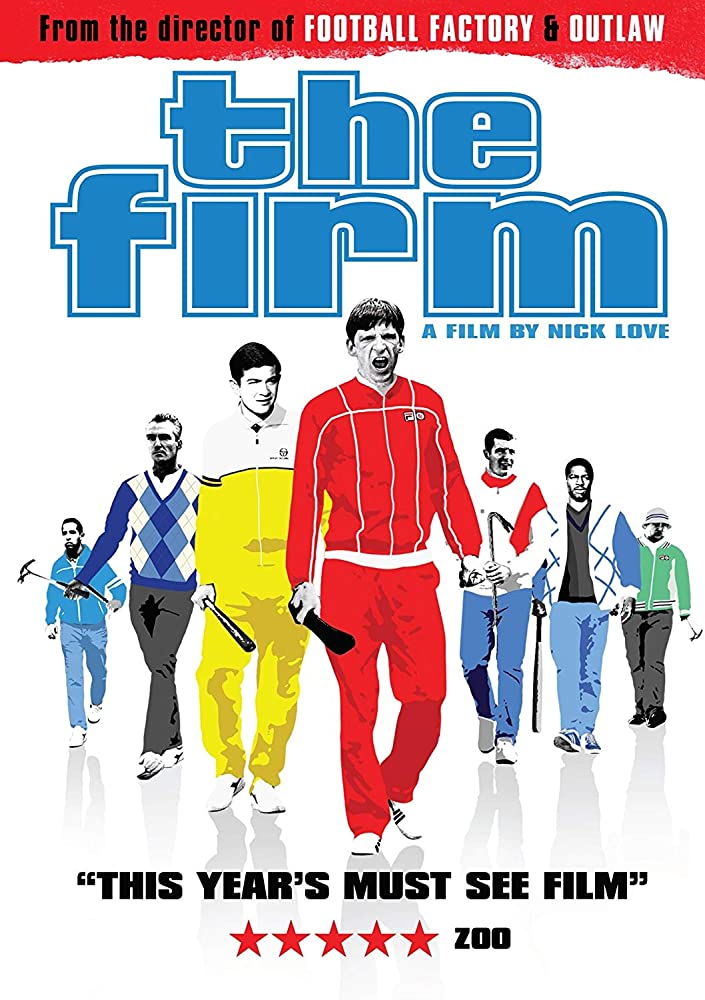
The Firm (2009, directed by Nick Love)


Dom (Calum MacNab) is a working class teenager living in London sometime in the 80s.  (The music on the soundtrack is early 80s but the clothing and the haircuts are all late 80s so who knows what the specific year is supposed to be.)  A chance meeting with the charismatic Bex Bessell (Paul Anderson) leads to Dom getting involved with Bex’s football firm.  A supporter of West Ham United, Bex and his group of football hooligans travel across the UK, engaging in fights with other firms.  Despite the fact that their lives seem to be structured around it, nobody in these firms seems to really care much about football.  Instead, it’s all about the fighting.

At first, Dom is happy to be a member of the firm.  It gives him something to do in his spare time and the other members of the group all seem to like him.  Bex takes him under his wing and soon, Dom is even starting to dress like Bex.  However, as Bex becomes more and more violent and grows obsessed with defeating Yeti (Daniel Mays), the leader of a rival firm, Dom starts to realize that he needs to find a way out.

The Firm is a loose remake of Alan Clarke’s 1989 film of the same title, which featured Gary Oldman giving one of the best performance of his career as Bex.  The original version was a character study of Bex, who was presented as being a newly minted member of the middle class and who was addicted to the rush of being a weekend hooligan.  The remake focuses on Dom, who was a minor character in the original.  If the original was meant to be a socio-political critique of the UK in the 80s, the remake is a coming-of-age story that almost feels nostalgic.  Dom eventually realizes that being a football hooligan isn’t for him but the remake seems to suggest that he’ll always value the memories.

The remake can’t really compare to the original, mostly because the remake doesn’t have Gary Oldman’s ferocious performance or Alan Clarke’s focused and gritty direction.  Taken on its own, though, the remake is not bad.  Calum MacNab is likable and relatable as Dom and Paul Anderson gives a good performance as Bex.  Anderson doesn’t try to imitate Oldman but instead brings his own spin to the character.  At first, Anderson’s Bex seems as if he’s considerably more buffoonish than Oldman’s Bex but, in the context of the remake, it works.  In the remake, it’s easy to underestimate Bex but give him a strange look or say the wrong thing and he’ll headbutt you just as quickly the Gary Oldman did to anyone who crossed him in the original.  The remake doesn’t have the original’s political subtext.  Instead, director Nick Love focuses more on historical nostalgia, stylized fight scenes, and the camaraderie that Dom initially finds in the firm.  The fights in the original were brutal and not always easy to watch.  The fights in the remake are exciting, up until it becomes obvious that Bex is losing his mind.

The remake of The Firm doesn’t do much to improve on the other but, when taken on its own terms, it’s a watchable story of football hooliganism.


Embracing the Melodrama Part II #110: Atonement (dir by Joe Wright)


Atonement_UK_posterWhenever I think back on the 2007 best picture nominee Atonement, my first thought is usually, “Oh my God!  Benedict Cumberbatch is in this movie!”

And, indeed, he is.  However, I’m kind of glad that I didn’t know who Benedict was when I first saw this film because, if I had, I doubt I would have ever been able to look at him in quite the same way again.  (Fortunately, I had somehow forgotten that I had previously seen him in Atonement when I first saw Benedict in Sherlock.)  Benedict’s role in Atonement is not a large one but it is pivotal to the film’s plot.  He plays Paul Marshall, a man who has made a fortune as a chocolate manufacturer in pre-World War II England.  Paul is handsome, charming, and rich.  After all, he’s played by Benedict Cumberbatch.  He’s also a rapist who, later in the film, marries one of his victims specifically to make it impossible for her to ever testify against him in court.

Atonement is one of those films where the British upper class meets the lower class and forbidden love and tragedy follow.  Cecilia Tallis (Keira Knightley) is the oldest of the Tallis sisters.  Her family is rich but she’s in love with Robbie Turner (James McAvoy), the son of the housekeeper.  One night, Robbie attempts to write a love note to Cecilia and, growing frustrated with his inability to come up with right words, he writes an over-the-top, sexually explicit letter as a joke.  (And the audience gaps, “Oh my God!  They used that word in the 30s!?”)  He then goes on to write a more standard love note.  However, when he asks Cicilia’s younger sister, 13 year-old Briony (Saorise Ronan) to deliver the note to Cecilia, he accidentally gives her the wrong note.  Briony reads it to her cousin Lola (Juno Temple) and, already jealous of Robbie and Cecilia’s flirtation, she decides that Robbie must be a “sex maniac.”

Briony, who writes plays in her spare time, later spies on Robbie and Cecilia as they have sex for the first time.  Briony, who has a crush on Robbie, grows more and more jealous.  Later that night, while looking for Lola’s twin brothers, Briony sees a man running through the woods.  When she goes to investigate, Briony discovers that the man has raped Lola.  When asked by the police, Briony lies and says that Robbie was the man running in the woods.  She also shows everyone the “joke” letter that Robbie wrote, proving, in their eyes, that Robbie is guilty.  Robbie is sent to prison.  Of the Tallises, only Cecilia believes that Robbie is innocent.  Angered over their quickness to accuse Robbie, Cecilia cuts off all contact with her family.

As the years pass, Briony comes to realize that Paul was the rapist and she struggles to deal with her guilt.  When World War II breaks out, Robbie is released from prison on the condition that he join the army.  Meanwhile, Briony volunteers as a nurse and tries to come up with a way to bring Cecilia and Robbie back together.

I didn’t really appreciate the film the first time that I saw it but, with subsequent viewings, I came to appreciate Atonement as an intelligent and well-acted look at guilt, forgiveness, and redemption.  James McAvoy and Keira Knightley both have amazing chemistry and Saoirse Ronan is amazing in her film debut.  You can see why Atonement‘s director, Joe Wright, subsequently cast her in Hanna.  Compared to the other films nominated for best picture of 2007 — No Country For Old Men, Juno, There Will Be Blood, and Michael ClaytonAtonement is definitely a low-key film.  But it definitely more than deserved its nomination.

Film Review: Made in Dagenham (dir. by Nigel Cole)


Made in Dagenham, an immensely likable and even inspiring film from England, is based on a true story.  It dramatizes the 1968 strike of sewing machinists at the Ford assembly plant in Dagenham, England.  The all-female workforce walked off the job in protest to the fact that they were not being paid an equal rate with their male co-workers.  Going from being treated as a sexist punchline to eventually shutting down production at the Dagenham plant, these women brought the issue of equal pay for equal work to the world’s attention and, ultimately, played a large part in the passage of legislation designed to guarantee equal pay regardless of sex.  And, while it might sound like the material for standard, overly sentimental move-of-the-week, Made in Dagenham is both a warm-hearted tribute and an immensely entertaining film.

Usually, I’m wary of films that claims to “pay tribute to strong women,” largely because they always 1) seem to be rather condescending towards the women they’re claiming to pay tribute and 2) always seem to be intent on providing a very narrow definition of what it means to be “strong.”  Far too often, either stridency or an idealized noble savagery is presented in the place of “strength.”  What makes Made in Dagenham a true tribute to strong women is that it portrays women as individuals and as human beings (as opposed to idealized figures of either reverence or loathing).  What a novel idea!  All of the strikers — from Sally Hawkins as the strike’s leader to Geraldine James as the oldest striker to Jaime Winestone as the youngest — are treated with a definite (and refreshing) respect yet at the same time they’re never so idealized as to become plastic saints.  They’re not presented as being models of perfection.  Instead, they’re just working mothers and wives who are simply standing up for their rights and you would have to be heartless not to end up rooting for them.

On my list of my 25 favorite films of 2010, Made in Dagenham was number #22 and that’s largely because of Sally Hawkins’ performance as the strike leader.  Hawkins is hardly a household name but if you’ve seen her in films like Happy-Go-Lucky, An Education, and Never Let Me Go, then you know that Hawkins is one of those rare performers who is capable of both being ordinary and a star at the same time.  She brings an authentic feel to her working class characters even when she’s acting for a condescending and elitist director like Mike Leigh.  To understand just how important Hawkins is to the success of this movie, just try to imagine the exact same film but starring either Sandra Bullock or Julia Roberts.  One can imagine that either Bullock or Roberts would be given a lot more inspiring speeches (complete with triumphant music in the background) and a few scenes where they would get to say something sassy (and ultimately pointless) to all the one-dimensional male chauvinists standing in their way.  They also probably would have contracts to keep from having to act underneath the hideous (but historically authentic) beehive hairdoes  that Hawkins and the other women in the film have.  Hawkins, however, gives her performance without any of the usual Hollywood safety nets and she is completely and totally winning playing a strong-willed but inherently nice woman who struggles to be a wife, a mother, a worker, and an activist all at the same time.  As I watched her performance, I couldn’t help but be reminded of my mom who raised four daughters on her own and who was the strongest woman I know.  I ultimately felt as if Hawkins performance was a tribute to not only my mom but every other woman throughout history whose strength is, far too often, ignored by those who do the recording.

Made in Dagenham is not a perfect film.  For all the authentic moments in the film, there’s a few that are a bit too obvious and, when they show up, they fit in so awkwardly with everything else on-screen that they temporarily throw the whole film out of whack.  This is the type of film where, as Sally Hawkins gives the most important speech of her life at a labor conference, she looks up just in time to see that her husband (Daniel Mays) has shown up in just the nick of time and is now standing in the back of the room, watching her with an apologetic smile on his face.  It’s a sweet scene and, for all I know, it actually did happen that way but it still temporarily makes the movie feel like a self-consciously inspirational Lifetime movie.

And then there’s the issue of Miranda Richardson, who essentially has an extended cameo role as Barbara Castle.  Though Castle is known not at all in the States (most of the people in the theater with me seemed to think Richardson was supposed to be playing Margaret Thatcher and I might have thought the same if I hadn’t looked the movie up on Wikipedia before seeing it), she was quite prominent in the UK.  A left-wing member of Parliament and a pioneer for women in politics, Castle was Secretary of State for Employment at the time of the strike and, as shown in the film, she eventually intervened in the strike and helped to bring about legislation designed to guarantee women equal pay with their male co-workers.  As such, Castle is as much of a part of this story as the actual strikers and you can’t fault the movie for including several briefs scenes featuring her watching the situation from afar.  What you can fault director Nigel Cole for is allowing Richardson to overact to such an extent that her scenes come across as so heavy-handed that they epitomize every negative cliché of a feminist film.  Richardson plays her role with an attitude that seems to shout, “The real star is here,” and I found myself resenting her because she seemed to be determined to ruin a truly inspiring film.

But the thing is, despite these flaws, Made in Dagenham is an inspiring film.  It’s inspiring because of Hawkins and it’s inspiring because of an ensemble of actresses (including Hawkins’ Education co-star Rosamund Pike who does a great job in a role that could have felt artificial if performed by a lesser actress) who come together perfectly.   I saw Made in Dagenham on January 1st and it was the perfect film to start 2011 off with.