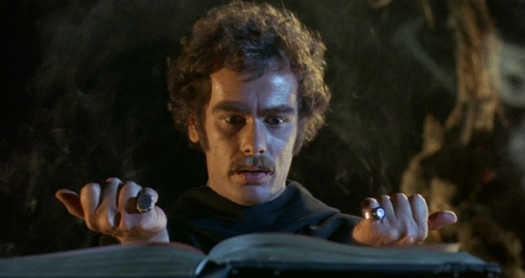
The TSL Horror Grindhouse: The Dunwich Horror (dir by Daniel Haller)


Look at me/I’m Sandra Dee….

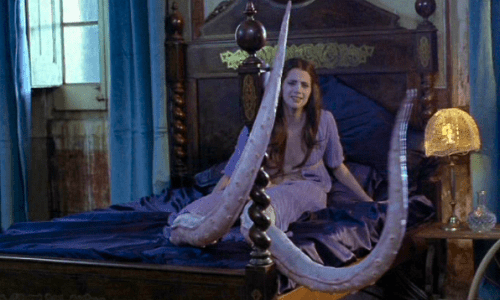
First released in the groovy and psychedelic year of 1970, The Dunwich Horror stars Sandra Dee as Nancy, an somewhat innocent grad student at Massachusetts’s Miskatonic University.  When the mysterious Wilbur Wheatley (Dean Stockwell) comes to the university and asks to take a look at a very rare book called The Necronomicon, Nancy agrees.  She does so even though there’s only one edition of The Necronomicon in existence and it’s supposed to be protected at all costs.  Maybe it’s Wilbur’s hypnotic eyes that convince Nancy to allow him to see and manhandle the book.  Prof. Henry Armitage (Ed Begley) is not happy to see Wilbur reading the book and he warns Nancy that the Wheatleys are no good.

Nancy still agrees to give Wilbur a ride back to his hometown of Dunwich.  She finds herself enchanted by the mysterious Wilbur and she’s intrigued as to why so many people in the town seem to hate Wilbur and his father (Sam Jaffe).  Soon, she is staying at Wilbur’s mansion and has apparently forgotten about actually returning to Miskatonic.  She has fallen under Wilbur’s spell and it soon becomes clear that Wilbur has sinister plans of his own.  It’s time to start chanting about the Old Ones and the eldritch powers while naked cultists run along the beach and Nancy writhes on an altar.  We are in Lovecraft county!

Actually, it’s tempting to wonder just how exactly H.P. Lovecraft would have felt about this adaptation of his short story.  On the one hand, it captures the chilly New England atmosphere of Lovecraft’s work and it features references to such Lovecraft mainstays as Miskatonic University, the Necronomicon, and the Old Ones.  As was often the case with Lovecraft’s stories, the main characters are students and academics.  At the same time, this is very much a film of the late 60s/early 70s.  That means that there are random naked hippies, odd camera angles, and frequent use of the zoom lens.  The film makes frequent use of solarization and other psychedelic effects that were all the rage in 1970.  Lovecraft may have been an unconventional thinker but I’m still not sure he would have appreciated seeing his fearsome cult transformed into a bunch of body-painting hippies.

Really, the true pleasure of The Dunwich Horror is watching a very earnest Sandra Dee act opposite a very stoned Dean Stockwell.  Stockwell was a charter member of the Hollywood counterculture, a friend of Dennis Hopper’s who had gone from being a top Hollywood child actor to playing hippie gurus in numerous AIP films.  As for Sandra Dee, one gets the feeling that this film was an attempt to change her square image.  When Wilbur tells Nancy that her nightmares sound like they’re sexual in origin and then explores her feelings about sex, Nancy replies, “I like sex,” and it’s obviously meant to be a moment that will make the audience say, “Hey, she’s one of us!”  But Sandra Dee delivers the line so hesitantly that it actually has the opposite effect.  Stockwell rather smoothely slips into the role of the eccentric Wilbur.  Wilbur is meant to be an outsider and one gets the feeling that’s how Stockwell viewed himself in 1970.  Sandra Dee, meanwhile, seems to be trying really hard to convince the viewer that she’s not the same actress who played Gidget and starred in A Summer Place, even though she clearly is.  It creates an oddly fascinating chemistry between the two of them.  Evil Wilbur actually comes across as being more honest than virtuous Nancy.

Executive produced by Roger Corman, The Dunwich Horror is an undeniably campy film but, if you’re a fan of the early 70s grindhouse and drive-in scene, it’s just silly enough to be entertaining.  Even when the film itself descends into nonsense, Stockwell’s bizarre charisma keeps things watchable and there are a few memorable supporting performances.  (Talia Shire has a small but memorable roll as a nurse.)  It’s a film that stays true to the spirit of Lovecraft, despite all of the hippies.
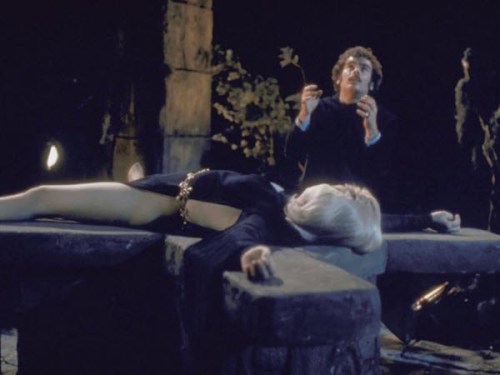
4 Shots From 4 Films: Special H.P. Lovecraft Edition


4 Shots From 4 Films is just what it says it is, 4 shots from 4 of our favorite films.  As opposed to the reviews and recaps that we usually post, 4 Shots From 4 Films is all about letting the visuals do the talking.

This edition of 4 Shots From 4 Films is dedicated to H.P. Lovecraft, on the occasion of his 135th birthday.

4 Shots From 4 Films

The Dunwich Horror (1970, directed by Daniel Haller)

The Dunwich Horror (1970, directed by Daniel Haller)

Dagon (2001, directed by Stuart Gordon)

Dagon (2001, directed by Stuart Gordon)

The Call of Cthulhu (2005, directed by Andrew Leman)

The Call of Cthulhu (2005, directed by Andrew Leman)

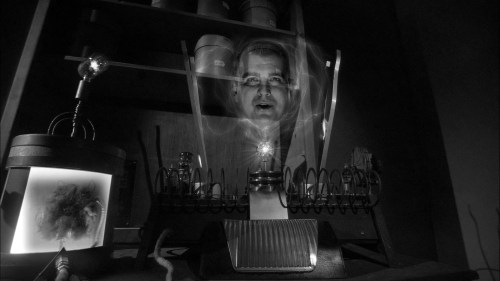
The Whisperer in Darkness (2011, directed by Sean Branney)

The Whisperer in Darkness (2011, directed by Sean Branney)

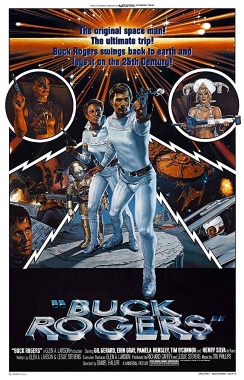
Buck Rogers in the 25th Century (1979, directed by Daniel Haller)


In the year 1987, NASA launches it’s final manned mission.  Captain Buck Rogers (Gil Gerard) is sent into space but, while he’s orbiting the Earth, he and his spacecraft fall victim to a strange space anomaly which leaves him in suspended animation.  On Earth, Buck Rogers is believed to be lost.  500 years pass.  Buck’s ship continues to orbit the Earth while, down below, mankind nearly destroys itself in a nuclear war.  Eventually, Earth is reduced to radioactive rubble and what remains of human civilization lives in the city of New Chicago.  (Old Chicago, meanwhile, has been taken over by mutants.)

Finally, in the 25th century, Buck and his ship are discovered by Draconia, a spaceship that belongs to the intergalactic Draconian Empire.  Buck is brought out of suspended animation and meets the beautiful Draconian Princess Ardala (Pamela Hensely) and her second-in-command, an Earthling named Kane (Henry Silva).  Ardala would obviously like to make Buck her prince but, after being in suspended animation for 500 years, Buck just wants to return to Earth.  The Draconians allow Buck to return home.

Upon landing in New Chicago, Buck discovers that the world is much different now.  Everyone wears skintight uniforms and a little robot named Twiki (voice by Mel Blanc) is the only person willing to be Buck’s friend.  Commander Wilma Deering (Erin Gray) is in charge of defending what’s left of human civilization and she’s immediately suspicious of Buck and his story.  When it turns out that Ardala and Kane implanted Buck with a tracking device, Deering want to execute him.  Can Buck prove his loyalty and also thwart Ardala and Kane’s plot to conquer humanity?

Buck Rogers In The 25th Century was originally a pilot for a Glen Larson-produced televisions series.  (Larson was also responsible for the original Battlestar Galactica, another sci-fi show whose pilot was given a theatrical release.)  Hoping to appeal to the same audiences who made Star Wars a monster hit, Universal spent a little extra money to upgrade the special effects, added a few suggestive scenes to prevent the pilot from getting the dreaded G-rating, and then released it in theaters a few months before the TV show premiered.  That was a good idea because the movie did become a minor hit and the TV series went on to run for two seasons.

As the movie itself, it never feels like anything more than an extended episode of a television series.  Gil Gerard is bland in the lead role and most serious sci-fi fans will probably lose interest as soon as the child-friendly robot shows up.  Buck Rogers may have been made to capitalize on the success of Star Wars but it doesn’t have any of the attention to detail or the careful world-building that went into George Lucas’s original space opera.  On the plus side, though, the Dads who took their kids to matinee showings of this film were probably happy to see Erin Gray and Pamela Hensley prominently featured in the film and Henry Silva is a great villain as always.  As with a lot of the sci-fi films that were released in the immediate wake of Star Wars, Buck Rogers In The 25th Century does have a definite camp appeal.  It’s bad but some people will enjoy it on a nostalgic level.

Probably the most memorable thing about Buck Rogers In the 25th Century was its James Bond-inspired title sequence.  Here it is, in all of its glory:

https://www.youtube.com/watch?v=BINijYepahA

4 Shots From 4 Films: Count Yorga Vampire, The Dunwich Horror, House of Dark Shadows, I Drink Your Blood


4 Shots From 4 Films is just what it says it is, 4 shots from 4 of our favorite films. As opposed to the reviews and recaps that we usually post, 4 Shots From 4 Films lets the visuals do the talking!

This October, we’re using 4 Shots From 4 Films to look at some of the best years that horror has to offer!

4 Shots From 4 1970 Horror Films

Count Yorga, Vampire (1970, dir by Bob Kelijan)

The Dunwich Horror (1970, dir by Daniel Haller)

House of Dark Shadows (1970, dir by Dan Curtis)

I Drink Your Blood (1970, dir by David Durston)

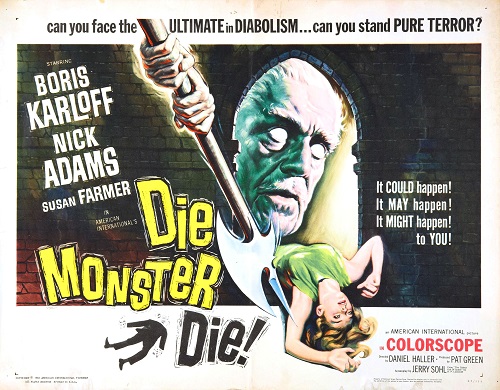
A Quickie with The King: Boris Karloff in DIE, MONSTER, DIE! (AIP 1965)


gary loggins's avatarcracked rear viewer

All you Cracked Rear Viewers know by now my affection for the King of Monsters, Boris Karloff . His Universal classics of the 30’s and RKO chillers of the 40’s hold an esteemed place in my personal Horror Valhalla. Karloff did his share of clunkers, too, especially later in his career. DIE, MONSTER, DIE! is one such film, it’s good intentions sunk by bad execution.

It’s the second screen adaptation of a story from the fertile mind of author  H.P. Lovecraft; the first, 1963’s THE HAUNTED PALACE, was a mash-up of Lovecraft and Edgar Allan Poe as part of the Roger Corman/Vincent Price series. Corman’s longtime Art Director Daniel Haller made his directorial debut, and the film certainly looks good. Veteran sci-fi writer Jerry Sohl contributed the screenplay, which was then tinkered with by Haller. Therein lies the problem; Haller’s changes drag down what could have been an exciting little…

View original post 383 more words

Halloween Havoc!: THE DUNWICH HORROR (AIP 1970)


gary loggins's avatarcracked rear viewer

THE DUNWICH HORROR is another film I saw when it was first released, on a double bill with the Spaghetti Western GOD FORGIVES, I DON’T. Unfortunately, this one fails to stand the test of time, with it’s trippy special effects and a somnambulant performance by Dean Stockwell , who was pretty obviously stoned out of his gourd during the shooting.

Professor of the occult Henry Armitage is lecturing on the Necronomicon, a book said to hold the key to the gate to another dimension, where a race of monsters known as “the old ones” dwell. Creepy Wilbur Whateley, great grandson of occultist Oliver, shows an abonrmal interest in the book. In fact, Wilbur wants to possess the Necronomicon to bring “the old ones” back to rule the Earth once again. To achieve this, he pretty much kidnaps and drugs student Nancy Wagner, hoping to use her in a bizarre sex…

View original post 363 more words

4 Shots From 4 Films: The Dunwich Horror, Dagon, The Call of Cthulhu, The Whisperer in Darkness


4 Shots From 4 Films is just what it says it is, 4 shots from 4 of our favorite films.  As opposed to the reviews and recaps that we usually post, 4 Shots From 4 Films is all about letting the visuals do the talking.

This edition of 4 Shots From 4 Films is dedicated to H.P. Lovecraft, on the occasion of his 125th birthday.

4 Shots From 4 Films

The Dunwich Horror (1970, directed by Daniel Haller)

The Dunwich Horror (1970, directed by Daniel Haller)

Dagon (2001, directed by Stuart Gordon)

Dagon (2001, directed by Stuart Gordon)

The Call of Cthulhu (2005, directed by Andrew Leman)

The Call of Cthulhu (2005, directed by Andrew Leman)

The Whisperer in Darkness (2011, directed by Sean Branney)

The Whisperer in Darkness (2011, directed by Sean Branney)