Retro Television Review: Homicide: Life On The Street 3.16 “Law & Disorder”


Welcome to Retro Television Reviews, a feature where we review some of our favorite and least favorite shows of the past!  On Sundays, I will be reviewing Homicide: Life On The Street, which aired from 1993 to 1999, on NBC!  It  can be viewed on Peacock.
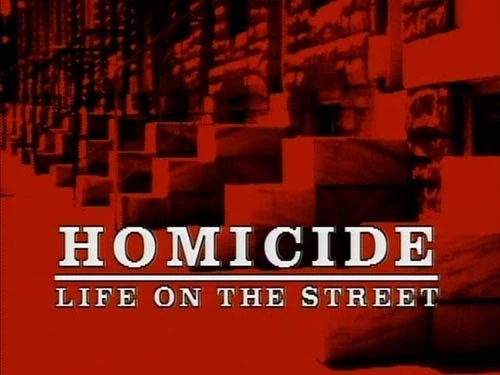
This week, Munch gets away with murder.

Episode 3.16 “Law & Disorder”

(Dir by John McNaughton, originally aired on February 24th, 1995)

This week’s episode of Homicide gets off to a strange start, with a cameo from Chris Noth as Law & Order‘s Detective Mike Logan.  (Logan appeared early in the history of Law & Order, before North became known as the ill-fated Mr. Big on Sex And The City.)  Logan is transporting a prisoner to Baltimore and that prisoner is played by none other than John Waters!  Meeting Pembleton at the Amtrak station, Logan proceeds to bitch about Baltimore.  Pembleton bitches about New York.  Waters comments that Edgar Allan Poe hated New York.  When Pembleton says that Waters will be heading to prison but at least it will be a Baltimore prison, Waters says that’s why he didn’t fight extradition.  It’s a cute scene, though, as I watched it, I was struck by just how better of an actor Andre Braugher was than Chris Noth.  Noth delivered all of his line like a TV actor.  Braughter delivered his dialogue like a poet.

As for the rest of the show, we get several plotlines.  Bayliss is investigating the death of Gordon Pratt but, because Pratt shot Bolander, Felton, and Howard, none of his fellow detectives are that concerned about solving his murder.  Bayliss comes to suspect that it was a homicide detective who shot Pratt.  He asks Pembleton, Lewis, and Munch for their alibis and none of them really have a good one.  Myself, I think it’s pretty obvious that Much shot Pratt.  Munch’s hero-worship of Bolander, his anger after Pratt walked out of the station, all of it pretty much makes him the main suspect.  Lewis, who is still struggling to come to terms with Crosetti’s suicide, seems like he would be more likely to deal with his anger by drinking.  Even if he doesn’t want to admit it, Pembleton is too much of a wannabe Jesuit to do the eye for an eye thing.  Munch, though …. yeah, there’s no way Munch didn’t kill Gordon Pratt.  John Munch is a murderer.  (Okay, to be clear, the show leaves it ambiguous and never outright states that Munch was the killer but it’s still kind of obvious.)

And he gets away with it.  Bayliss tells Giardello that he’s followed-up every lead and that the Pratt case is just going to have remain open and go cold.  “Won’t help your clearance level,” Giardello shrugs.  It’s a decision that’s going to haunt Bayliss but the show suggests that Bayliss sees it as a sort of cosmic justice.  Before announcing that the case is going to go cold, Bayliss has a conversation with Pembleton and, of course, Bayliss brings up the Adena Watson case.  The Arabist got away with killing Adena Watson so Bayliss is going to let someone — Munch, let’s be honest — get away with killing Gordon Pratt.

Munch isn’t just a murder suspect in this episode.  He’s also a laughing-stock as a nude photo of him from his hippie days is the centerpiece of a photography exhibition that’s being put on by an ex-girlfriend (Valerie Perrine).  It was kind of strange, watching the episode go from Much being a suspected murderer to Munch being the comedic relief.  Still, I always enjoy it when the show remembers that Munch is basically a drug-addled survivor of the 60s.

Felton returns to the squad room, cleared for light duty.  He insists on going out to a crime scene with Giardello, leading to Felton stumbling around, making a fool of himself, and then throwing up afterwards.  Giardello informs Felton that he’s not a good detective in his current state but then again, Giardello adds, Felton has never been a good detective.  Ouch!  That’s harsh.  Of course, it’s also true.  As I’ve said before, I would not want sweaty, racist, borderline illiterate Beau Felton investigating the murder of anyone close to me.

Finally, Pembleton and Lewis investigated an apparently random shooting.  Pembleton thought the gunshot came from the projects.  Lewis insisted that the gunshot came from the white side of the neighborhood.  It turned out Lewis was right but Pembleton was unapologetic, saying he would investigate the case the exact same way if he had to do it all over again.  Watching this storyline, I found myself thinking about how black characters on television often feel interchangeable and they rarely have much of a personality beyond being a white person’s idea of what their black best friend might be like.  Homicide featured three prominent black characters — Lewis, Pembleton, and Giardello — and all three of them are portrayed as being unique individuals with their own different ways of viewing the world, the job, and each other.  Even today, when every television show is desperate to make sure everyone knows how “committed to diversity” they are, it’s rare to see a network show like Homicide, where black characters are portrayed as being individuals as opposed to just stereotypes.  This is something for which Homicide definitely deserves a bit more credit.

This was a good episode.  It appears the murder of Gordon Pratt will never be solved.  Of course, we all know Much did it.
Retro Television Review: Homicide: Life On The Street 3.15 “End Game”


Welcome to Retro Television Reviews, a feature where we review some of our favorite and least favorite shows of the past!  On Sundays, I will be reviewing Homicide: Life On The Street, which aired from 1993 to 1999, on NBC!  It  can be viewed on Peacock.

This week, the Homicide detective finally arrest the shooter but can they get a confession?

Episode 3.15 “End Game”

(Dir by Lee Bonner, originally aired on February 10th, 1995)

Finally, the Homicide detectives have figured out who actually shot Bolander, Howard, and Felton.  Gordon Pratt (Steve Buscemi), who lived at the apartment that the detectives were accidentally sent to, is a gun-obsessed pseudo-intellectual whose apartment is full of books that he’s probably never read and a picture of himself posing like Lee Harvey Oswald with the rifle he used to kill JFK.  Pratt also has an outstanding warrant for his arrest, explaining why he panicked when the cops accidentally knocked on his door.

Here’s my question.  Why exactly did it not occur to anyone to see who lived in Apartment 201 when the shootings first happened?  I understand that they were focused on a different suspect but it still seems strange that, with all the detectives assigned to the case, no one bothered to check out the guy who lived in Apartment 201.

Anyway, Bayliss and Mitch Drummond drop in on Pratt’s parents, who own a farmhouse and insist that Gordon would never shoot anyone.  Meanwhile, Pratt’s co-workers all talk about how much they hate his guts with one guy mentioning that Pratt went out of his way to antagonize people.  Pratt is finally tracked down at a massage parlor.

The majority of this episode centers around Pembleton and Bayliss interrogating Pratt.  It’s an obvious attempt to recapture the intensity of the first season’s Three Men and Adena and it actually succeeds, thanks to some smart writing and the performances of Andre Braugher, Kyle Secor, and especially Steve Buscemi.  Buscemi plays Pratt as being the ultimate uneducated know-it-all, someone who has picked bits and pieces of philosophy and who has learned that, if you deliver your mundane thoughts with a sneering contempt, some people will assume that you’re smarter than you actually are.  Pembleton and Bayliss have fun picking apart Pratt’s arrogance but — and this is what sets Homicide apart from so many other cop shows — Pembleton ultimately goes too far.  When he takes a look at Pratt’s copy of Plato’s The Republic and realizes that it’s written in Greek, Pembleton can’t help but taunt Pratt and point out that, unlike Pratt, he can actually read ancient Greek because he was educated by “the Jesuits,” while Pratt didn’t even mange to graduate high school.

“I want a lawyer!” Pratt shouts.

At this point, I realized that I had gotten so wrapped up in the interrogation scene that I had totally forgotten about the fact that all of the evidence linking Pratt to the shooting was circumstantial.  Without a gun or a confession, there’s not enough evidence to hold Pratt.  He pleads out to his outstanding assault warrant and he’s free within a few hours.

“You got too cute, Frank,” Munch says, leading to Pembleton physically attacking Munch and then storming out of the station.  Munch goes to the hospital to see Bolander (who has woken up from his coma but who has no memory of who Much actually is) and Bayliss is the only person left to take the call when Gordon Pratt turns up dead in the lobby of his apartment building, shot in the head.

Who murdered Gordon Pratt and was it a cop?  That’s what Bayliss — who sarcastically declares “I love my job!” before heading to the crime scene — will have to figure out.

Great episode!  Not only was it wonderfully performed but, just when you thought to yourself, “There’s no way Pembleton could get away with this in real life,” it turns out that Pembleton couldn’t get away with it on Homicide either.  That’s what makes Frank Pembleton such a fascinating character.  He’s a brilliant detective but, in this episode, he let his desire to embarrass Pratt get in the way of doing his job.  “He who loses control loses,” Pembleton says and, in this episode, he lost control.  Pembleton’s reaction is to storm out of the station in a huff, leaving Bayliss the task of figuring out who killed Gordon Pratt.

My money’s on Munch, just because of how upset he was when Pratt walked and also that it would make sense for Munch to avenge Bolander’s head wound by shooting Pratt in the head.  We’ll see if I’m correct next week!

Retro Television Review: Homicide: Life On The Street 3.14 “Dead End”


Welcome to Retro Television Reviews, a feature where we review some of our favorite and least favorite shows of the past!  On Sundays, I will be reviewing Homicide: Life On The Street, which aired from 1993 to 1999, on NBC!  It  can be viewed on Peacock.

This week, the elusive Glenn Holton is captured but is really the shooter?  Read on and find out!

Episode 3.13 “Dead End”

(Dir by Whitney Ransick, originally aired on February 3rd, 1995)

There’s a truly remarkable moment in this week’s episode of Homicide.

Glenn Holton (Steve Hofvendahl) has finally been arrested and is sitting in the Box.  Holton is the pedophile who is suspected of murdering a child.  Last week, Felton, Bolander, and Howard were all shot while trying to serve a warrant for his arrest.  Bayliss and Pembleton are interviewing him, attempting to get him to confess to shooting the detectives.

At first, Holton is adamant that he did not shoot anyone.  But as Pembleton and Bayliss shout at him and tell him about all the things that are going to happen to him as a sex offender in prison, Holton’s demeanor starts to change.  He becomes desperate and confused and suddenly, he confesses to shooting the detectives.  The only problem is that the story Holton comes up with doesn’t match the facts of the case.  He claims that he shot the detectives on the roof of his apartment building.  He claims they were coming at him.  When asked what type of gun he used, Holton says it was just some gun that he bought on the street.  The more Holton talks, the more obvious it becomes that, while he did murder the child, he didn’t shoot the detectives.

It’s an interesting scene because it shows just how easy it could be to get a false confession out of a suspect.  It’s left ambiguous as to whether or not Holton was lying because he preferred to be sent to prison for shooting a cop instead of killing a kid or if maybe Holton actually had deluded himself into thinking he was the shooter.  If Bayliss and Pembleton hadn’t asked him follow-up questions about the shooting, Holton probably would have been charged with the shooting.  He did, after all, confess.

Holton’s going to jail for murder but the shooter is still out there.  Who fired the gun?  I suspect I know, just because next week’s episode features a special guest star.  But we’ll talk about that next week!

The interrogation scene was the highlight of this week’s episode.  Still, I enjoyed the scenes of Munch working with Bolander’s ex-partner Mitch and struggling to hide his jealousy.  (Bolander is always complaining that Mitch was a far better partner than Munch.)  I was a bit less interested in this week’s Russert plot.  Megan was told to investigate whether or not Giardello was at fault for the detectives going to the wrong apartment.  She discovered Giardello did approve and initial the warrant without double-checking the address.  Giardello  was prepared to take the blame but Russet instead lied and claimed that, because of budget cuts, she and Giardello were both often rushed into signing things without getting a chance to fully examine them.  I’m not sure that’s a particularly good excuse but it worked.

At the hospital, Howard woke up from her coma.  Bolander is still in his coma and was not present during this episode.  (From what I’ve read, Ned Beatty was apparently not happy with the whole shooting storyling, feeling that it went against the realism that was supposed to be Homicide’s calling card.)  Lewis and Felton had a heart-to-heart about what it’s like to lose one’s partner.  It was an effective scene, even if Felton has become a bit of a one-note character.

This was a good episode and a marked improvement on last week.  I look forward to seeing how things conclude (or if they even do conclude) in the next episode.

A Movie A Day #181: Guilty As Sin (1993, directed by Sidney Lumet)


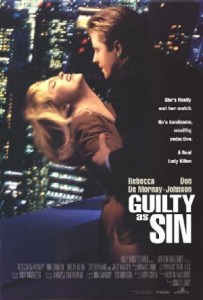
When wealthy playboy David Greenhill (Don Johnson, doing a one-note Michael Douglas impersonation) is accused of throwing his wife out of a window, there’s only one lawyer who he wants to defend him.  Jennifer Haines (Rebecca De Mornay) may have just won a huge case but it is obvious that the only reason that David wants her on his team is because she’s sexy as Hell and David has an obsessive streak.  Still, despite the misgivings of her boyfriend (Stephen Lang) and her mentor (Jack Warden), she takes the case, convinced that she is the only attorney smart enough to be able to get David acquitted.

It becomes very obvious that David is not only probably guilty but that he might be a serial killer as well.  Not only does he start to turn up everywhere that Jennifer goes but, protected by attorney/client privilege, he starts to tell her all of his dark secrets.  Jennifer finds herself trapped into defending an obviously guilty client, one who appears to be setting her up to be his next victim.  Even when he fails to pay her for her services, the trial judge refuses to allow Jennifer to quit the case.

Back in the 90s, Guilty As Sin used to frequently show up on late night HBO and Cinemax.  I always watched because I had a crush on Rebecca De Mornay and I bet I was not alone as far as that’s concerned.  Late night cable is where Guilty As Sin belongs, which makes it strange that this weak and implausible movie was directed by Sidney Lumet.  One of the legitimately great American directors, Lumet directed several classic courtroom thrillers over the course of his career.  Guilty As Sin is not one of them.  This is probably the most impersonal film that Lumet ever made.  Other than the presence of Lumet favorite Jack Warden, there is nothing about Guilty As Sin that would lead anyone to think that it had been directed by the same man responsible for 12 Angry Men, Dog Day Afternoon, Network, or Prince of the City.

Fortunately, though Guilty As Sin was one of his Lumet’s last films as a director, it was not his final film.  Released in 2007, Lumet’s final film was a crafty thriller called Before The Devil Knows Your Dead, which showed that, at the age of 83, Lumet was still one of the greats and that Guilty As Sin was just a minor bump in an otherwise brilliant career.