The TSL Grindhouse: Caligula: The Ultimate Cut (dir by Tinto Brass)


How many cuts do we need of a bad movie?

Caligula is a film with a long and storied history.  In the mid-1970s, Penthouse publisher Bob Guccione wanted to follow the lead of his rival, Hugh Hefner, and get into the movie business.  His plan was to make an explicit adult film with high production values, one that could be sold as a mainstream feature film.  He decided that the infamously decadent Roman Emperor Caligula would be the subject of his film.  In order to give the project some gravitas, he accepted scripts from both Lina Wertmuller and Gore Vidal.  Ultimately, he chose to go with Vidal’s script because Vidal’s name had more cultural cachet than Wertmuller’s.  It certainly wasn’t because he liked Vidal’s script, which Vidal later said featured a lot of gay sex but only one scene of heterosexual coupling.

With the promise that Caligula would be a classy production that would push the boundaries of cinematic sex without actually being pornographic, Guccione was able to bring together a truly impressive cast of actors.  Malcolm McDowell agreed to play Caligula.  Helen Mirren was cast as Caligula’s wife, Caesonia.  John Gielgud took on the role of Nerva the philosopher while Peter O’Toole was cast as the diseased Emperor Tiberius.  Guccione offered directing duties to John Huston and Lina Wertmuller.  In the end, no matter how much money he was willing to spend or how distinguished a cast he had assembled, Guccione could not find a prominent, mainstream director who was willing to work with him.  Guccione ended up hiring a director he knew little about, an Italian arthouse filmmaker named Tinto Brass.

Brass proceeded to rewrite Vidal’s script.  Brass’s version of the film featured more sex and less politics.  Guccione was happy about that until he discovered that Brass’s plan was to direct the sex scenes to be grotesque and disturbing.  To his horror, Guccione discovered that Brass was essentially parodying the type of film that Guccione wanted him to direct.  Even when Guccione insisted that the latest “Penthouse pets” be cast in the film, Brass tried to keep them in the background.  As Guccione’s demands grew, Brass responded by refusing to emphasize the ornate and very expensive sets that Guccione had paid to have created.  A working ship was built but Brass reportedly chose to put it in a small warehouse so that there would never be room to get a full shot of it.  Guccione responded by taking the film away in post-production and inserting several hardcore sex scenes, which upset the members of the cast who did not sign on to appear in a pornographic film.

As for the film itself, it must be said that Caligula is probably one of the most historically accurate portrayals of ancient Rome.  The city was said to be a mix of dirty streets and ornate palaces and Caligula certainly captured the mix of beauty and sordid decadence that was the Roman Empire.  The film’s plot actually sticks very closely to what was written about Caligula by Roman historians like Suetonius.  Helen Mirren and Malcolm McDowell both give strong performances, even if McDowell later claimed the film ruined his career by typecasting him as a perverse villain.  Peter O’Toole is memorably grotesque as Tiberius.  Exploitation vets John Steiner and Teresa Ann Savoy also make an impression in their roles and one gets the feeling that they both understood what type of film they were appearing in, even if the bigger names in the cast did not.  There are moments of shocking grandeur and visual beauty to be found in Caligula and also moments of such total ugliness that they are difficult to watch.  In many ways, Caligula is what Guccione wanted.  It’s a big, expensive film that tests boundaries and features explicit sex.

But, Good God, is it ever boring!  Seriously, the scene where Caligula visits Tiberius in Capri goes on forever.  Despite McDowell’s strong performance, Caligula is not a particularly compelling character.  He becomes emperor and then he goes mad.  For over two hours, Caligula does one terrible thing after another and there’s only so long that you can watch it before you just want someone to hurry up and kill him.  The film suggests that Caligula was rebelling against the Roman establishment but, in the end, who cares?  He kills his friends.  He has sex with his sister.  In the film’s most disturbing scene, he rapes a bride and then fists the groom.  It just goes on and on and it gets old pretty quickly.

Still, there’s always been a lot of debate over whether or not it would be possible to make Caligula into a good film.  Bob Guccione claimed that he saved the film.  Tinto Brass disagreed and his director’s cut, which takes out Guccione’s hardcore inserts, is considerably better-paced than the Guccione version but the nonstop ugliness still gets rather boring.

That brings us to the latest version of Caligula, the Ultimate Cut.  Assembled without the input of Tinto Brass or the deceased Bob Guccione, Caligula: The Ultimate Cut played at Cannes in 2023 and was given a limited release by Drafthouse Films in 2024.  It was largely assembled out of unused footage and alternate takes.  I’ve read that not a single fame from the original version of Caligula is in The Ultimate Cut but I don’t think that’s quite true.  (The scene with the giant beheading machine appears to be the same footage that appeared in the original version.)  Caligula: The Ultimate Cut removes all of Guccione’s hardcore footage but it also downplays a lot of Brass’s directorial flourishes as well.  Instead, The Ultimate Cut is said to much more closely follow Gore Vidal’s vision of the film.

Is the Ultimate Cut any good?  It definitely looks better than the previous version of Caligula.  The restoration makes Rome into a very colorful city.  There’s a bit more humor to McDowell’s performance in the Ultimate Cut.  While his version of Caligula still becomes a monster (and the wedding rape is still included in the film), he starts out as a clown whose mission is to humiliate the Roman establishment in much the same way that Tiberius used to humiliate him.  In The Ultimate Cut, Caligula is much more of an anarchist.  At the same time, the Ultimate Cut features a bit less of John Steiner as the duplicitous Longinus and that’s a shame because Steiner’s performance was one of the best in the original version.  As well, Helen Mirren’s performance is stronger in the original version than in The Ultimate Cut.  The alternate takes that were used in The Ultimate Cut often seem to favor McDowell over Mirren.

That said, The Ultimate Cut is still a bit of an endurance test.  Caligula’s meeting with Tiberius still goes on forever and the nonstop evil of his reign still gets a bit dull after a while.  It turns out that Caligula the Anarchist is no more compelling than Caligula the Madman.  Brass and even Guccione may have had a point with the original version of CaligulaCaligula is a film that requires a truly sordid and shameless sensibility to be interesting.

In the end, it’s hard not to feel that all of this could have been avoided if Gemellus had been named emperor.

Lisa Marie’s Grindhouse Trailers: 12 Trailers For Halloween


For today’s Halloween edition of Lisa’s Marie Favorite Grindhouse Trailers, I present to you, without comment, the trailers for my 12 favorite horror movies.

Happy Halloween!

  1. The Shining (1980)

2. Suspiria (1977)

3. A Field in England (2013)

4. Night of the Living Dead (1968)

5. Zombi 2 (1979)

6. The Exorcist (1973)

7. Halloween (1978)

8. Two Orphan Vampires (1996)

9. Near Dark (1987)

10. Scream and Scream Again (1970)

11. Horror of Dracula (1958)

12. Messiah of Evil (1973)

The TSL Horror Grindhouse: Don’t Look Away (dir by Michael Bafaro)


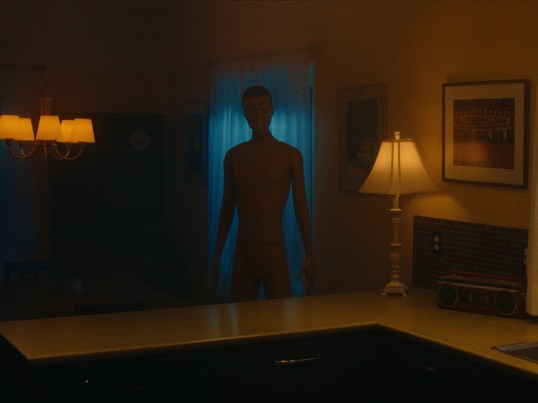
The main thing you need to know about 2023’s Don’t Look Away is that the killer looks like this.

Yes, the killer is a mannequin and a rather silly-looking one at that.  Silly or not, the mannequin is undeniably creepy, as mannequins tend to be.  The mannequin is apparently stalking a group of friends.  Frankie (Kelly Bastard) is convinced that the mannequin is alive and possessed by some sort of supernatural power.  Her friends disagree …. until they start dying, one-by-one.

Now, I should make clear that, for the majority of the film’s running time, we don’t actually see the mannequin kill anyone.  At the most, we see the mannequin suddenly show up behind someone.  He evens shows up in a swimming pool at one point.  Occasionally, his facial expression seems to change but, for the most, he always has the same goofy smile painted on his face.  The mannequin stalks one person-at-a-time and if you see him behind you and then look away, he’ll be closer the second time you look at him.

We do see the aftermath of meeting the mannequin.  As silly as it may seem to get killed by a mannequin (and I mean, seriously, how do you handle that shame while waiting in Purgatory), Kelly’s friends are actually dying, though it appears that they could all just be having unfortunate accidents or committing suicide.  Is it possible that the mannequin is just a mess delusion and that Kelly’s paranoia has poisoned the group?  The thing is, though …. if you were going to imagine a scary mannequin trying to kill you, wouldn’t you actually visualize something a lot more scary than a naked, emasculated wooden man with a silly smile on his face?

Don’t Look Away doesn’t quite work.  None of the friends really make a huge impression or even register as anything more than horror movie stereotypes.  There’s a scene set in a disco that I appreciated but that’s just because I appreciated anything that’s set in a disco.  Don’t Look Away suffers from a common affliction amongst horror films that were made after It Follows, in that the action moves way too slowly.  When the film should be fast-paced and silly, it’s somber and strangely self-serious.

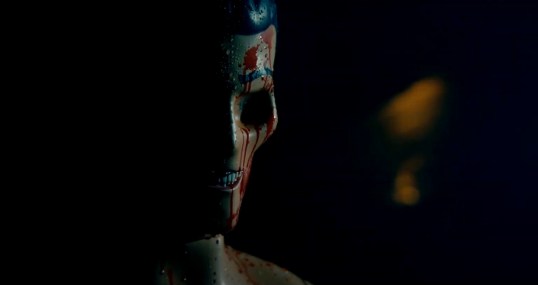
The film’s big star, of course, is that mannequin.  Here’s another shot of him.

I mean, yeah, he’s creepy.  The first few times that you see him, he’s legitimately scary.  But then, after a while, he just become silly.  There’s only so much you can do with a goofy-looking mannequin.  I mean, don’t get me wrong.  I’ve seen some good killer mannequin films.  Mannequins can definitely be scary and I wouldn’t want to get locked in a warehouse with them or anything like that.  Mario Bava’s Lisa and the Devil makes wonderful use of the creepiness of mannequins.  But the mannequin at the heart of Don’t Look Away becomes less creepy and more goofy every time that you see him.  I’ll admit that I looked away a few times in an effort not to laugh.

Hmmm …. that may have been a mistake.

6 Trailers For The Tuesday Before Halloween


It’s a holiday and you know what that means!

Or maybe you don’t.  Sometimes, I forget that not everyone can read my mind.  Anyway, I used to do a weekly post of my favorite grindhouse trailers.  Eventually, it went from being a weekly thing to being an occasional thing, largely due to the fact that there’s only so many trailers available on YouTube.  Now, Lisa Marie’s Favorite Grindhouse and Exploitation Film Trailers is something that I usually only bring out on a holiday.

Like today!

So, here are 6 trailers for the last week of October!

  1. Last House On The Left (1972)

“Two girls from the suburbs.  Going to the city to have …. good time….”  Wow, thanks for explaining that, Mr. Creepy Narrator Dude.  That classic tag line about how to avoid fainting would be imitated time and again for …. well, actually, it’s still being imitated.  This was Wes Craven’s 1st film and also one of the most influential horror films of all time.

2. The Texas Chainsaw Massacre (1974)

Speaking of influential horror movies, the trailer for The Texas Chainsaw Massacre is almost scarier than the film itself!

3. Lisa Lisa (1977)

I love this trailer!  Can you guess why?

4. Ruby (1977)

Ruby, starring Piper Laurie!  I’m going to assume this was after Piper Laurie played Margaret White in Carrie.  Don’t take your love to town, Ruby.

5. Jennifer (1978)

Jennifer was another film that pretty obviously inspired by Carrie.  In this one, Jennifer has psychic control over snakes.  So, don’t mess with Jennifer.

6. The Visitor (1979)

Finally, this Italian Omen rip-off features Franco Nero as Jesus, so it’s automatically the greatest film ever made.

Happy Weekend Before Halloween!

The TSL Horror Grindhouse: The Reverend (dir by Neil Jones)


At the start of 2011’s The Reverend, the Devil (Rutger Hauer) pulls up in front of a luxurious hotel.  He gets out of his limo, enters the hotel, and finds God (Giovanni Lombardo Radice) sitting at his desk, surrounded by armed priests.

God asks the Devil what he’s been doing.  The Devil says he’s been traveling the world and tempting men to do evil.  The Devil says that he wants permission to ruin the life of one man who is virtuous and God-fearing, saying that the man will reject his faith as things get worse and worse.  God agrees, as long as the man is not killed….

Does this sound familiar?  Yep, this is yet another adaptation of the Book of Job.  Or, I should say, this film pretends to be an adaptation of the Book of Job.  The nameless Reverend (Stuart Brennan) is a God-fearing man whose life goes downhill after he’s bitten by a vampire.  That said, there’s really not much of a comparison to be made between the Reverend and Job.  Job lost everything, including his land and his family and the majority of his friends.  The Reverend doesn’t really have any friends to lose and he actually gets better at his job after he is turned into a vampire and proceeds to take out his village’s criminal element.

In fact, the entire prologue between God and the Devil feels as if it was tacked on at the last minute.  It really doesn’t connect to the rest of the film and we certainly don’t learn whether it was God or the Devil who won the bet.  Hauer and Radice only appear in that one scene and then they are never heard from again.  That’s a shame because, to be honest, the only reason I watched this movie was for the chance to see Hauer and Radice together.  They were both incredible character actors and tragically, both of them are no longer with us.  Hauer passed away in 2019 and Radice died last year.  Neither one of them looks particularly healthy in the prologue, though it is nice to see the two of them sharing the screen together, albeit for just a few minutes.

As for the rest of the film, it did have potential.  There’s a lot of blood spilled and that’s always a plus when it comes to a vampire movie.  Doug Bradley gives a good performance as the Reverend’s enigmatic superior.  Stuart Brannen is himself likable enough as the Reverend and the scene where he’s first bitten has a kinetic energy to it that briefly gave me some hope for the rest of the film.

Unfortunately, with the exception of the aforementioned scenes, The Reverend is a rather slow movie and one that never succeeds in building up any sort of narrative momentum.  (I guess that’s a polite way of saying that it’s kind of boring.)  As a character, The Reverend is likable but he’s never compelling and the film ends on a rather anticlimactic note.  The film had potential but sadly, most of it went unrealized.

The TSL Horror Grindhouse: Delirium (dir by Peter Maris)


1979’s Delirium takes place on the mean streets of St. Louis and the surrounding countryside.  Crime is out of control and something has to be done about it!  Thanks to Earl Warren and the Carter administration, the police are powerless to stop the criminals.  (“Miranda rights my ass!” you can almost hear the film’s screenwriter shouting.)  So, the wealthier citizens of St. Louis get together and hire a bald Vietnam vet named Eric Stern (Barron Winchester) to lead a paramilitary group of vigilantes.  One of Stern’s men is another vet, Charlie (Nick Panouzis).  Charlie suffers from PTSD and it turn out that being a part of a militia is not the best way to deal with war trauma.  Who would have guessed?

Charlie snaps.  He starts killing people, in both St. Louis and the surrounding farms.  One victim is a hitchhiker who is dumb enough to hitch a ride from him and then to taunt him when he refuses to go skinny dipping with her.  It turns out that Charlie’s been impotent ever since he came home from the war.  He doesn’t respond well to jokes about it.

As Charlie claims more and more victims, both the police and vigilantes search for him.  The police want to stop his rampage,  The vigilantes don’t want Charlie to accidentally reveal their existence.  The whole thing ends in violence, gun fights, and flashbacks in which Vietnam looks a lot like rural Missouri.

Delirium is a film that I first noticed on my list of Tubi recommendations a few months ago.  I finally watched it last night and I have to admit that my first reaction was, “What the Hell was that?”  Delirium is bizarre mix of slasher horror and vigilante thrills, the type of mishmash that one can only really find in a grindhouse film.  That the budget was low is obvious in every shot.  The wealthy conspiracy meets in what appears to be a hut. As I previously mentioned, the Vietnam scenes were clearly filmed in Missouri.  The acting is largely amateurish, with the exceptions of the intense Nick Panouzis and the absolutely insane performance of Barron Winchester.  The film was gory enough to have earned a spot on the infamous Videos Nastys list but, as is so often case, what was shocking in 1979 seems rather tame in 2024.  I did like the conspiracy aspects of the film.  The idea of a group of wealthy people putting together a vigilante squad without actually bothering to do any background checks on the people they recruited actually has a good deal of potential.  The film is a mess but it’s a mess in the oddly fascinating way that many low-budget 70s films were.  The mix of ambition and a low budget often led to watchable oddities like Delirium.

The main thing that really stuck with me about Delirium is just how annoyed and angry almost every single character in the film seemed to be.  Even the cop trying to stop Charlie seems like he was pissed off about having to actually do his job.  I guess St. Louis does that to people.

The TSL Horror Grindhouse: Fraternity Demon (dir by C.B. Rubin)


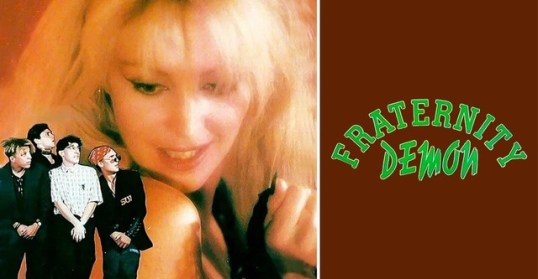
In 1992’s Fraternity Demon, Isha (Trixxie Bowie) is a succubus who is summoned into the real world by a nerdy frat boy who is doing something with a personal computer.  To be honest, I’m not totally sure what nerdy Dave (Al Darrouch) did to summon the succubus but she shows up in the real world and proceeds to have softcore sex with some 30 year-old frat boys in her quest to find Dave.

To be honest, I should have stopped this film as soon as I saw the New York skyline and “Troma Presents” at the start of it.  I’ve seen enough Troma films that I knew exactly what I was getting myself into but I kept watching the film just in case it turned out to be some sort of lost masterpiece.  Unfortunately, the film turned out to just be another boring Troma softcore film, featuring bad acting, bad humor, and terrible sound quality.  I honestly cannot begin to put into words just how wooden most of the acting was.  This was apparently C.B. Rubin’s only film as a director and watching the film, one can see why.  Fraternity Demon is an 86 minute film that feels like four hours, largely because the director obviously had no idea how to tell a story cinematically.

That said, I stuck with the film because everything that I read about Fraternity Demon said that the film was worth sitting through for the performance of Shock-Ra, the band that plays the fraternity party.  And I will say that I did like Sh0ck-Ra.  They reminded me a bit of X, the Los Angeles punk band that I’ve been obsessed with ever since I watched The Decline of Western Civilization a few months ago.  Speaking of punk, the film features a character who apparently lives on the front steps of the frat house.  He wears a Black Flag t-shirt and he growls at people.  He was probably the best actor in the film, assuming that he was an actor and not just some guy who the director couldn’t convince to leave.

Let’s see, what else was amusing in this film?  The fraternity was named SUX.  The sorority was named ASS.  That was pretty dumb but it made me laugh because, when I get delirious in my boredom, I tend to laugh at dumb things.  Nerdy Dave and his potential girlfriend, Kelly (Deborah Carlin), were kind of a cute couple.  One of the sorority girls comments that she likes a shy guy that she’s seen in at the frat house.  Kelly immediately says, “Dave?” because, of course, frat houses are only allowed to have one shy guy.

I initially assumed that Trixxie Bowie was an adult actress slumming in a Troma softcore flick but it turns out that Fraternity Demon was her only film role.  She made her debut as a star and then she never made another film.  Her performance in this film isn’t particularly good but she does manage to get off a few good one-liners.

Is that 500 words yet?  It is?  Good, let’s end this review.

Seriously, no more Troma films for me….

The TSL Horror Grindhouse: Blind Date (dir by Nico Mastokaris)


In 1984’s Blind Date, Joseph Bottoms stars as Jonathon Ratcliff, an American who works in Greece.

Jonathon would appear to have it all.  He has a good job in an exotic land.  He has a nice home.  He has a beautiful girlfriend named Claire (Kirstie Alley).  He has co-workers who love him so much that they insist on throwing him a birthday party and giving him his cake while he’s making love to Claire.  Jonathon enjoys jogging and listening to music and spying on his neighbor, which the film treats as a harmless little thing that all men do.  I mean, I guess we should be happy that Jonathon isn’t disguising himself as a taxi driver and murdering the women that he picks up with a scalpel.  No, someone else is doing that.

Jonathon suddenly loses his eyesight.  Fortunately, Dr. Steiger (James Daughton) has a solution.  He’s created a computer program that turns sound into very primitive, grid-like images.  As long as Jonathon is wearing his headphones, he can see … kind of.  At first, it’s all good fun.  Jonathon beats up the extremely flamboyant muggers who have been harassing him at the subway station.  And he continues to spy on his neighbor whenever she’s getting undressed which is not cool considering that Claire has stayed with him through his entire ordeal.

Meanwhile, the scalpel murders are continuing….

Now, to be honest, I assumed that Jonathon was going to form some sort of mental connection with the killer and start seeing the murder through the killer’s eyes.  Instead, Jonathon just hears the killer walking with one of his victims and he ends up investigating on his own, despite not really being able to see well.  Basically, the whole idea of Jonathon being blind doesn’t have much to do with the thriller aspect of the plot.  I could maybe accept that if the film hadn’t spent a huge amount of time explaining in pain-staking detail how exactly Jonathon’s “eyes” work.  The action literally stopped for a huge chunk of the film’s running time so that the film could make its most ludicrous plot point seem even more ludicrous.

Greek director Nico Mastokaris is obviously trying to do an Argento-style giallo with Blind Date and, indeed, Argento himself has a noted habit of including intriguing but ultimately pointless red herrings in his films.  Just as Asia Argento having the Stendhal Syndrome proved to be a bit inconsequential to The Stendhal Syndrome, Joseph Bottoms being blind is inconsequential to Blind Date.  That said, Argento can get away with that sort of thing because, even in his weaker films, he’s clever stylist and he usually maintain a solid narrative pace.  Blind Date, on the other hand, is rather draggy and Joseph Bottoms is not a particularly likeable hero.

On the positive side, James Daughton (he was the head of the evil frat in Animal House) gives a genuinely interesting performance and Kirstie Alley is likable as the neurotic Claire.  For the most part, though, one can see why the sequel promised in the closing credits never came to be.

6 Ed Wood Trailers For Horrorthon


Since the 10th of October was the 100th anniversary of the birth of director Edward D. Wood, Jr., it seems appropriate to dedicate this week’s edition of Lisa Marie’s Favorite Grindhouse Trailers to him!

Below …. can you handle six trailers for six Ed Wood films!?

Watch, if you dare!

  1. Glen or Glenda (1953)

2. Jail Bait (1954)

3. Bride of the Monster (1955)

4. Plan 9 From Outer Space (1957)

5. The Sinister Urge (1960)

6. Meatcleaver Massacre (1977)

The TSL Horror Grindhouse: The Wizard of Gore (dir by Herschell Gordon Lewis)


First released in 1970, Herschell Gordon’s Lewis’s The Wizard of Gore tells the story of Montag The Magnificent (Ray Sager), a magician who has a rather macabre stage show.

After lecturing his audience about how everyone secretly wants to see blood and violence, he selects a female volunteer from the audience.  Both the woman and the rest of the audience are hypnotized.  Montag’s tricks all involve mutilating his volunteers.  One volunteer is chainsawed.  Another gets a metal spike driven into her brain.  Another is drilled by a giant punch press.  (Like seriously, how does one store a giant punch press?)  The hypnotized audience only sees Montag using his various instruments of torture but they don’t see the wounds or the blood or the intestines.  (The movie audience is a bit less lucky.)  The victim is hypnotized into not realizing that she has essentially been murdered but, when the hypnosis wears off after the show, they promptly drop dead, mysteriously mutilated in the same way that everyone saw Montag miming on stage.

Naturally, the police arrest Montag and the movie ends.

No, actually, it doesn’t.  Even though it’s obvious that Montag is the murderer and that he’s hypnotizing people, the police don’t arrest him because his hypnotized audience swears that Montag didn’t really hurt anyone during his stage act.  However, television host Sherry (Judy Cler) and her lunkhead boyfriend, Jack (Wayne Ratay), both come to believe that Montag is the killer and they try set up a plot to expose him on national television,  Montag can’t hypnotize people through the television …. can he!?  And if he can do that, who is to say that he hasn’t hypnotized the people in the theater who would have been watching The Wizard of Gore when it was first released?

The Wizard of Gore appears to have been Herschell Gordon Lewis’s attempt to comment on his own status as a director who was notorious for making gory films.  (His 1963 film, Blood Feast, is often referred to as being the first gore film.)  Montag is a monster who appeals to his audience’s desire to see something extreme and forbidden.  For all of Montag’s evil, he can only exist and get more victims because people are willing to watch him torture strangers.  Lewis was not exactly known for being a particularly artful director but the shots of Montag’s victims screaming in terror while Montag’s audience silently and unemotionally watches are about as close to a genuinely powerful moment as you’re likely to find in a Herschell Gordon Lewis film.  The Wizard of Gore, with its commentary on the gore genre that Lewis himself largely invented, is one of Lewis’s more self-referential films.  And with it’s trick ending and shots of people suddenly collapsing with their intestines literally spilling out of them, it’s also one of Lewis’s stranger films and that’s saying something when you consider just how many odd films Lewis made over the course of the 60s and 70s.  (There’s a reason why one of his better films was called Something Weird.The Wizard of Gore is definitely a Lewis film, with his trademark stiff actors and non sequitur dialogue giving the whole thing a dream-like feel.

There’s a scene in Juno where Jason Bateman tells the film’s title character that Herschell Gordon Lewis is a superior filmmaker to Dario Argento and that The Wizard of Gore is scarier than Suspiria.  As soon as I heard that, I knew his character was going to turn out to be a sleaze and I was right.  The Wizard of Gore is a historically interesting film, especially for those who love the old grindhouse films.  But it’s no Suspiria.