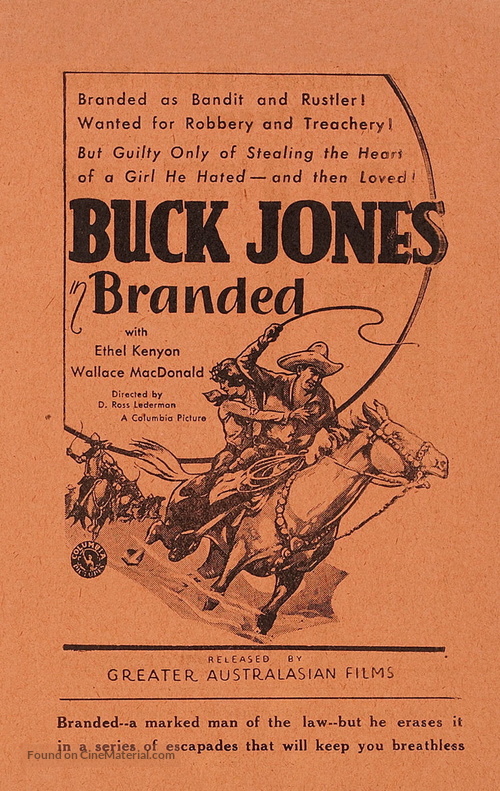
Branded (1931, directed by D. Ross Lederman)


Tom Dale (Buck Jones) and his employee, Swede (John Oscar), come across a stage coach robbery.  Though the robber gets away, Tom and Swede recover a stolen mailbag.  Tom finds a letter to himself and it is revealed that his real name is Cuthbert Chauncey Dale.  After explaining that he goes by Tom because that was his uncle’s name, Tom says that he’ll shoot anyone who calls him Cuthbert and he’s the movie’s hero!

When the local posse comes upon Tom and Swede, they accuse them of having robbed the stagecoach.  Tom and Swede manage to escape from jail during the dead of night and ride to a neighboring town, where Tom has inherited his uncle’s ranch.  Tom and Swede work on the ranch, building fences and branding cattle.  Tom starts to fall for Lou Preston (Ethel Kenyon), earing him the enmity of Joe Moore (Albert J. Smith), who is also in love with Lou.  Joe frames Tom and Swede for cattle rustling.  Tom and Swede attempt to clear their names with the help of their new friend, the same man (Wallace MacDonald) who previously robbed the stage coach!

This short but complicated B-western has its share of gunfights and chases on horseback but it still has some slow spots.  There are a lot of scenes of Tom and Swede working around the ranch.  When you’re ready for another gunfight, Tom and Swede have to go work on the fence.  Still, fans of early westerns will probably enjoy Branded.  Wallace MacDonald is a likable rouge as the Stagecoach Robber and the movie ends on a little more of a serious note than the typical poverty row western.  Buck Jones was an authentic cowboy before he went into the movies and he’s believable whenever he’s riding a horse, shooting a gun, or just walking around his ranch.  Just don’t call him Cuthbert!

The Fighting Marshal (1931, directed by D. Ross Lederman)


The town of Silver City has a new marshal. He’s tough, no-nonsense, and an expert marksman. He is exactly what it needed to clean up the town and he is also a complete fraud. The marshal is actually Tim Benton (played by Tim McCoy), an escaped convict who was doing time after being framed for the murder of his father. Seeking revenge on the men who framed him and who stole his family’s silver mine, Tim escaped from prison with the help of Red Larkin (Matthew Betz), who actually was guilty of the crimes for which he was imprisoned. After Red kills the man who was actually appointed to serve as Silver City’s new marshal, Tim took the man’s identity.

Despite the years that he spent wrongly imprisoned, Tim really isn’t an outlaw at heart. He’s one of the good guys and he soon starts to settle into his role as town marshal. He even falls in love with Alice Wheeler (Dorothy Gulliver). However, Tim still has to get revenge for his father’s death and he is also going to have to deal with Red Larkin, who has no interest in going straight. Ironically, what Tim doesn’t know, is that he was only a day or two away from receiving a full pardon when he broke out of prison and went on the run.

The Fighting Marshal is an above average western programmer. Though the low-budget and rushed quality of the production is obvious (just check out the opening title card, which misspells Marshal), Tim McCoy is a credible western hero, looking credible on a horse and handling a gun with the skill of someone who started his career as a sharp shooter. The film’s mistaken identity plot is an interesting wrinkle on all of the usual western action and McCoy is convincing as he goes from being an escaped convict to being a man who truly cares about maintaining law and order in Silver City.

Of course, like many of the early western stars, McCoy was himself an authentic cowboy. He looked convincing with a gun because, in real life, McCoy was an expert marksman who was considered to be the best shooter in Hollywood. When he wasn’t making movies, McCoy served in the U.S. Army and he was also one of the first Hollywood actors to try to make the leap over to politics, running unsuccessfully for the U.S. Senate in Wyoming. Later, when his film career waned, McCoy hosted a children’s show where he would show his movies and discuss the history of the old west. He was nominated for a daytime Emmy but refused to attend the ceremony when he discovered he would be competing against a show featuring a talking duck. His exact words, when turning down the invitation to the ceremony, are often quoted as being; “I’ll be damned if I’m going to sit there and get beaten by a talking duck!”

One final note: According the IMDb, The Fighting Marashal was filmed over the course of a week in October in 1931. Less than a month later, it was released on November 25th. That’s the old Hollywood system for you. They didn’t waste anytime getting their movies into the theaters.

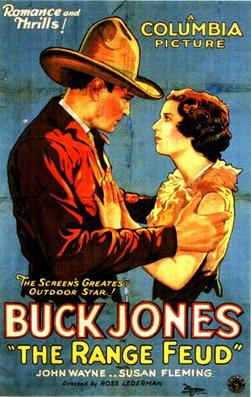
The Range Feud (1931, directed by D. Ross Lederman)


In a frontier town, two ranching families are at war.  The Turners claim that the Waltons have been stealing and reselling their cattle.  Even an attempt to hold a peace meeting at the local church just leads to more fighting.  Complicating things is that young Clint Turner (John Wayne) is in love with Judy Walton (Susan Fleming).  When someone shoots John Walton (Edward LeSaint) through the window of his office, Clint is the number one suspect.  Not helping is that Clint had an empty round in his gun.  Clint says that he fired at a coyote but he missed.  Everyone else in town says that its time to hang Clint without a trial.

Only Sheriff Buck Gordon (Buck Jones) stands between the mob and Clint.  Buck was raised by the Turner family and considers Clint to be his brother.  However, Buck still knows that Clint might be guilty but there’s no way that Buck is going to allow mob justice to rule his town!

The Range Feud was one of the many B-programmers that were released in the 30s.  Running less than 60 minutes, it is a briskly paced western that features a theme that was present in many westerns, the battle between mob justice and the law.  The townspeople who are eager to hang Clint without a trial represent the old ways of doing things while Buck represents the new way, in which everyone is innocent until proven guilty and entitled to a fair trial.

Buck Jones was one of the best of the early western heroes.  He played tough-but-fair men who could definitely handle themselves in a fight but who preferred to try to reason their way out of conflict.  Buck Jones served in a Calvary unit, worked as a cowboy, and started in the film business as a stunt man.  He had an authenticity that set him apart from others who merely pretended to be cowboys.  That authenticity serves him well in The Range Feud.  He may feel bad about having to arrest his stepbrother but any character played by Buck Jones can be guaranteed to follow the law.  In real life, Buck Jones died a hero.  In 1942, Buck Jones was at the Cocoanut Grove nightclub in Boston when a fire broke out.  Though Jones initially was able to get out of the nightclub, he subsequently reentered to help other people get out.  Severely burned, he died of his injuries two days later.

Of course, the main reason that people will track down this film is for a chance to see the young John Wayne playing a key  supporting role as Clint Turner.  It’s always a little bit strange to see Wayne playing a young man.  He’s one of those actors who you always assume was always in his 40s.  Wayne is likable as the free-spirited Clint, though it is again strange to see Wayne playing someone other than an authority figure.  For once, it’s Wayne who ends up in jail and who is dependent on someone else to save him.

The Range Feud is an entertaining and fast-moving western.  Fans of the genre and of Buck Jones and John Wayne will appreciate it.