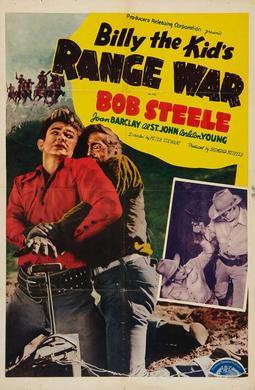
 Billy the Kid (Bob Steele) escapes from a Mexican prison (where he was being held on a trumped-up charge) and ends up in Corral City, Texas with his old friend, Fuzzy Jones (Al St. John). This version of Billy the Kid may be an outlaw but he’s a really nice outlaw. He holds up two men who had previously held up a express wagon but he turns over the loot after he and Fuzzy are appointed the new law in Corral City. The bad outlaws don’t want Billy the Kid or anyone else as their new sheriff so they bring in a notorious gunslinger (Carleton Young) to help them keep the town under their control but it turns out that Billy and the gunslinger have a past that no one knew about.
Bob Steele played Billy the Kid in a series of films, until Buster Crabbe took over the role in 1942. Steele was a convincing cowboy and a convincing gunman but he wasn’t a convincing kid. Of course, this version of Billy the Kid didn’t have much in common with the real Billy the Kid. The movie version of Billy the Kid got into a lot of trouble but it was usually due to a misunderstanding.
Billy the Kid In Texas is definitely a Poverty Row western. It looks cheap and it was cheap but it did feature a good fight scene between Bob Steele and Charles King and the relationship between Billy the Kid and Carleton Young’s gunslinger also added some extra dimension to the otherwise predictable story. This film is okay for western fans who aren’t sticklers for historical accuracy.
 Through the Shattered Lens