Suspense Film Review: Rope (dir by Alfred Hitchcock)


Rope, an odd little 1948 experiment from Alfred Hitchcock, opens with a murder.

Two wealthy young men, Brandon (John Dall) and Philip (Farley Granger), invite their friend, David Kentley (Dick Hogan), up to their apartment.  When David arrives, they strangle him and hide his body in a wooden chest.  As quickly becomes obvious, Brandon and Philip killed David largely to see if they could pull off the perfect murder.  Brandon is sure that they did and, that by doing so, they proved the concept of Nietzsche’s Übermensch,  The alcoholic Philip is less sure and starts drinking.

Brandon and Philip don’t just have murder planned for the day.  They’re also planning on throwing a little dinner party and, among those on the guest list, are David’s parents, his girlfriend, and his girlfriend’s former boyfriend.  Also attending will be Brandon and Philip’s former teacher and housemaster, Rupert Cadell (James Stewart).  In fact, Brandon regularly claims that he got the idea to commit the perfect murder as a result of discussing philosophy with Rupert.  Apparently, Rupert turned Brandon onto Nietzsche….

AGCK!  JIMMY STEWART LEADING YOUNG MEN TO FASCISM!?  SAY IT’S NOT SO!

Well, fortunately, the dinner party conversations reveals that Brandon and Philip misunderstood what Rupert was trying to tell them.  They assumed, using the same type of logic that currently fuels most debate today, that just because Rupert mentioned something that meant that he approved of it.  As it becomes clear that Rupert would not approve of what his students have done and as Rupert himself starts to suspect that something bad has happened at the apartment, Brandon and Philip start to plot against their former mentor….

Now, it can be argued that Rope is not a horror movie.  And indeed, if your definition of horror is ghosts, vampires, werewolves, or any other type of paranormal creature than yes, Rope has none of those.  Instead, the horror of Rope is the horror of human cruelty.  It’s the horror of two privileged young men who have so twisted the words of their mentor that they’ve become monsters.  The horror in Rope comes from the fact that, in 1948, Brandon and Philip have embraced the same philosophy that, only a few years earlier, had plunged the entire world into war.  While families mourned their dead and Europe struggled to rebuild, Brandon and Philip showed that they had no understanding of or concern for the trauma that humanity had just suffered.  And making it even more disturbing is that they found the justification for their crimes in the lessons taught by the epitome of American decency, Jimmy Stewart.  The idea of that is more terrifying than any Hammer vampire flick.

Of course, Rope is best known for being a bit of an experiment.  Hitchcock edited the film to make it appear as if it was all shot in one take and events, therefore, played out in real time.  It’s an interesting idea and, as always, you have to admire Hitchcock’s ingenuity and, even in a film as grim as this one, his playfulness.  At the same time, Hitchcock’s technique makes an already stagey story feel even stagier.  Some of the actors — like James Stewart, John Dall, and Cedric Hardwicke in the role of David’s father — are able to give naturalistic and convincing performances despite the staginess of the material. Others, like poor Farley Granger, find themselves overshadowed by the film’s one-shot gimmick.

Rope is an experiment that doesn’t quite work but flawed Hitchcock is still a pleasure to watch.  The final few minutes, with Stewart and Dall finally confronting each other, are among the best that Hitchcock ever put together.  I appreciate Rope, even if it doesn’t quite succeed.

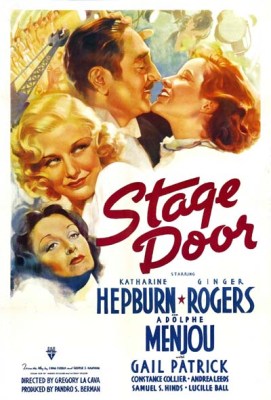
Cleaning Out The DVR #35: Stage Door (dir by Gregory La Cava)


(For those following at home, Lisa is attempting to clean out her DVR by watching and reviewing 38 films by the end of today!!!!!  Will she make it?  Keep following the site to find out!)

Stage_Door_(1937)

The 1937 film Stage Door is a great example of a unique genre of American film, the Katharine Hepburn Gets Humbled genre.

In the 1930s, Katharine Hepburn went through a period of time where she was considered to be “box office poison.”  She was undeniably talented but it was obvious that the studios weren’t sure how to showcase that talent.  They put her in high-brow films that often did not have much appeal to audiences.  As well, the press hated her.  Katharine Hepburn was outspoken, she was confident, she was a nonconformist, and, too many, her refusal to do interviews and sign autographs marked her as a snob.  Very few people wanted to see a movie starring Katharine Hepburn and therefore, very few people were willing to make a movie starring Katharine Hepburn.

(Interestingly enough, as I sit here typing this, another KH — Katharine Heigl — is pretty much in the exact same situation, with the main difference being that Hepburn was a far more interesting actress.)

Fortunately, Katharine Hepburn was smart enough to recognize the problem and she started to appear in films like Stage Door.  In Stage Door, she essentially played a character who mirrored the public’s perception of her.  Terry Randall is a snobbish and pretentious aspiring actress who comes to New York to pursue her career and moves into a theatrical rooming house.  At first, her attitude makes her unpopular with the other actresses living in the house.  But, as the film progresses, Terry slowly starts to let down her defenses and reveals that she’s just as insecure, neurotic, and vulnerable as everyone else.  She also proves herself to be willing to stand up to manipulative producers and condescending directors.  When she’s cast in her first Broadway show, it turns out that the show is being financed by her father and his hope is that she’ll do such a bad job and be so humiliated that she’ll give up acting.  And, at first, it appears that Terry will be terrible.  During rehearsals, she is stiff and mannered.  (Hepburn was actually quite brave to portray Terry as being such a believably bad actress.)

Of course, Terry isn’t the only actress at the rooming house who has issues to deal with.  For instance, Judy Canfield (Lucille Ball) has to choose between pursuing her career or getting married and starting a family.  Kay (Andrea Leeds) is a once successful actress who is now struggling to find roles, can’t pay her bills, and has become suicidal as a result.  And then there’s Jean (Ginger Rogers), Terry’s cynical roommate and frequent enemy and occasional friend.  Jean is falling in love with Anthony Powell (Adolphe Menjou), the lecherous producer of Terry’s play.

Stage Door is a wonderfully entertaining mix of melodrama and comedy.  You’ll laugh, you’ll cry, and you’ll really find yourself hoping that all of the actresses at the rooming house will have their dreams come true.  While the film is dominated by Hepburn and Rogers, it truly is an ensemble piece.  Not only does the cast include Eve Arden, Lucille Ball and Andrea Leeds (giving the film’s best and most poignant performance) but the great dancer Ann Miller appears as Jean’s equally cynical best friend.  Stage Door may be 79 years old but it’s aged wonderfully.

At the box office, Stage Door was a modest success and it directly led to Hepburn being cast in the classic screwball comedy, Bringing Up Baby.  Stage Door was nominated for best picture but it lost to The Life of Emile Zola.