Silent Film Review: Tarzan of the Apes (dir by Scott Sidney)


Elmo Lincoln.

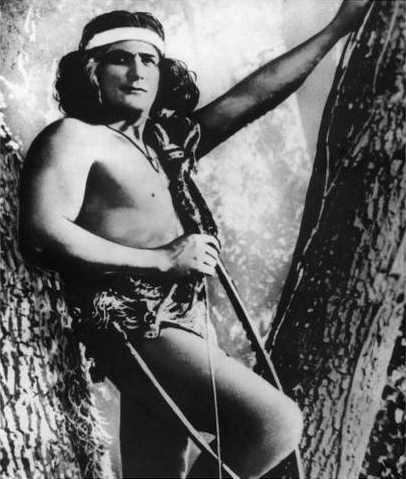
That name may not sound all the imposing but Elmo Lincoln played a very important role in the early days of Hollywood.  He was the first actor to play the adult version of Tarzan, the Lord of the Jungle.  Originally from Indiana, Elmo Lincoln was a 29 year-old former sailor and boxer when he was selected to replace Stellan Windrow as the star of 1918’s Tarzan of the Apes.  (A stunt man, Windrow had already filmed the majority of Tarzan’s stunts before he was drafted to serve in World War I.)  Lincoln, who had already appeared in a few of D.W. Griffith’s films, would briefly find stardom as a result of playing Tarzan.

Of course, it takes a while for Lincoln to appear in Tarzan of the Apes.  The film was reportedly two hours long when it was initially released but today, it only exists in a 61-minute version.  (Because each municipality had its own board of censors, the version of Tarzan of the Apes that played in one city could be quite different from the version that played in another.  Unfortunately, with that many censors snipping scenes from city to city, a lot of footage that was cut from the film was undoubtedly lost forever.)  The first half of the film deals with the birth of Tarzan while the second half features Tarzan as an adult.  Technically, the first actor to play Tarzan was the uncredited baby who appears shortly after Lord Greystoke (True Boardman) and his wife (Kathleen Kirkham) are abandoned by mutineers in Africa.  After the baby is given to the Apes, child actor Gordon Griffith takes over the role.  Finally, once an expedition is sent to investigate whether or not the stories about Tarzan are true, Elmo Lincoln takes over the role and saves Jane (Enid Markey) after she’s kidnapped by a group of natives.  The film ends with Tarzan and Jane just starting to fall in love.  (A sequel, The Romance of Tarzan, was released that same year but it’s a lost film.)

In the role of Tarzan, Elmo Lincoln is …. well, he’s okay.  He’s not a great actor but he’s a good Tarzan.  He’s obviously strong and athletic and he looks convincing when he’s hiding in the trees.  Lincoln was not a particularly expressive actor and that natural stiffness is noticeable whenever he’s called upon to demonstrate anything other than grim determination.  He has a strong physical presence and, in 1918, that was probably enough to make him a star.  When he gazes at Jane and the title cards tells us that he’s saying, “Tarzan is a man and man does not force the love of a woman,” the viewer believes it.  If I was lost in the jungle, I’d probably want Elmo Lincoln to help me out.  We wouldn’t have much to talk about but I would have faith in his ability to take care of any problems that we ran into on the way back to civilization.

That said, the film is at its best when it depicts Tarzan’s childhood.  There’s a sense of fun and wonder to those scenes that is missing from the second half of the film.  Gordon Griffith did a good job as the young Tarzan.  Louisiana is a surprisingly effective stand-in for the jungles of Africa.  By today’s standards, Tarzan of the Apes can seem a bit creaky.  (The camera barely moves at all.)  But watching it, one can still understand why Hollywood fell in love with the idea of a man raised by apes.  One can even understand why, for a brief period of time, Elmo Lincoln became a star.
Cleaning Out The DVR #23: The Adventures of Robin Hood (dir by Michael Curtiz)


(For those following at home, Lisa is attempting to clean out her DVR by watching and reviewing 38 films by this Friday.  Will she make it?  Keep following the site to find out!)

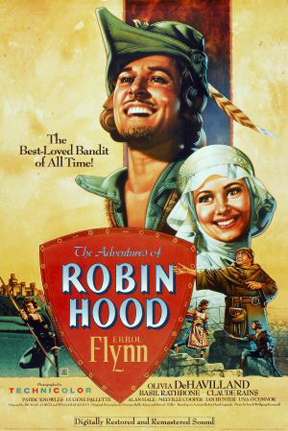
Robin_hood_movieposter

Flamboyant.  Athletic.  Joyous.  Determined.  Handsome.  Outspoken.  Bigger than life.  Revolutionary.  Anarchist.  Sexy.  Libertarian.  Is there any doubt why Errol Flynn remains the definitive Robin Hood?

And. for that matter, is there any doubt why the 1938 film The Adventures of Robin Hood remains not only the definitive Robin Hood film but also one of the most influential action films in history?

The Adventures of Robin Hood tells the story that we’re all familiar with.  The King of England, Richard The Lionhearted (Ian Hunter), is captured while returning from the Crusades.  His brother, King John (Claude Rains, in full autocratic villain mode), usurps the throne while Richard is gone and immediately raises taxes.  He claims that he’s only doing this to raise the money to set Richard free.  Of course, the real reason is that John is a greedy tyrant.

The only nobleman with the courage to openly oppose John is Sir Robin of Locksely (Errol Flynn).  Sir Robin protects his fellow citizens from John’s main henchman, Sir Guy of Gisbourne (Basil Rathbone, also in full autocratic villain mode).  In fact, Robin is so brave that, on multiple occasions, he even enters Sir Guy’s castle so that he can specifically tell King John and Sir Guy that he has no use for their laws.  This, of course, always leads to Robin having to make a dramatic escape while arrows flies and swords are unsheathed all around.

And through it all, Robin Hood keeps smiling and laughing.  He’s a wonderfully cheerful revolutionary.  He may be fighting a war against a ruthless and unstoppable enemy and he may be the most wanted man in England but Robin is determined to have fun.  One need only compare Robin to his humorless foes to see the difference between freedom and bureaucracy.

(We could use Errol Flynn’s Robin Hood today, though I suspect our government would just blow him up with a drone and then issue a statement about how, by stealing money from the rich and giving it to the poor, Robin was keeping the government from being able to rebuild bridges and repair roads.)

When Robin isn’t exposing the foolishness of organized government, he’s hanging out in Sherwood Forest.  He’s recruiting valuable allies like Friar Tuck (Eugene Pallette) and Little John (Alan Hale, Sr.)  He’s playing constant pranks and promoting revolution and, to his credit, he’s a lot more fun to listen to than that guy from V For Vendetta.  He’s also romancing Maid Marian (Olivia de Havilland) and good for him.  Two beautiful people deserve to be together.

Even better, he’s doing it in glorious Technicolor!  There’s a lot of great things about The Adventures of Robin Hood.  The action scenes are exciting.  The music is thrilling.  The film is perfectly cast.  Errol Flynn may not have been a great actor but he was a great Robin Hood.  But what I really love about the film is just the look of it.  We tend to take color for granted so it’s interesting to watch a film like The Adventures of Robin Hood, one that was made at a time when color film was something of a novelty.  For those of us who spend a lot of time talking about how much we love old school black-and-white, The Adventures of Robin Hood is a film that says, “Hey, color can be great too!”

But what I mostly love about The Adventures of Robin Hood is just the pure joy of the film.  Just compare this Robin Hood to the grimly tedious version played by Russell Crowe.

(True, nobody in The Adventures of Robin Hood shouts, “I declare him to be …. AN OUTLAAAAAAAAAAAAWWWWWWWW!”  Actually, now that I think about it, Ridley Scott’s Robin Hood would have worked much better if Oscar Isaac and Russell Crowe had switched roles.)

The Adventures of Robin Hood was nominated for best picture and it probably should have won.  However, the Oscar went to Frank Capra’s You Can’t Take It With You.

Cleaning Out The DVR #16: Johnny Belinda (dir by Jean Negulesco)


X-johnnybelindalenda48-jjp

Continuing my effort to watch 38 films in 10 days (and, as of today, I only have 6 days left!), I spent part of last night watching the 1948 film Johnny Belinda.

Johnny Belinda takes place in Canada, on Cape Breton Island.  The residents of the island are a hearty, no-nonsense group of people.  They work hard, they don’t play hard because they never play, they farm, and they don’t have much use for outsiders.  When a new doctor, Robert Richardson (Lew Ayres), arrives on the island, he has to work hard to earn their trust.

Dr. Richardson is fascinated by Belinda McDonald (Jane Wyman), a young woman who is deaf and mute.  Belinda lives on a farm with her father (Charles Bickford) and her aunt (Agnes Moorehead).  Everyone in the community assumes that Belinda is a simple-minded and, because her mother died giving birth to her, she is resented by her father.  Only Dr. Richardson believes that Belinda is in any way intelligent and, over her father’s objections, he teaches Belinda sign language.

Dr. Richardson’s secretary, Stella (Jan Sterling), falls in love with him and grows angry when it becomes apparent that he’s more interested in taking care of Belinda than pursuing an adulterous romance with Stella.  Meanwhile, Stella’s husband, a viscous alcoholic named Locky (Stephen McNally), gets drunk and rapes Belinda.  9 months later, when Belinda gives birth to a boy that she names Johnny, everyone assumes that Dr. Richardson is the father.  Soon, both Richardson and the McDonald family are being shunned by the judgmental community.

Locky, meanwhile, is determined to keep anyone from finding out about his crime, to the extent that he’s willing to commit murder.  Both Locky and Stella are determined to take Johnny away from Belinda and it all eventually leads to further tragedy and, somewhat inevitably, a dramatic murder trial.

Much like Random Harvest, Johnny Belinda is another film that I could imagine being remade for Lifetime.  It’s a well-made melodrama that appeals to all of the emotions and features a cast of talented actors doing good work playing characters that are probably just a bit too familiar.  In fact, there’s really not a single moment of Johnny Belinda that will take you by surprise but, despite that, the film still works.  Jane Wyman does such a good job playing the silent Belinda that it makes the entire movie worth watching.  (It’s interesting to contrast Wyman’s innocent, vulnerable, and sympathetic performance here with her far more severe work in The Yearling.)  Reportedly, Wyman devoted so much time and effort to her performance that it was cited as a reason for her divorce from future President Ronald Reagan.  For Johnny Belinda, Wyman lost the chance to be first lady but she did win an Oscar.

(And, for the record, Wyman voted for Reagan in 1980 and 1984, saying that it wasn’t often that you got to vote for your ex-husband.)

Johnny Belinda was nominated for best picture of the year and, with 10 nominations, it was the most nominated film of 1947.  Though it won an Osar for Wyman, it lost best picture to Laurence Olivier’s Hamlet.

Lisa Watches an Oscar Nominee: Witness for the Prosecution (dir by Billy Wilder)


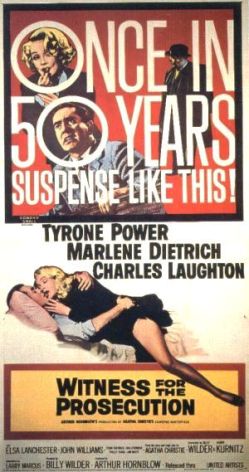
Movie_poster_for_-Witness_for_the_Prosecution-

Earlier today, I DVRed the 1957 best picture nominee, Witness for the Prosecution, off of TCM.  I watched the film as soon as I finished dinner and, having now seen Witness for the Prosecution, I am prepared to give you my professional and erudite review.

Okay, are you ready for it?  Here we go:

🙂 Oh my God, I freaking love this movie!!!!!!!!! 🙂

Witness for the Prosecution is many things.  It’s a courtroom drama.  It’s a domestic comedy.  It’s a twisty murder mystery.  It’s a showcase for three great performers.  It’s crowd pleaser that will make you think and, even if it does involve people killing each other, it will probably make you smile as well.  Don’t let that 1957 date fool you.  Witness For the Prosecution is a lot of fun.

Leonard Vole (Tyrone Power) is a somewhat sleazy man who has two claims to fame.  One is that he claims to be responsible for inventing the egg beater.  The other is that he’s been accused of murdering Mrs. French (Norma Varden), a wealthy widow who had recently named Leonard as the beneficiary of her will.  Everyone assumes that Leonard must have been having an affair with Mrs. French but Leonard claims that he’s innocent.

Suspecting that he is soon going to be arrested, Leonard hires Sir Wilfred Robarts (Charles Laughton) to serve as his attorney.  Though Sir Wilfred is recovering from a heart attack and has been ordered to not take on any more stressful criminal cases, he agrees to defend Leonard.  He proceeds to do just that, under the watchful eye of his nurse, the protective Mrs. Plimsoll (Elsa Lanchester).

(The testy relationship between Sir Wilfred and Mrs. Plimsoll provides the film with its comedic relief.  Laughton and Lanchester were married in real life and, watching the film, you can tell that they had a lot of fun acting opposite each other.)

Sir Wilfred is convinced that he can win acquittal for Leonard, especially since Leonard’s German wife, Christine (Marlene Dietrich), is willing to provide an alibi for him.  (In one of the film’s best moments, Sir Wilfred talks about how distraught Christine will be to discover that Leonard has been arrested just to then have the very calm and self-possessed Christine step into the room.)  However, to everyone’s shock, Christine is called as a witness for the prosecution.  She testifies that Leonard confessed the murder to her and that she only provided an alibi out of fear and love.

Things aren’t looking good for Leonard but then, a mysterious woman with a cockney accent contacts Sir Wilfred and reveals that Christine may have had reasons of her own for not giving Leonard an alibi…

Witness For The Prosecution ends with a voice over that says, “The management of this theater suggests that for the greater entertainment of your friends who have not yet seen the picture, you will not divulge, to anyone, the secret of the ending of Witness for the Prosecution.”  And I have to say that, when I heard that, it just made me love the film even more.  I had enjoyed the film so much and had so much fun following all the twists and the turns of the mystery that I found myself nodding in agreement.

“Sure, 58 year-old voice over,” I said, “I will not divulge the secret ending of Witness For The Prosecution.”

And I’m not going to!  Though, to be honest, you’ll probably guess the secret before it’s revealed.  It’s a plot twist that has been imitated by so many other courtroom dramas that it’s probably not as much of a mind-blower today as it may have been back in 1957.

But no matter!  Witness For The Prosecution is still a lot of fun.  Even if you figure out the mystery early, you can still watch the film and enjoy Laughton’s wonderfully theatrical performance.

Witness for the Prosecution was nominated for best picture and, interestingly enough, another theatrical courtroom drama — 12 Angry Men — was also nominated that year.  It’s interesting to compare the low-key drama of 12 Angry Men to the cheerful flamboyance of Witness For The Prosecution.  They are both great films about the law but each is told from a very different perspective.

Of course, in the end, both of these great films ended up losing to The Bridge On The River Kwai.