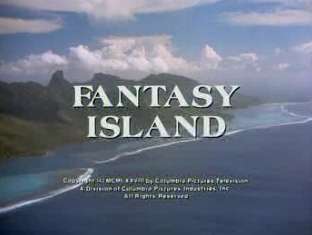
Retro Television Review: Fantasy Island 7.6 “Second Time Around/Three’s A Crowd”


Welcome to Retro Television Reviews, a feature where we review some of our favorite and least favorite shows of the past!  On Tuesdays, I will be reviewing the original Fantasy Island, which ran on ABC from 1977 to 1984.  Unfortunately, the show has been removed from most streaming sites.  Fortunately, I’ve got nearly every episode on my DVR.

This week, the Island is kind of dull.  Tattoo is missed.

Episode 7.6 “Second Time Around/Three’s A Crowd”

(Dir by Philip Leacock, originally aired on November 19th, 1983)

Love is in the air again at Fantasy Island!  Remember when this show used to feature mermaids and Greek Gods and ghosts and gothic mansions and stuff like that?  Those were good times!

Kate Tucker (Cristina Ferrare) comes to the Island to confront her husband, Gary Tucker (Geoffrey Scott, the quarterback from 1st and Ten), about his infidelity.  Roarke decides to bring Gary’s mistress, Helen (Michelle Phillips, who once played the mermaid on this very show), to the Island as well!  It’s all a part of Roarke’s plan to show both women that Gary’s not worth all the trouble.  Kate realizes she doesn’t want Gary and Helen doesn’t want him either.  Kate leaves the Island a single woman.  Good for her!

Meanwhile, widowed Joan (Dorothy McGuire) comes to the Island and falls for handsome Alan Reynolds (Craig Stevens).  Joan’s son (Stuart Damon) is upset at the idea of Joan marrying someone else.  Eventually, he comes to see the error of his ways and smiles as Joan and Alan find happiness.

This may have been an episode of Fantasy Island but it felt more like The Love Boat.  Roarke helped everyone find true love and Lawrence …. Lawrence was just kind of there.  At this point, I kind of feel that, if they were determined to get rid of Tattoo, they should have just had Roarke running the Island by himself.  Lawrence’s presence doesn’t accomplish anything beyond making the viewer miss Tattoo.

This was a pretty forgettable trip to the Island.

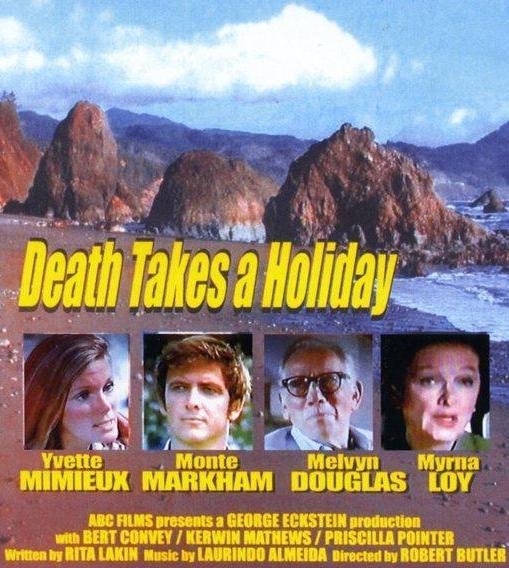
Retro Television Review: Death Takes A Holiday (dir by Robert Butler)


Welcome to Retro Television Reviews, a feature where we review some of our favorite and least favorite shows of the past!  On Sundays, I will be reviewing the made-for-television movies that used to be a primetime mainstay.  Today’s film is 1971’s Death Takes A Holiday!  It  can be viewed on YouTube.

For a few days in 1971, no one dies.

The Vietnam War continues but there are no casualties.  There are natural disasters but no one loses their life.  Doctors are stunned.  World leaders start to panic.  An emergency session of the UN is called to debate what to do about living in a world where no one is dying.  One gets the feeling that the world’s leaders prefer it when people are dying in wars and disasters.

Death has taken a holiday.

Death (Monte Markham) has become confused as to why humans so desperately want to live despite the fact that the world in which they exist is not always a happy one.  He is particularly confused by the elderly Judge Earl Chapman (Melvyn Douglas), who has suffered multiple strokes and other ailments and yet has always resisted whenever Death has come for him.  Death decides to take his holiday on the isolated beach where the Judge and his family are spending their weekend.  Though Death introduces himself as being David Smith, the Judge recognizes him.  It turns out that the Judge was always aware of death lingering around him and his family.

Death, for his part, has fallen in love with the Judge’s headstrong and rebellious daughter, Peggy (Yvette Mimieux).  In fact, Peggy was meant to die on the beach but, as soon as Death saw her drowning, he decided not to take her and instead allowed her to wash up back on the beach.  Death explains to the Judge that he can only spend so much time on vacation and that soon, people will start dying again.  Death says that he’ll be taking Peggy to the afterlife after the weekend ends.  The Judge tries to change his mind but Death is in love and he wants Peggy to be with him.

An adaptation of a play that inspired both 1934’s Death Takes A Holiday and 1998’s Meet Joe Black, the 1971 version of Death Takes A Holiday is a well-acted and intelligent made-for-television movie, one that eschews heavy-handed drama in favor of being a rather low-key meditation on what it means to both live and to die.  Melvyn Douglas and, as his wife, Myrna Loy both give poignant performances and Douglas even manages to sell the potentially maudlin moment where he explains why he has always clinged to life.  Monte Markham may not be the first actor who comes to mind when you think of someone to cast as the human form of Death but he does a good job in the role and he and Yvette Mimieux have a wonderful chemistry together.  The beach scenery is lovely and the story is an interesting one.  Clocking in at just 73 minutes, this version of Death Takes A Holiday is the best of all of them.

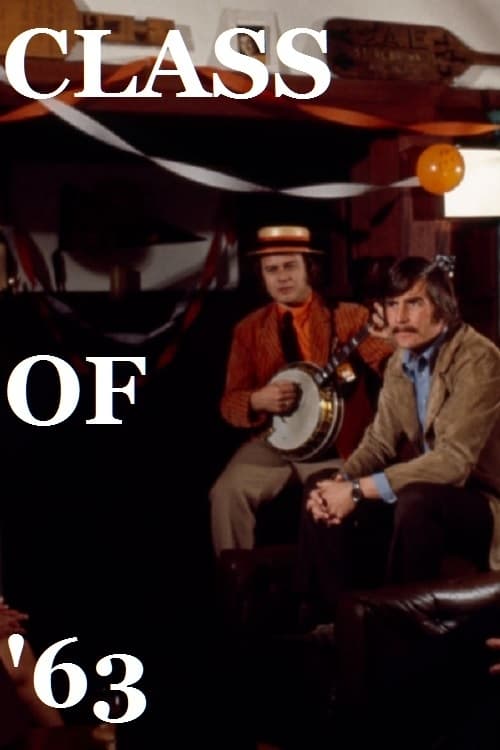
Retro Television Reviews: Class of ’63 (dir by John Korty)


Welcome to Retro Television Reviews, a feature where we review some of our favorite and least favorite shows of the past!  On Sundays, I will be reviewing the made-for-television movies that used to be a primetime mainstay.  Today’s film is 1973’s Class of ’63!  It  can be viewed on YouTube!

It’s college reunion time!  Alumni of all ages and from all over the country are returning to the place where they became adults and spent the best years of their lives.

Joe Hart (James Brolin), of the Class of ’63, returns to the campus but he immediately feels like a bit like an outsider.  As opposed to his former classmates, many of whom are desperately trying to recapture their fading youth, Joe is quiet and sensitive and he’s aware of the passage of time.  He hasn’t come back to college so that he can relive his carefree fraternity days.  Instead, his main interest is whether or not his former fiancée will be there.

And it turns out that Louise Swerner (Joan Hackett) is there!  She’s accompanied by her husband and fellow member of the Class 0f 63, Mickey Swerner (Cliff Gorman).  From the minute that Mickey appears, it’s obvious that he has both a chip on his shoulder and a lot of insecurity.  He is visibly annoyed when people fail to immediately recognize him.  He and Louise have a strained marriage and he’s not particularly happy with how excited she is to see Joe again.  While Mickey tries to convince everyone that he’s grown up to be a winner, Louise and Joe get reacquainted and it becomes obvious that they still love each other.  Will Louise and Joe leave the reunion together and should they be more concerned with the fact that Mickey just happens to have a sniper rifle in his luggage?  And what to make of Dave McKay (Ed Lauter), the former classmate who seems to be just a little bit too excited to see everyone?

It’s an interesting film and I have to say that it didn’t quite go the direction that I was expecting it to.  Despite the presence of the rifle and Mickey’s obvious instability, the film is less a thriller and more a look at what it means to grow up and the difficulty of letting go of the past.  None of the characters are caricatures.  Joe and Louise may seem perfect together but the film makes clear that they’re also idealizing their time together.  With neither one of them really happy with their current life, they’ve both fallen into the trap of wondering, “What if?”  Meanwhile, Mickey may be flawed but it’s impossible not to have some sympathy for him.  As hostile as Cliff can be, it’s obvious that the person that he hates the most is himself and Cliff Gorman does a good job of capturing Mickey’s raging insecurity.  Gorman’s intensity provides a good balance to Brolin’s more laid back performance and, by the end of the film, one can understand why and how Louise was able to fall in love with two men who superficially seem to be so different.

Class of ’63 is a good drama, one that requires a little patience but which ultimately rewards the audience for sticking with it.

Film Review: The Hindenburg (dir by Robert Wise)


80 years ago, on May 6th, 1937, the Hindenburg, a German airship, exploded in the air over New Jersey.  The disaster was not only covered live by radio reporter Herbert Morrison (whose cry of “Oh the humanity!” continues to be parodied to this day) but it was also one of the first disasters to be recorded on film.  Looking at the footage of the Hindenburg exploding into flame and sinking to the ground, a mere skeleton of what it once was, it’s hard to believe that only 36 people died in the disaster.  The majority of those who died were crew members, most of whom lost their lives while helping passengers off of the airship.  (Fortunately, the Hindenburg was close enough to the ground that many of the passengers were able to escape by simply jumping.)

Not surprisingly, there was a lot of speculation about what led to the Hindenburg (which has successfully completed 63 flights before the disaster) exploding.  The most commonly accepted explanation was that it was simply an act of God, the result of either lightning or improperly stored helium.  Apparently, there was no official evidence found to suggest that sabotage was involved but, even back in 1937, people loved conspiracy theories.

And really, it’s not totally implausible to think that the Hindenburg was sabotaged.  The Hindenburg was making its first trans-Atlantic flight and it was viewed as being a symbol of Nazi Germany.  One of the ship’s passengers, Captain Ernest Lehman, was coming to the U.S. in order to lobby Congress to give Germany helium for their airships.  With Hitler regularly bragging about the superiority of German industry, the theory was that an anti-Nazi crewman or passengers planted a bomb on the Hindenburg.  Since no individual or group ever stepped forward to claim responsibility, the theory continues that the saboteur must have perished in the disaster.

At the very least, that’s the theory put forward by a film that I watched earlier today, the 1975 disaster movie, The Hindenburg.

A mix of historical speculation and disaster film melodrama, The Hindenburg stars George C. Scott as Col. Franz Ritter, a veteran of the German air force who is assigned to travel on the Hindenburg and protect it from saboteurs.  Ritter is a Nazi but, the film argues, he’s a reluctant and disillusioned Nazi.  Just a few weeks before the launch of the airship, his teenage son was killed while vandalizing a synagogue.  Ritter is a patriot who no longer recognizes his country and George C. Scott actually does a pretty good job portraying him.  (You do have to wonder why a seasoned veteran of the German air force would have a gruff, slightly mid-Atlantic accent but oh well.  It’s a 70s disaster film.  These things happen.)

Ritter is assigned to work with Martin Vogel (Roy Thinnes), a member of the Gestapo who is working undercover as the Hindenburg’s photographer.  Tt soon becomes obvious that he is as much a fanatic as Ritter is reluctant.  Vogel is a sadist, convinced that every Jewish passenger is secretly a saboteur.  Thinnes is chilling in the role.  What makes him especially frightening is not just his prejudice but his casual assumption that everyone feels the same way that he does.

And yet, as good as Scott and Thinnes are, the rest of the cast is rather disappointing.  The Hindenburg features a large ensemble of actors, all playing characters who are dealing with their own privates dramas while hoping not to burn to death during the final 15 minutes of the film.  Unfortunately, even by the standards of a typical 70s disaster film, the passengers are thinly drawn.  I liked Burgess Meredith and Rene Auberjonois as two con artists but that was mostly because Meredith and Auberjonois are so charming that they’re fun to watch even if they don’t have anything to do.  Anne Bancroft has one or two good scenes as a German baroness and Robert Clary does well as a vaudeville performer who comes under suspicion because of his anti-Nazi leanings.  Otherwise, the passengers are forgettable.  Whether they die in the inferno and manage to make it to the ground, your main reaction will probably be to look at them and say, “Who was that again?”

Anyway, despite all of Ritter and Vogel’s sleuthing, it’s not much of mystery because it’s pretty easy to figure out that the saboteur is a crewman named Boerth (William Atherton).  Having seen Real GeniusDie Hard and the original Ghostbusters, I found it odd to see William Atherton playing a sympathetic character.  Atherton did okay in the role but his attempt at a German accent mostly served to remind me that absolutely no one else in the film was trying to sound German.

Anyway, the main problem with The Hindenburg is that it takes forever for the airship to actually explode.  The film tries to create some suspense over whether Ritter will keep the bomb from exploding but we already know that he’s not going to.  (Let’s be honest.  If you didn’t already know about the Hindenburg disaster, you probably wouldn’t be watching the movie in the first place.)  The film probably would have worked better if it had started with the Hindenburg exploding and then had an investigator working backwards, trying to figure out who the saboteur was.

However, the scenes of the explosion almost make up for everything that came before.  When that bomb goes off, the entire film suddenly switches to black-and-white.  That may sound like a cheap or even sensationalistic trick but it actually works quite well.  It also allows the scenes of passengers and crewmen trying to escape to be seamlessly integrated with actual footage of the Hindenburg bursting into flame and crashing to the ground.  The real-life footage is still shocking, especially if you’re scared of fire.  Watching the real-life inferno, I was again shocked to realize that only 36 people died in the disaster.

In the end, The Hindenburg is flawed but watchable.  George C. Scott was always at his most watchable when playing a character disappointed with humanity and the real-life footage of the Hindenburg disaster is morbidly fascinating.

Oh, the humanity indeed!