Film Review: The Shoes of The Fisherman (dir by Michael Anderson)


The 1968 film, The Shoes of The Fisherman, opens in a snowy Siberian labor camp.  For the past twenty years, this camp has been the home of Kiril Pavlovich Lakota (Anthony Quinn), the Ukrainian archbishop of Liviv.  Kiril is unexpectedly released by Russia’s new leader, Piotr Ilyich Kamenev (a very British Laurence Olivier).  After explaining to Kiril that Russia and China are on the verge of nuclear war due to a famine that has been instigated by U.S. sanctions, Kamenev tells Kiril that he is being released on the condition that he tell no one about the conditions at the Russian labor camp.  Kiril starts to protest just for Father Telemond (Oskar Werner), the Vatican’s representative, to say that the conditions have already been agreed to.

In Rome, Kiril meets the Pope (John Gielgud), who makes the humble Kiril a cardinal, over Kiril’s objections that he just a “simple man.”  Later, when the aged Pope suddenly dies, Kiril is unexpectedly elected, as a compromise candidate, to succeed him.  Still humble and considering himself to be a simple man with a simple mission, Kiril suddenly finds himself as one of the most revered and powerful men on the planet.  With Father Telemond as his secretary, Kiril tries to make the Vatican responsive to the needs of the people and sets out to bring peace between the Russians and the Chinese. That turns out to be easier said than done, especially when Telemond himself is eventually accused of heresy for his progressive views.

(And yes, Telemond is a Jesuit….)

The Shoes of the Fisherman is a type of film that should be familiar to anyone who has any knowledge of the Hollywood studios in the 60s.  It’s the type of big and self-serious film that was meant to tell audiences, “You won’t find anything this opulent and important on television!”  The cast is designed to appeal to everyone.  Anthony Quinn and Laurence Olivier are there for the older viewers (especially the older viewers who made up the majority of the Oscar voters in 1968) while, for the younger voters, there’s handsome Oskar Werner as a Jesuit who interpretation of the Gospels is so radical that even Pope Francis would probably tell him to step back a little.  For the older, anti-communist viewers, there are scenes that portray the harsh conditions at a Siberian labor camp.  The commies put Kiril in prison so he must be one of the good guys.  And for the younger, more liberal viewers, there was the suggestion that the threat of World War III was largely due to the actions of the American government.  And, just in case there was still anyone who thought that television was preferable to a prestige picture, TV star David Janssen shows up as a cynical reporter whose wife (played by Barbara Jefford) is a doctor who Kiril helps to get some medicine for one of her dying patients.  Director Michael Anderson includes enough sudden zoom shots to let younger viewers know that he’s with them while still directing in a stately enough manner to appeal to the older viewers.

The end result is a film that is big and grand but also rather slow.  The film gets bogged down in subplots that don’t really add much to the overall story.  We spend way too much time with the reporter and his wife.  Anthony Quinn does a good enough job as Kiril, giving a rather subdued performance by Quinn standards.  (A scene where Kiril recites a Jewish prayer for a dying man is wonderfully acted by Quinn, who seems to truly be emotionally invested in the film’s message of togetherness.)  Laurence Olivier is not at all convincing as a Russian but still, he has the stately bearing of a man used to being in power.  Like many of the studio productions of the late 60s, The Shoes of The Fisherman tries a bit too hard to strike a balance between old school Hollywood and the counterculture and the film ultimately feels rather wishy-washy as a result.  It’s a noble film with good intentions but it’s not particularly memorable.
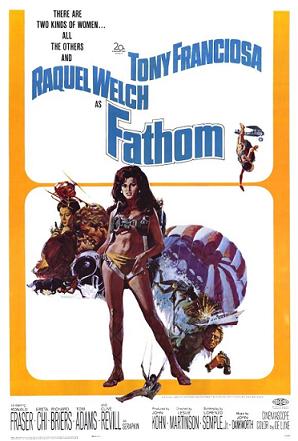
Lisa Cleans Out Her DVR: Fathom (dir by Leslie H. Martinson)


(Lisa is currently in the process of cleaning out her DVR!  It’s going to take her forever but, with the help of Dexedrine and energy drinks, she is determined to get it done!  She recorded 1967’s Fathom off of FXM on April 3rd of this year!)

Fathom is a spy spoof, one that was made the height of the initial James Bond craze.  It’s very much a late 60s film, in everything from the way the film looks to the overly complicated storyline to the film’s cultural attitudes.  This is one of those films that you know was probably considered to be “naughty” when it was released but, seen today, it’s all rather quaint.  There’s no nudity, there’s no cursing, and there’s very little violence.  However, it does feature in Raquel Welch in a lime green bikini and you just know that, when this film came out, there were probably people bemoaning it as the end of civilization.  “What happened to the movies that you could take the entire family too!?” they probably wailed.  That’s the way history works.  What was once daring now seems remarkably innocent.

I watched the film last night but I’d be lying if I said I could follow the plot.  I think that was intentional on the part of the filmmakers.  Fathom satirizes the spy films of the late 60s by taking all of their familiar elements to their logical extreme.  Spy thrillers feature unexpected twists and turns.  Fathom has a new twist every 10 minutes or so.  Spy thrillers feature sudden betrayal and double agents.  With the exception of Raquel Welch, literally no one in Fathom is who they initially claim to be.  It becomes exhausting to try to keep up.  In many ways, Fathom plays out like an old serial.  Every few minutes or so, there’s another cliffhanger.  Oh no, Raquel Welch is on an out-of-control motorboat!  Oh no, the bad guys have got Raquel Welch on an airplane!  Oh no, Raquel Welch is being chased by a bull and she’s wearing a red dress!  ¡Olé!

Raquel plays Fathom Harvill, who works as a dental hygienist except for when she’s touring Europe as a member of the U.S. parachute team.  She’s recruited by some spies to help track down a nuclear triggering mechanism, one that is being hidden somewhere in Spain.  The Scottish secret service just wants her to parachute into a villa owned by a mysterious American named Peter Meriweather (Anthony Franciosa) and plant a recording device.  Things don’t go quite as smoothly as they should and soon, Fathom’s going from one extreme situation to another.

(Even though Peter is supposed to be a suave, James Bond-type, Franciosa gives such an oddly intense performance that it feels like a dry run for his later work in Dario Argento’s Tenebrae.  Interestingly enough, in Argento’s film, Franciosa’s character is named Peter Neal.  Is it possible that Peter Meriweather changed his last name?)

But really, the entire plot is just an excuse to get Raquel into that lime green bikini and she totally owns the moment.  Raquel Welch is one of my favorite of the old film stars because she never apologized for who she was.  She had the body, she was sexy, she knew it, and she used it to her advantage.  Of course, when seen today, it’s disappointing that Fathom spends the entire movie being rescued by men but then again, I imagine that just the idea of a woman being a secret agent was revolutionary in 1967.  Actually allowing her to get out of situations on her own might have made heads explode.  If Fathom were made today, Fathom would at least get one scene where she gets to kick some ass, Angelina Jolie-style.

Anyway, Fathom is an enjoyably silly spy film.  Don’t worry about trying to follow the plot and, instead, just enjoy it as an over-the-top time capsule.  It doesn’t get more 1967 than Fathom.

A Movie A Day #44: Let Him Have It (1991, directed by Peter Medak)


The year is 1953.  The place is Croydon.  Derek Bentley (Christopher Eccleston) is 19 years old but has the mental capability of an 11 year-old.  Unable to hold down a job and judged unfit for the national service, Derek drifts into a gang led by 16 year-old Christopher Craig (Paul Reynolds).  When Derek and Craig are caught burglarizing a warehouse, it leads to a tense rooftop confrontation between Craig and the police.  Derek has already been captured by the time that the police demand that Craig hand over his gun.  Bentley shouts, “Let him have it, Chris!”  Craig opens fire, killing one officer.

Because he’s a minor, Craig is only facing a prison sentence for killing the police officer.  But, as a legal (if not mental) adult, Derek will be hung if he’s found guilty.  Under the common purpose doctrine, it doesn’t matter that Derek didn’t actually shoot the gun.  The only thing that matters is what Derek meant when he said, “Let him have it, Chris!”  Derek says that he was telling Craig to hand over his gun.  The Crown says that Derek was ordering Craig to open fire.

Let Him Have It is based on a true story.  The case of Derek Bentley was one of the many cases that eventually led to the death penalty being abolished in the UK.  Let Him Have It was released at the height of a long campaign to secure a pardon for Derek.  That pardon was finally issued in 1998, though it was too late to help Derek Bentley.

Let Him Have It is a powerful and angry docudrama, one that reveals in searing detail how Derek was railroaded by the British legal system.  In his film debut, Eccleston gives a powerful performance as Derek and he is ably supported by both Paul Reynolds and, in the role of Derek’s father, Tom Courtenay.  Let Him Have It leaves little doubt as to why the case of Derek Bentley remained a cause célèbre for 45 years after his initial trial.