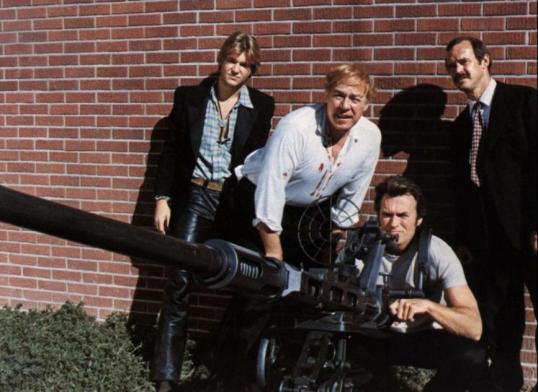
Late Night Retro Television Review: CHiPs 4.4 “The Poachers”


Welcome to Late Night Retro Television Reviews, a feature where we review some of our favorite and least favorite shows of the past!  On Mondays, I will be reviewing CHiPs, which ran on NBC from 1977 to 1983.  The entire show is currently streaming on Prime!
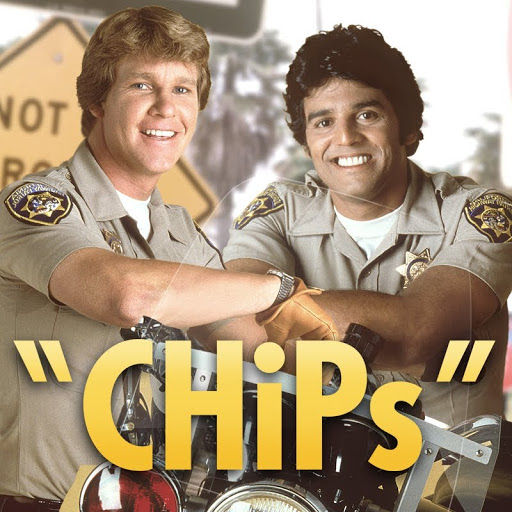
This week, Ponch brings us all closer together.

Episode 4.4 “The Poachers”

(Dir by Barry Crane, originally aired on October 19th, 1980)

In the beautiful hills surrounding Los Angeles, Jon and Ponch (but mostly Ponch because, as of the start of season four, this is The Ponch Show) pursue two poachers (Robert F. Lyons and Michael Gwynne).  However, Ponch is not the only one after the poachers.  A Native American grandfather named Nathan (Michael Ansara) is in the hills with his grandson (Tony Raymond) and, together, they shoot arrows at the poachers.

Hey, that’s attempted murder!

Well, no matter.  No one like poachers, least of all me.

While Ponch captures the poachers and befriends the grandfather, the rest of the Highway Patrol spend their time at the drag strip and try to win races and set records.  Ponch insists that he should be the one allowed to represent the force on the track and he’s probably right because he’s Ponch and this is The Ponch Show.  Instead, Sgt. Getraer — who technically outranks Ponch but who knows how long that will last — takes to the track himself and amazes everyone with his speed.  Woo hoo!  Meanwhile, poor Baker stands in the background and perhaps remembers how, when the show started, he actually got to do stuff other than follow Ponch around.

This episode was nothing special.  It was well-intentioned with its anti-poaching storyline but it also featured even more cliches than usual.  Michael Ansara was himself not Native American.  He was born in Syria.  The actors who played his son and his grandfather were also not Native American, at least not as far as I could detect from their IMDb profiles.  In short, this was an episode about the wisdom of Native Americans that doesn’t appear to have featured any actual Native Americans.

All that said, it was nice to Robert Pine get to have some fun with the role of Sgt. Getrear.  Pine’s tough-but-fair performance as Getraer has often been this show’s secret weapon and, in this episode, he at least got to smile for once.  He earned it!
Film Review: Thunderbolt and Lightfoot (dir by Michael Cimino)


1974’s Thunderbolt and Lightfoot opens with two men, one young and one middle-aged, facing a moment of truth.

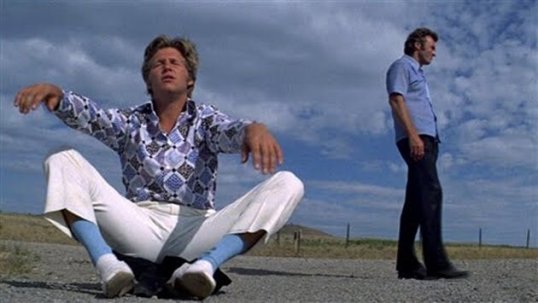
The younger of the two is Lightfoot (Jeff Bridges), a wild and hyperactive rich kid who is in his 20s and who steals a corvette right off of a used car lot.  The other man is simply known by his nickname, Thunderbolt (Clint Eastwood).  When we first see Thunderbolt, he’s giving a sermon in a small Montana church.  When a gun-wielding man steps into the church and promptly starts firing at Thunderbolt, he takes off running.  Pursued by his attacker, Thunderbolt runs through a field and just happens to jump onto Lightfoot’s speeding corvette.  Lightfoot runs over the Thunderbolt’s pursuer.  Thunderbolt slips into the car and Lightfoot drives on for a bit.  Lightfoot is excited and talkative.  Thunderbolt is more concerned with popping his shoulder back into its socket.  A stop at a gas station leads to the men stealing someone else’s car.

And so it goes for a good deal of the movie.  Thunderbolt and Lightfoot is a road movie, the majority of which is taken up with scenes of the two men just hanging out.  Thunderbolt and Lightfoot take an instant liking to each other.  When Lightfoot picks up a prostitute (Catherine Bach), he makes sure to ask that she bring along a friend for Thunderbolt.  When a criminal punches Lightfoot, Thunderbolt is quick to punch back.  “That’s for the kid,” Thunderbolt says.  That’s the type of friendship that they have.  Jeff Bridges is handsome and full of energy as Lightfoot and Clint Eastwood smiles more in this film than I think I’ve seen him smile in any other film.  For once, Eastwood is not playing a perpetually grumpy stranger or a supercop.  Instead, he’s just a blue collar guy who enjoys having a friend to travel with.

Eventually, Thunderbolt and Lightfoot meet up with two of Thunderbolt’s former associates.  Red (George Kennedy) is a brutal brawler who, it is suggested, served with Thunderbolt in the Korean War.  Goody (Geoffrey Lewis) is a gentle soul who takes orders from Red but still can’t bring himself to shoot anyone, no matter how much Red demands that he pull the trigger.  Red and Goody have always assumed that Thunderbolt stole the loot from a bank robbery that they pulled off.  Thunderbolt explains that he didn’t steal the money.  He just got arrested after hiding it.  Lightfoot suggests that maybe the four of them could pull off another bank heist….

Kennedy and Lewis are perfectly cast as the two criminals who end up working with Thunderbolt and Lightfoot.  In many ways, the relationship between Red and Goody mirrors the relationship between our lead characters.  The main difference is that Red is sadistic and quick to loose his temper, whereas Thunderbolt controls his emotions and tries not to hurt anyone while committing his crimes.  Lightfoot looks up to Thunderbolt and Goody looks up to Red.  Again, the difference is that Thunderbolt actually cares about Lightfoot, whereas Red is incapable of truly caring about anyone but himself.  Eastwood, Bridges, Kennedy, and Lewis make quite a team and it’s hard not to worry about all four of them, especially when the film takes an unexpectedly dramatic turn during its third act.

I really wasn’t expecting Thunderbolt and Lightfoot to make me cry but the final thirty minutes of the film brought tears to my eyes as what started out as a buddy comedy turned into a tragedy.  (I shouldn’t have been surprised.  I’ve seen enough 70s movies that I really should have known better than to have expected a happy ending.)  Thanks to the perceptive script by Michael Cimino (who would go on to make The Deer Hunter and Heaven’s Gate) and the performances of Eastwood and Bridges, the movie’s final moments carry quite a punch and they leave you wondering if Thunderbolt and Lightfoot’s road trip was worth the price that was ultimately paid.  The film works as not only a tribute to friendship but also as a fatalistic portrait of life on the backroads of America.

Thunderbolt and Lightfoot was the first Eastwood film to receive an Oscar nomination, with Jeff Bridges competing for Best Supporting Actor.  (He lost to Robert De Niro’s star turn in The Godfather, Part II.)  Eastwood, reportedly, felt that he deserved a nomination for his performance as Thunderbolt and, considering that that Oscar itself was won by Art Carney for his pleasant but hardly revelatory work in Harry and Tonto, Eastwood was correct.  Instead, Eastwood would have to wait for another 18 years before he finally received Academy recognition for starring in, producing, and directing Unforgiven.

Late Night Retro Television Review: CHiPs 1.20 “Rainy Day”


Welcome to Late Night Retro Television Reviews, a feature where we review some of our favorite and least favorite shows of the past!  On Mondays, I will be reviewing CHiPs, which ran on NBC from 1977 to 1983.  The entire show is currently streaming on Freevee!

What would CHiPs be like without motorcycles?  We’re about to find out.

Episode 1.20 “Rainy Day”

(Dir by Gordon Hessler, originally aired on March 2nd, 1978)

While riding his motorcycle on the California highway, Baker groans as he feels a drop of water.  He tells Ponch that it’s going to rain and the two of them are going to end up getting stuck in a patrol car.

“It’s only sprinkling!” Ponch replies.

One jump cut later and Ponch and Baker are trapped in the middle of a downpour.  Despite the heavy rain and the fact that they’re getting soaked, they still manage to save a teacher after a car swerves on the slick road and hits her school bus.  (Apparently, in 1978, teachers also had to drive the school buses.)  The teacher is young and attractive so, of course, Ponch tells her that she and her students can drop by the station and see him any time that they want.

As for the rain, it turns out that Baker was right.  After giving them a hard time about their wet uniforms (and not even bothering to acknowledge that those uniforms got wet while Baker and Ponch were saving someone’s life), Getraer assigns them to a patrol car for the day.  It’s a new patrol car so Getraer warns them not to get a scratch on it.  Usually, I can kind of understand why Getraer is a bit weary of Ponch but, in this episode, the guy’s just a jerk about everything.

You can probably already guess what the main problem with this episode is.  The appeal of CHiPs, at least from what I’ve seen so far, is that it features a lot of exciting motorcycle stunts.  Chase scenes involving motorcycles are fun to watch because motorcycles can go extremely fast and they can weave in-and-out of traffic.  The show works best when Ponch and Baker are on their motorcycles.  This episodes put them in a bulky, slow-moving squad car.  Even stuck in the car, Ponch and Baker manage to catch a car thief and they put an end to an illegal gambling casino that’s been hidden inside of an RV.  But it really doesn’t matter because they’re in a squad car.  There’s nothing exciting about a squad car.

And yes, the squad car does get trashed, specifically while Ponch and Baker are chasing a degenerate gambler (Herb Edelman) who was seeking revenge against the RV casino.  Getraer is not happy about the damage to the car, despite the fact that there really wasn’t any way to avoid it and Ponch and Baker managed to prevent a lot of people from getting injured.  Fortunately, Officer Grossman (Paul Linke) accidentally backs into the squad car, leaving it ambiguous as to who is responsible for what damage.  Getraer will just have to get mad at everyone, I guess.

I love the rain so I did appreciate the fact that this episode featured a lot of it.  But otherwise, the whole thing just felt off.  I don’t care how wet it is outside.  Baker and Ponch just do not belong in a car.

Film Review: Payday (dir by Daryl Duke)


First released way back in 1972, Payday tells the story of Maury Dann (played by the late, great Texas actor, Rip Torn).

Maury is a country singer.  He sings songs about wholesome values and good country girls.  His music isn’t exactly ground-breaking but his fans still love him and it’s easy to see why.  The movie opens with Maury performing in a small, country club and his charisma is undeniable.  He has a good singing voice and he easily dominates the stage.  Between songs, he flashes a friendly but slightly mischievous smile.  After his performance, he is perfectly charming when he meets his older fans.  And, when he meets a younger fan, he takes her outside and has sex with her in the backseat of his Cadillac.  He does this while her boyfriend is wandering around the parking lot looking for her.

Maury is a man who is in control when he’s on stage.  However, when he’s off-stage, the real Muary comes out.  When he’s not singing and basking in the applause of his fans, Maury is …. well, he’s a total mess.  Actually, mess doesn’t quite do justice to just how screwed up Maury Dann is.  He cheats on his girlfriend.  He pops pills constantly.  He treats the members of his band with a casual cruelty.  When Maury’s off-stage, that charming smile changes into a rather demented smirk.  Just when you think Maury’s done the worst possible thing that he could do, he does something even worse.

Payday follows Maury as he is driven through the South, singing songs and ruining lives.  Along the way, he gets into a fight with his mother and then a fight with his ex-wife and eventually, a fight with the boyfriend of that younger fan from the start of the movie.  We watch as Maury drinks, bribes DJs, and frames his employees for all sorts of crimes.  It’s an episodic film about a man who seems to understand that he’s destined to self-destruct no matter what he does.

Payday is very much a film of the early 70s.  Though the film may be about a self-destructive country star, it’s hard not to suspect that — as with most of the films from that era — Maury and his adventures were meant to be a metaphor for America itself.  Country Western is a uniquely American genre and by showcasing the damage that Maury does to everyone around him, the film seems to be suggesting that Maury’s sins are also America’s sins.  The people who idolize Maury and make him a star despite all of his flaws are the same people who reelected Richard Nixon and supported sending young men to die in Vietnam.

It’s all a bit much for one film to carry on its shoulders and spending two hours with Maury Dann is not exactly a pleasant experience but the film works because of the performance of Rip Torn.  When Torn died earlier this week, there was a lot of discussion about which performance was his best.  Quite a few people on twitter cited his roles in Defending Your Life and The Larry Sanders Show.  I personally mentioned The Man Who Fell To Earth and Maidstone.  But if you really want to see what made Rip Torn such a great actor, you simply must watch Payday.  Maury is a jerk with little in the way of redeeming qualities but Torn gives such a fearless and cheerfully demented performance that it’s impossible not to get caught up in his story.  As much as you want to look away, you can’t because Rip Torn keeps you so off-balance that you cannot stop watching.  Torn is smart enough to play Maury with just enough self-awareness that the character becomes fascinatingly corrupt as opposed to just being a self-centered jerk.

Finally, Payday simply feels authentic.  The film was made way before my time but I’m a Southern girl who has spent enough time in the country to know that the backroads of rural America haven’t changed that much over the past few decades.  At times, while watching Payday, I felt like I was back on my granduncle’s farm in Arkansas, walking through high grass and listening to the cicadas while watching the sun go down.

Payday is definitely a film that’s worth the trouble to track down.  Watch it and appreciate the fearless genius of the great Rip Torn.