Embracing the Melodrama Part II #15: Casablanca (dir by Michael Curtiz)


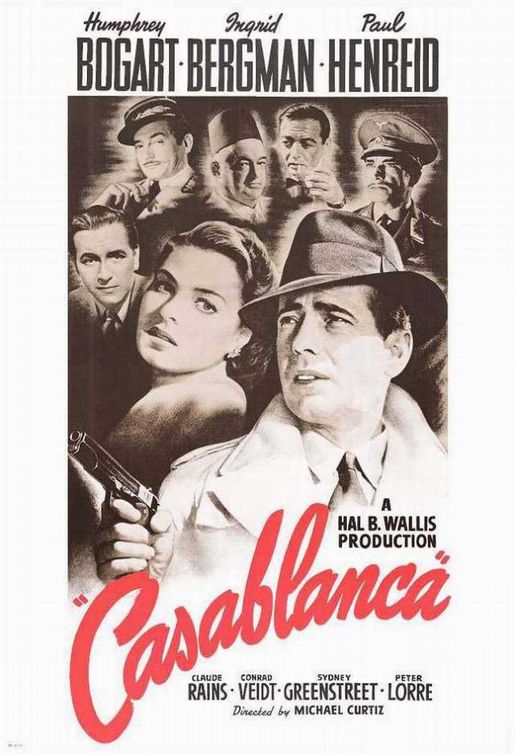
CasablancaPoster-Gold

(This review contains spoilers but seriously, you should know all of this already.)

Is there anything left to be said about Casablanca?

Probably not.

As a film reviewer, I’m not supposed to admit that.  I’m supposed to come up with some sort of new, out-of-nowhere, batshit crazy way to look at Casablanca.  I’m supposed to argue that Rick was actually meant to be a survivor of abuse or that Victor Laszlo was some sort of precursor to President Obama or something.  Or, if that doesn’t work, I’m supposed to intentionally troll everyone by writing something like, “10 reasons why Casablanca is overrated” or “I hate Casablanca and I don’t care who knows it!”

But I’m not going to do that.

The fact of the matter is that Casablanca is as good a film as everyone says it is.  It is a film that everyone should see.  It is a film that quite rightfully was named best picture of 1943.  It deserves to be celebrated.  It deserves to be seen.  In fact, stop reading this review right now and go watch it.  Don’t let me waste another second of your time.

The thing with Casablanca is that it’s such an iconic film that everyone knows what happens, regardless of whether they’ve actually watched the entire film or not.  They know that the film takes place in Casablanca during World War II.  They know that Casablanca is full of refugees, spies, and people who are hiding from their past.  They know that Casablanca is policed by the charmingly corrupt Capt. Louis Renault (Claude Rains).  They know that Major Strasser (Conrad Veidt) is the Nazi in charge.  (I nearly said that Strasser was the “evil Nazi in charge” but when you identify someone as a Nazi, is it really necessary to add that they’re evil?)  They know that Rick (Humphrey Bogart) is the American expatriate who owns Rick’s Cafe Americain and that everyone comes to Rick’s.  They know that Rick’s slogan is that he doesn’t stick his neck out for anyone but they also know that his cynicism hides the fact that he’s still in love with Ilsa (Ingrid Bergman).  They know that when Ilsa shows up at Rick’s and needs him to help her husband, Victor Laszlo (Paul Henreid), escape from Occupied Europe, Rick is forced to decide whether or not to get involved in the resistance.

And, whether you’ve seen the film or not, you know that it all ends on a foggy airstrip.  Ilsa wants to stay in Casablanca with Rick but Rick tells her that she has to get on the plane with Laszlo because, if she doesn’t, she’ll regret it.  Ilsa goes with Laszlo, leaving Rick behind.

And it may have been the right thing to do but how many viewers would have done the same if they had been in Ilsa’s high heels?  Throughout the entire movie, we hear about how wonderful Laszlo is but, whenever he actually shows up on screen, it’s always a little bit surprising to discover just how boring a character Victor Laszlo really is.  Unlike the troubled and deceptively cynical Rick, there’s not much going on underneath the surface with Laszlo.  Just as Rick overshadows Laszlo, Bogart’s performance overshadows Paul Henreid’s.  Bogart and Bergman have all the chemistry and the charisma.  Henreid, on the other hand, comes across as stiff and a little dull.  But, as the film suggests, World War II was not a time for self-doubt and self-interest.  World War II was a time when the world needed straight-forward, determined men like Victor Laszlo.

And, if the world needed Laszlo and Laszlo needed Ilsa, then that meant Ilsa had to get on that plane.

That said, I’ve always liked to think that Ilsa ended up leaving Laszlo in 1945 and immediately made her way back to Morocco.  Rick and Ilsa belonged together.

But until Ilsa comes back, Rick has his friendship with Renault.  “Louis,” he says, “I think this is the beginning of a beautiful friendship.”  Did Bogart realize, when he delivered that line, that literally thousands of people would be repeating it decades later?  Bogart’s performance is probably one of the most imitated performances of all time.  Anyone who sees Casablanca thinks that they can talk about gin joints and hills of beans in Bogart’s trademark style.  Of course, they can’t and it’s a testament to the power of Bogart’s performance that it remains effective even after being endlessly imitated.

On Valentine’s Day of 2014, I saw Casablanca at the Alamo Drafthouse in Austin.  It was an amazing and romantic experience.  See Casablanca on the big screen.  It’ll make you love life and bring life to your love.

Needless to say, Casablanca is an intimidating film to review.  So, I’ll just say this: Casablanca is even better than you think it is.  If you haven’t seen it, go watch it.  If you have seen it, go watch it again.

Just resist the temptation to say, “Play it again, Sam,” in your best Bogart-like voice.

Because, seriously, Rick never actually says that line.

Shattered Politics #4: Mr. Smith Goes To Washington (dir by Frank Capra)


mr-smith-goes-to-washington

So, when you read that I was going to be reviewing 94 political films here at the Shattered Lens, you probably knew that one of them would have to be the 1939 best picture nominee, Mr. Smith Goes To Washington.

So, we all know that story right?  The senator from an unnamed state dies.  The weak-willed Governor (Guy Kibbee) has to appoint a new senator.  Political boss Jim Taylor (Edward Arnold) demands that the governor appoint one of his cronies.  The state’s reformers demand that the Governor appoint a never-seen crusader named Henry Hill (who, whenever I hear his name, makes me think of Ray Liotta snorting cocaine in Goodfellas).  The Governor’s children demand that he appoint Jefferson Smith (James Stewart, of course!), who is the head of something called the Boy Rangers.  The Governor flips a coin.  The coin lands on its edge but it also lands next to a newspaper story about Jeff Smith.

So, of course, Mr. Smith goes to Washington.

Now, as the movie quickly makes clear, Jeff Smith is immediately out-of-place in Washington.  For one thing, he’s actually excited to be there.  He’s convinced that he’s there to make America a better place.  When a bunch of drunken reporters (led by the great Thomas Mitchell) make Smith look foolish, Smith responds by running around Washington and punching them out.  (That whole sequence probably serves as wish fulfilment for a lot of politicians.)  When his cynical legislative aide Saunders (Jean Arthur) tells him that he’s too naive to survive in Washington, he wins her over with the purity of his idealism.  When his mentor, Senator Paine (Claude Rains), is revealed to be a part of Washington’s corrupt culture, Smith is stunned.  When Taylor tries to destroy his political career, Smith responds by giving the filibuster to end all filibusters.  He’s one man standing up against a culture of corruption and…

And there’s a reason why, 76 years later, aspiring political candidates still attempt to portray themselves as being a real-life, modern Jefferson Smith.

This is one of those films that everyone seems to agree is great and, of course, there’s many reasons to love Mr. Smith Goes To Washington.  There’s the lead performance of Jimmy Stewart, of course.  While this may not be his best performance (I prefer the more layered characterization that he brought to It’s A Wonderful Life and Anatomy of a Murder), it is Stewart at his most likable and, most importantly, he makes you feel Jeff Smith’s pain as he discovers that Washington is not the great place that he originally assumed it to be.  Claude Rains was always great when it came to playing good men gone wrong and he’s perfect as Sen. Paine.  Thomas Mitchell and Jean Arthur are perfectly cast and I always enjoy seeing the bemused smile on the face of Vice President Harry Carey as Smith conducts his filibuster.

But I think the best thing about Mr. Smith Goes To Washington is that it actually makes you believe that there are Jeff Smiths out there who actually could make a difference.  And, until Judd Apatow gets around to remaking the film with Adam Sandler, audiences will continue to believe.

http://www.youtube.com/watch?v=sm9qaEJ3MBc

Shattered Politics #2: They Won’t Forget (dir by Mervyn LeRoy)


they_won_t_forget-582401011-large

The title of the 1937 film They Won’t Forget works on many levels.

It describes the reaction of a small Southern town, following the brutal murder of teenager Mary Clay (played, in her film debut, by Lana Turner).  The town won’t forget Mary and they won’t forget the terror caused by her murder.  They also won’t forget that local teacher Robert Hale (Edward Norris) was accused of the crime.

The district attorney, Andrew Griffin (Claude Rains), hopes that the people of his state won’t forget his efforts to see Griffin convicted of that crime.  Griffin wants to be elected to the U.S. Senate and he knows that the high profile case could be just what his career needs.

The Governor (Paul Everton) knows that, if he steps into the case and acts on his suspicion that Hale is innocent, the voters of his state will never forget.  And they certainly won’t be willing to forgive.

And, on a larger level, the title lets us know that the South and the North will never forget the Civil War and the conflict between the two regions.  The film opens with three elderly veterans of the Confederate Army, preparing to march in the town’s annual Confederate Memorial Day parade and admitting to each other that, after all these years, it’s difficult to remember much about the war other than the fact that they’re proud that they fought in it.

It’s while the rest of the town is busy watching Griffin and the governor ride in the parade that Mary Clay is murdered.  It’s easy to assume that Hale was the murderer because Hale was one of the few townspeople not to go to the parade.  You see, Hale is originally from New York City.  When he’s accused of murder, it’s equally easy for Griffin and tabloid reporter William A. Brock (Allyn Joslyn) to convince the town people to blame this Northern intruder for both the murder of Mary Clay and, symbolically, for all of the post-Civil War struggles of the South itself.

Meanwhile, up North, Hale is seen as a victim of the South’s intolerance.  A high-profile lawyer (Otto Kruger) is sent down to defend Hale but, as quickly becomes clear, everyone involved in the case is more interested in refighting the Civil War than determining the guilt or innocence of Andrew Hale.

They Won’t Forget is a hard-hitting and fascinating look at politics, justice, and paranoia.  It’s all the more interesting because it’s based on a true story.  In 1913, a 13 year-old girl named Mary Phagan was murdered in Atlanta.  Leo Frank was accused and convicted of the murder.  (In Frank’s case, he was born in Texas but was also Jewish and had previously lived in New York before moving to Atlanta, all of which made him suspicious in the eyes of many.)  On the word of a night watchmen, who many believe was the actual murderer of Mary Phagan, Leo Frank was convicted and sentence to death.  After spending days reviewing all of the evidence and growing convinced that Frank had been wrongly convicted, Georgia’s governor committed an act of political suicide by commuting Frank’s sentence to life imprisonment.  Leo Frank was subsequently lynched and the man who had prosecuted the case against him was subsequently elected governor.

Well-acted and intelligently directed, They Won’t Forget is probably one of the best films of which few people have heard.  Fortunately, it shows up fairly regularly on TCM and, the next time that it does, be sure to watch.  It’s a great film that you won’t easily forget.


Embracing the Melodrama #9: Kings Row (dir by Sam Wood)


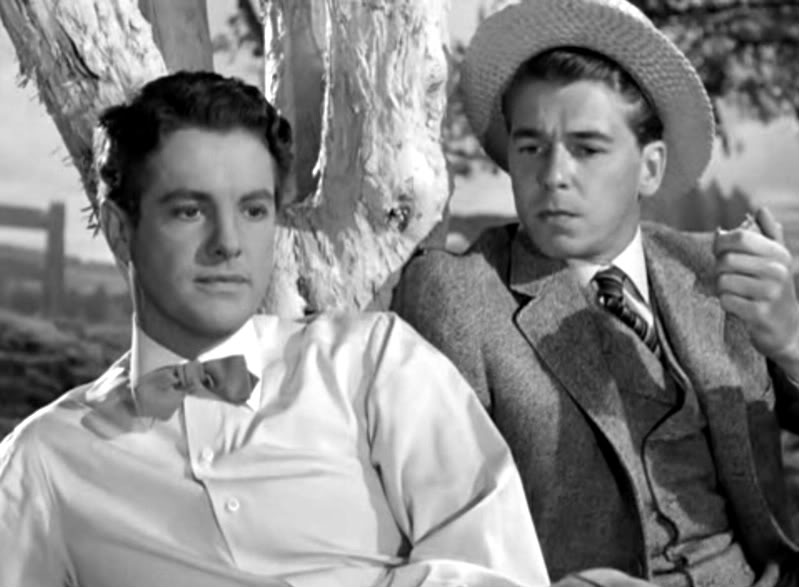
Kings Row“Where’s the rest of me!?” — Drake McHugh (Ronald Reagan), upon waking up to discover that his legs have been amputated, in Kings Row (1942)

It is with that line that the 1942 best picture nominee Kings Row earns its place in film history.  The formerly carefree and rich Drake had lost all of his money due to a crooked banker.  However, instead of feeling for himself, Drake got a job working for the railroad and finally started to show that he was capable of acting like a mature, responsible adult.  However, when Drake was injured in a boxcar accident, he had the misfortune to be taken to the sadistic Dr. Gordon (Charles Coburn).  Gordon felt that it was his duty to punish those who he considered to be wicked and that’s exactly how he felt about about Drake.  So, despite the fact that Drake had once been in love with Gordon’s daughter, Gordon proceeded to chop of Drake’s legs.

It’s just another day in Kings Row.

Of course, to an outsider, Kings Row looks like your typically calm and pleasant community.  But behind closed doors, this small town is full of sordid secrets.  Only those who have grown up in Kings Row understand the truth.  Only they can understand how Drake McHugh could end up losing his legs.

When they were both growing up at the turn of the century, Drake’s best friend was Parris Mitchell (Robert Cummings).  While Drake was pursuing Dr. Gordon’s daughter, and being loved from afar by Randy Monaghan (Ann Sheridan), Parris was studying to be a doctor under the tutelage of Kings Row’s other doctor, Dr. Alexander Tower (Claude Rains).  While Dr. Tower appeared to be a much nicer man than Dr. Gordon, he definitely had his eccentricities.  For instance, there was the wife who was reportedly confined somewhere in the house and never allowed to leave.  And then there was Dr. Tower’s daughter, Cassandra (Betty Field).  Dr. Tower was very protective of Cassandra, perhaps too protective.  How would Dr. Tower react when Parris, his best student, started to develop romantic feelings towards Cassandra?

Again, it’s just another day in Kings Row.

So, by now, it should be pretty obvious that Kings Row is one of those films that deals with big secrets in small towns.  That, of course, is a theme that was explored by films that were made long before Kings Row.  What made Kings Row unique is that it was perhaps the first film to actually portray that evil as specifically existing and thriving because of the repressive nature of a small town.  Whereas other films had featured outsiders bringing bad habits to an otherwise innocent and idyllic community (and be sure to watch Hitchcock’s Shadow of a Doubt if you want a perfect example of this), Kings Row suggested that the very nature of its setting is what led to all of the melodrama.  The film suggests that evil men like Dr. Gordon can specifically thrive in a town like Kings Row because his fellow townspeople aren’t willing to risk the placid surface of their existence by exposing him.  As such, Kings Row serves as a template for all of the sin-in-a-small-town films and TV shows that have followed.

Beyond the film’s historical importance, Kings Row holds us pretty well as entertainment.  As the film’s hero, Robert Cummings is a bit on the bland side but, fortunately, he’s surrounded by an excellent cast of character actors.  It’s a bit of a cliché to say that Claude Rains was perfectly cast because, seriously, when wasn’t Claude Rains perfectly cast?  But, in the role Dr. Tower, Claude Rains is perfectly cast.  Charles Coburn makes for a perfectly terrifying villain.  Ann Sheridan is likable and sympathetic as the woman who tries to help Drake recover after Dr. Gordon takes away his legs.  And finally, you’ve got future President Ronald Reagan in the role of Drake McHugh.  Reagan is usually dismissed a being a pretty boring actor (and I really haven’t seen enough of his films to say one way or the other) but he gave a great performance in Kings Row.

And that’s why, even beyond its historical significance, Kings Row is still a film that is more than worth watching.

KingsRowFRIENDS-1