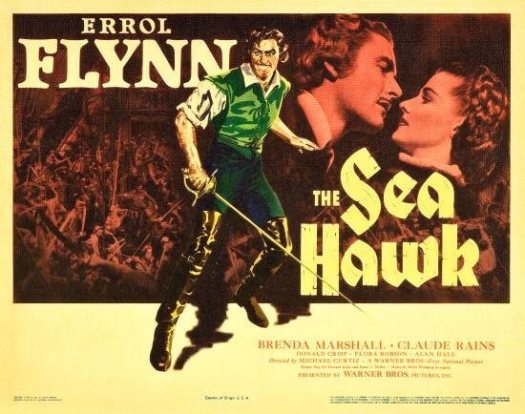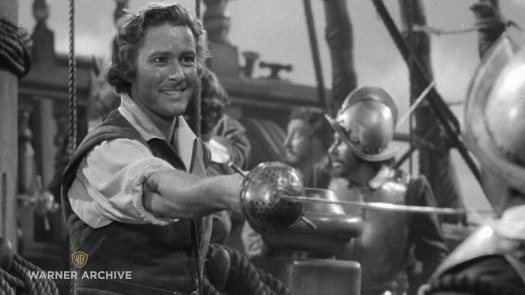
On Her Majesty’s Secret Service: Errol Flynn in THE SEA HAWK (Warner Brothers 1940)


gary loggins's avatarcracked rear viewer

Warner Brothers pulled out all the stops for their 1940 epic THE SEA HAWK. There’s dashing Errol Flynn swashbuckling his way across the Silver Screen once again, the proverbial cast of thousands, high seas action, romance, political intrigue, superb special effects, and a spirited score by Erich Wolfgang Korngold. The only thing missing that could’ve possibly made this movie better is Technicolor, but since Jack and his bros had already spent $1.7 million (equivalent to almost thirty million today) to produce it, why quibble?

Flynn is in fine form as privateer Geoffrey Thorpe, captain of the pirate ship Albatross, in service to Her Majesty Queen Elizabeth I. When they attack and plunder a Spanish ship carrying Ambassador Don Alvarez de Cordoba and his beautiful niece Maria, Captain Thorpe is reprimanded and told to lay off the Spanish. Spain, however, is building up their Armada with world conquest in mind, and…

View original post 603 more words

Spy in the House of Love: Alfred Hitchcock’s NOTORIOUS (RKO 1946) — cracked rear viewer


You won’t find a more glamorous pair of spies than Cary Grant and Ingrid Bergman in Alfred Hitchcock’s NOTORIOUS… except maybe in other films that feature Cary Grant as a spy! The Master of Suspense once again goes full speed ahead in bringing this exciting espionage caper to the screen loaded with the usual “Hitchcock Touches”, and […]

via Spy in the House of Love: Alfred Hitchcock’s NOTORIOUS (RKO 1946) — cracked rear viewer

Here’s Looking at You On The Big Screen, CASABLANCA!


gary loggins's avatarcracked rear viewer

Longtime readers of this blog know CASABLANCA is my all-time favorite film. It’s blend of stars, supporting cast, script, direction, drama, romance, and humor is the perfect example of 1940’s Hollywood storytelling,  when Tinseltown was at the peak of its moviemaking powers . I’ve seen the film at least 80 times in many different formats, from broadcast television to cable and satellite, from VHS to DVD to DVR, but never before on the big screen – until this past Sunday, that is!

Fathom Events, in conjunction with TCM, presents classic films on a monthly basis in theaters across the country. In my area, they’re shown at Regal Cinemas in Swansea, MA, a half hour drive down the highway. I’ve been tempted to make the trip a few times, but never got around to it for one reason or another. But when I heard CASABLANCA was this month’s feature, I knew…

View original post 664 more words

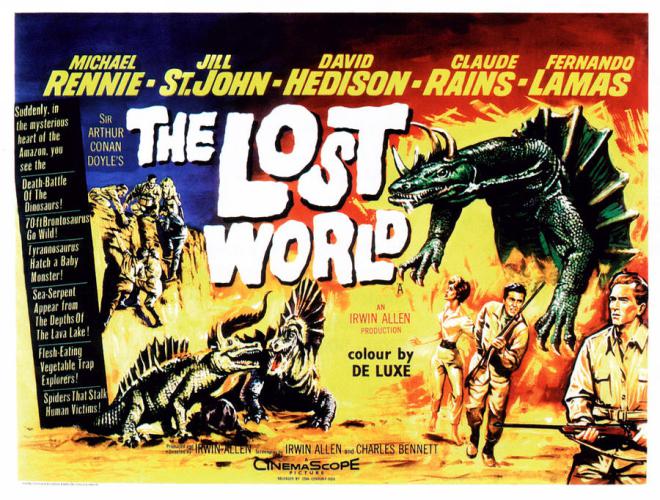
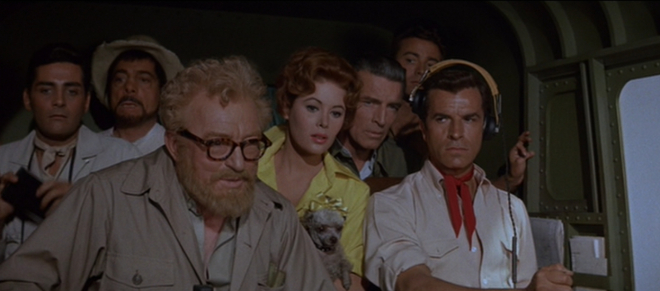
Jurassic Joke: THE LOST WORLD (20th Century Fox 1960)


gary loggins's avatarcracked rear viewer

Sir Arthur Conan Doyle’s adventure novel THE LOST WORLD was first filmed in 1925 with special effects by the legendary Willis O’Brien  . O’Brien gets a technical credit in Irwin Allen’s 1960 remake, but his wizardry is nowhere to be found, replaced with dolled-up lizards and iguanas designed to frighten absolutely no one. This one’s strictly for the Saturday matinee kiddie crowd, and though it boasts a high profile cast, it’s ultimately disappointing.

Genre fans will appreciate the presence of The Invisible Man himself, Claude Rains , in the role of expedition leader Professor Challenger. The 71 year old Rains is full of ham here, playing to the balcony, and still managing to command the screen with his sheer talent. Challenger claims to have discovered “live dinosaurs” in the remote Amazon rainforest, a claim scoffed at by the scientific community, especially rival Professor Summerlee (the equally hammy Richard Hayden). The crusty Challenger…

View original post 315 more words

Horror Film Review: The Invisible Man (dir by James Whale)


the-invisible-man

The 1933 Universal horror film, The Invisible Man, never seems to get as much attention as Frankenstein, Dracula, The Wolf Man, or The Mummy.  Perhaps it’s because the invisible man really isn’t a supernatural monster.  He’s just a scientist who has turned himself invisible and is now going mad as a result.  Or maybe it’s because there have been so many crappy films that have used invisibility as a plot point that the reputation of the original Invisible Man suffers by association.

For whatever reason, The Invisible Man never seems to get spoken about in the same breathless, gleeful manner as some of the other Universal monsters.  But I have to admit that, though I usually can’t stand movies about invisibility, I rather like The Invisible Man.

Based on a novel by H.G. Wells, The Invisible Man opens with a mysterious man (played by Claude Rains) arriving in a small English village.  He checks into a small inn and soon, everyone in the village is scared of him.  It’s not just his haughty attitude or his habit of ranting about his own superiority.  There’s also the fact that he is literally covered, from head to toe, in bandages.  He always wears gloves and dark glasses.  He insists that he’s doing important research and demands to be left alone.

The inn keeper (Forrester Harvey) and his histrionic wife (Una O’Connor) put up with the mysterious man until he falls behind on his rent.  However, once confronted, the mysterious man announces that he’s not going anywhere.  When the police and a mob of villagers arrives, the man starts to laugh like a maniac.  He unwraps the bandages around his head and…

THERE’S NOTHING UNDERNEATH!

Well, there is something there.  It’s just that the man is invisible so no one can see what’s underneath.  It turns out that the man is Dr. Jack Griffin, a chemist who has been missing for several days.  He’s created an invisibility serum but he can’t figure out how to reverse the effects.  Even worse, the serum is driving him insane.  Griffin’s fiancée, Flora (Gloria Stuart), and her father, Dr. Cranley (Henry Travers), are searching for Jack but Jack doesn’t particularly want to be found.  Jack is more interested in exploring how he might be able to use invisibility to conquer the world…

The Invisible Man is historically important because it was the film that brought Claude Rains to Hollywood.  Rains has previously made films in the UK but this was his first American film.  Think of how different film history would have turned out if The Invisible Man had, as originally planned, starred Boris Karloff.  Without Claude Rains coming to America, who would have played Louis in Casablanca?  Who would have played Sen. Paine in Mr. Smith Goes To Washington or Alex Sebastian in Notorious?  Of course, we don’t really see Claude Rains’s face until the very end of The Invisible Man.  Instead, we just hear his voice but what a voice Claude had!  He delivers his dialogue with just the right amount of malicious sarcasm.

I like The Invisible Man.  For modern audiences, it’s not particularly scary.  (Though I do find the idea of being unknowingly followed by an invisible person to be a little unnerving…)  However, unlike a lot of other old horror films, you can watch The Invisible Man and see why it would have been scary to an audience seeing it for the very first time.  In 1933, a time when film was still a relatively new medium and audiences had yet to become jaded by special effects, here was a man unwrapping his bandages to reveal that there was nothing underneath!  That had to have freaked people out!

The Invisible Man was directed by James Whale and the film features the same demented sense of humor that distinguished The Bride of Frankenstein.  The villagers are portrayed as being so hysterical that you can’t help but think that maybe Griffin has a point about being surrounded by fools.  By the time the local constable declares, “What’s all this then?,” you can’t help but start to sympathize with Jack Griffin.

There’s been a lot of  bad invisibility movies made but The Invisible Man is not one of them.  It may not be as well remembered as some of the other Universal horrors but it’s definitely one worth seeing.

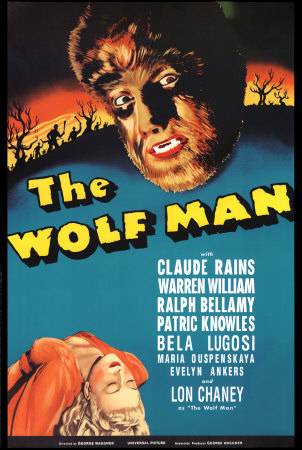
Horror Film Review: The Wolf Man (dir by George Waggner)


the-wolfman

“Even a man who is pure in heart, and says his prayers by night;

May become a wolf when the wolfbane blooms and the autumn moon is bright.”

— Gypsy Poem, The Wolf Man (1941)

Poor Larry Talbot.

We all know his story, of course.  The plot of the original Wolf Man is so iconic and has been imitated in so many other films that, even if you somehow have never seen the original 1941 film, you still know what happened.

Larry (played by Lon Chaney, Jr.) is a loser.  When we first meet him, he is nervously returning to his childhood home in Wales.  (Chaney doesn’t sounds at all Welsh nor does he sounds like he’s from any other part of the UK for that matter, but that’s not really important.)  Larry’s older brother has recently died and Larry hopes that maybe he can reconcile with his father, Sir John (Claude Rains).  Larry’s brother was the favored son, the one who lived up to the Talbot name and made his father proud.  Larry, on the other hand, hasn’t really succeeded at anything he’s ever done.  To use the slang of the time, Larry comes across as basically being a lug.  A big dumb lug.

After discovering that his father really doesn’t seem to want to have much to do with him, Larry goes for a stroll through the nearby village.  He buys a silver-headed walking stick, mostly so he can flirt with the salesgirl, Gwen (Evelyn Ankers).  It turns out that there’s a gypsy camp nearby.  What better place to go on a date!?

Well, perhaps Larry should have just invited her to the movies.  Not only does a fortune teller (Maria Ouspenskaya) see something terrible in his future but Larry ends up getting bitten by what appears to be a wolf.  The good news is that Larry was bitten while saving the life of one of Gwen’s friends, which is certainly going to make him look like good boyfriend material.  The bad news is that the wolf was actually the fortune teller’s son, Bela (played by none other than Bela Lugosi).  It turns out that Bela was a werewolf and now, Larry’s going to be a werewolf too!

Larry, needless to say, is not happy about this.  But then again, Larry wasn’t happy before he became the werewolf either.  Lon Chaney, Jr. played Larry Talbot in five different movies and I don’t think he smiled once.  I guess that’s understandable, seeing as how he was a werewolf.  In every film in which he appeared, Larry would beg someone to kill him and put him out of his misery.  And, in every sequel, Larry would somehow be brought back to life and have to go through it all over again.  I guess he earned the right to be a little glum.

But still, even before he’s bitten in The Wolf Man, Larry is kind of a boring character.  The only time that he’s interesting is when he’s a wolf man.  And really, he’s a far more successful werewolf than human.  When we first meet Larry, he apologizing to his father for never living up to his expectations.  But once Larry turns into the Wolf Man, he finally manages to get things done.  When he’s the wolf man, Larry has the inner drive that he lacks as a human.

To me, the heart of The Wolf Man is not to be found in Chaney’s glum performance.  Instead, it’s in Claude Rains’s performance as John.  When we first meet Sir John, he seems like a rather imposing figure but, over the course of this 70 minute film, John slowly lowers his guard.  We discover that he’s actually a loving father and there’s something rather sweet about watching as he slowly welcomes Larry back into his life.  Of course, it all ends in tragedy.  These things often do.

Everything, from the set design to shadowy cinematography to the hard-working fog machine (which keeps the moors looking properly creepy) to the performances of Claude Rains and Maria Ouspenskaya, comes together to make The Wolf Man into a genuine classic of horror cinema.  And, of course, I have to mention the brilliant makeup job that was done to transform Chaney into The Wolf Man.  

Still, I have to wonder — why did Lugosi turn into an actual wolf while Chaney turned into this?

wm

Oh well, it probably doesn’t matter.  Just relax and enjoy the damn film, as a wise person somewhere once said.  Be sure to watch The Wolf Man this holiday season!

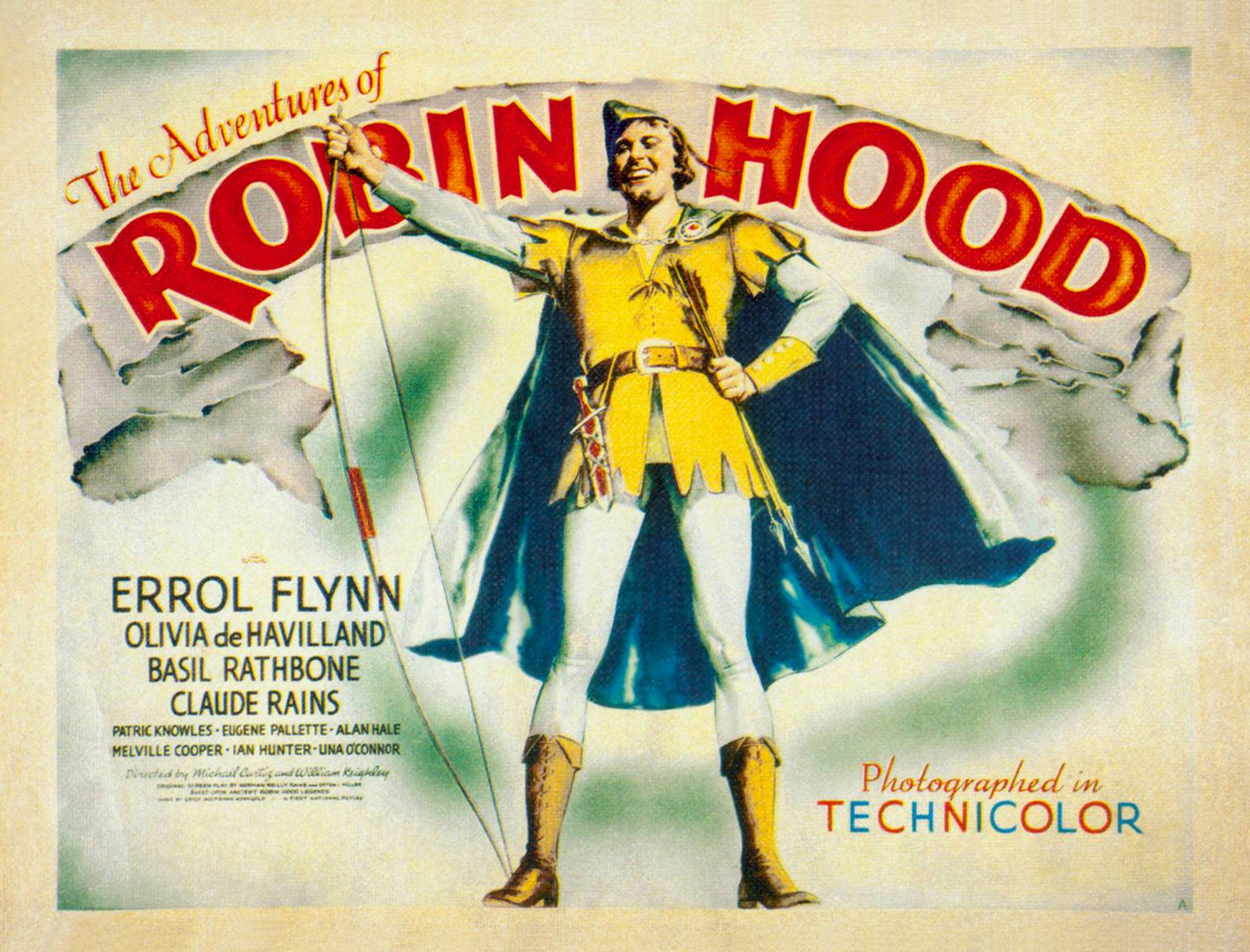
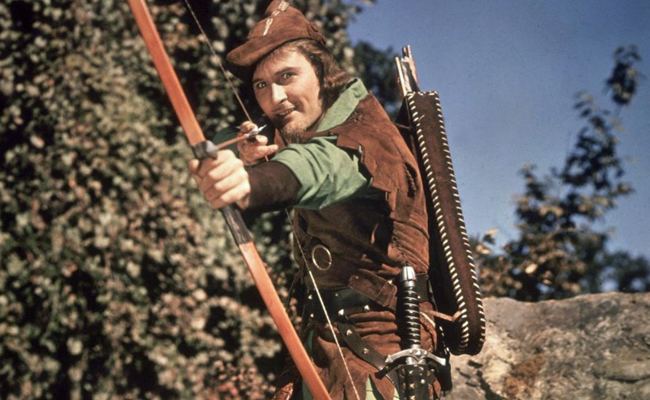
Why I Love THE ADVENTURES OF ROBIN HOOD (Warner Brothers 1938)


gary loggins's avatarcracked rear viewer

robin1

Readers of this blog know CASABLANCA is my all-time favorite movie, but THE ADVENTURES OF ROBIN HOOD is definitely in the Top Ten, maybe even Top Five (I’d have to think about it… sounds like a future post!). The story’s been told on-screen dozens of times, from the silent 1922 Douglas Fairbanks swashbuckler to Disney’s 1973 animated version to the recent Russell Crowe/Ridley Scott offering. But it’s this 1938  classic that remains definitive, thanks to a marvelous cast, breathtaking Technicolor, and the greatest cinematic swordfight in history.

robin2

You all know the legend of Robin Hood by now, so no need for a recap. Instead, I’ll go right into what makes this film so great, starting with Errol Flynn as the brave Sir Robin of Locksley. Flynn was at the peak of his career here, after starring in such action-packed hits as CAPTAIN BLOOD   , THE CHARGE OF THE LIGHT…

View original post 685 more words

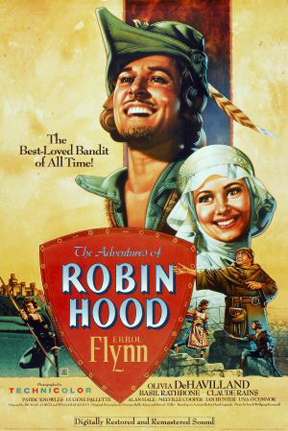
Cleaning Out The DVR #23: The Adventures of Robin Hood (dir by Michael Curtiz)


(For those following at home, Lisa is attempting to clean out her DVR by watching and reviewing 38 films by this Friday.  Will she make it?  Keep following the site to find out!)

Robin_hood_movieposter

Flamboyant.  Athletic.  Joyous.  Determined.  Handsome.  Outspoken.  Bigger than life.  Revolutionary.  Anarchist.  Sexy.  Libertarian.  Is there any doubt why Errol Flynn remains the definitive Robin Hood?

And. for that matter, is there any doubt why the 1938 film The Adventures of Robin Hood remains not only the definitive Robin Hood film but also one of the most influential action films in history?

The Adventures of Robin Hood tells the story that we’re all familiar with.  The King of England, Richard The Lionhearted (Ian Hunter), is captured while returning from the Crusades.  His brother, King John (Claude Rains, in full autocratic villain mode), usurps the throne while Richard is gone and immediately raises taxes.  He claims that he’s only doing this to raise the money to set Richard free.  Of course, the real reason is that John is a greedy tyrant.

The only nobleman with the courage to openly oppose John is Sir Robin of Locksely (Errol Flynn).  Sir Robin protects his fellow citizens from John’s main henchman, Sir Guy of Gisbourne (Basil Rathbone, also in full autocratic villain mode).  In fact, Robin is so brave that, on multiple occasions, he even enters Sir Guy’s castle so that he can specifically tell King John and Sir Guy that he has no use for their laws.  This, of course, always leads to Robin having to make a dramatic escape while arrows flies and swords are unsheathed all around.

And through it all, Robin Hood keeps smiling and laughing.  He’s a wonderfully cheerful revolutionary.  He may be fighting a war against a ruthless and unstoppable enemy and he may be the most wanted man in England but Robin is determined to have fun.  One need only compare Robin to his humorless foes to see the difference between freedom and bureaucracy.

(We could use Errol Flynn’s Robin Hood today, though I suspect our government would just blow him up with a drone and then issue a statement about how, by stealing money from the rich and giving it to the poor, Robin was keeping the government from being able to rebuild bridges and repair roads.)

When Robin isn’t exposing the foolishness of organized government, he’s hanging out in Sherwood Forest.  He’s recruiting valuable allies like Friar Tuck (Eugene Pallette) and Little John (Alan Hale, Sr.)  He’s playing constant pranks and promoting revolution and, to his credit, he’s a lot more fun to listen to than that guy from V For Vendetta.  He’s also romancing Maid Marian (Olivia de Havilland) and good for him.  Two beautiful people deserve to be together.

Even better, he’s doing it in glorious Technicolor!  There’s a lot of great things about The Adventures of Robin Hood.  The action scenes are exciting.  The music is thrilling.  The film is perfectly cast.  Errol Flynn may not have been a great actor but he was a great Robin Hood.  But what I really love about the film is just the look of it.  We tend to take color for granted so it’s interesting to watch a film like The Adventures of Robin Hood, one that was made at a time when color film was something of a novelty.  For those of us who spend a lot of time talking about how much we love old school black-and-white, The Adventures of Robin Hood is a film that says, “Hey, color can be great too!”

But what I mostly love about The Adventures of Robin Hood is just the pure joy of the film.  Just compare this Robin Hood to the grimly tedious version played by Russell Crowe.

(True, nobody in The Adventures of Robin Hood shouts, “I declare him to be …. AN OUTLAAAAAAAAAAAAWWWWWWWW!”  Actually, now that I think about it, Ridley Scott’s Robin Hood would have worked much better if Oscar Isaac and Russell Crowe had switched roles.)

The Adventures of Robin Hood was nominated for best picture and it probably should have won.  However, the Oscar went to Frank Capra’s You Can’t Take It With You.

Cleaning Out The DVR #4: Four Daughters (dir by Michael Curtiz)


Fourdaughters1938

Last night, after I finished watching My Sweet Audrina, I decided to watch one more film off of the DVR.  Seeing as how I had already watched a coming-of-age drama, a classic war film, and a Lifetime melodrama, I decided that my final film of the night would be 1938’s Four Daughters.  According to the plot description, it was the story of four musically talented sisters and their father.  It sounded nice and undemanding.

I recorded Four Daughters off of TCM, where it was shown as a part of the 31 Days of Oscar.  When it originally aired, I was warned about it by some of my fellow Oscar fanatics.  They all told me that it was an okay movie but it was nothing special.  “Don’t let the best picture nomination fool you!” they all said.  And, it’s true that the Four Daughters is one of the more forgotten best picture nominees.  Go check out the list of external reviews on the imdb and you’ll see that only a handful of reviews have been posted for Four Daughters.

But you know what?  I liked Four Daughters.  Yes, when compared to some of the other films that have been nominated for best picture, Four Daughters may seem rather slight.  Just compare it to some of the other films that were nominated for best picture of 1938: Grand Illusion, The Adventures of Robin Hood, Jezebel, and the winner, You Can’t Take It With You.  Interestingly enough, Michael Curtiz directed both The Adventures of Robin Hood and Four Daughters.  Curtiz was nominated for directing Four Daughters, though Robin Hood is certainly the better regarded film.

And yet, with all that in mind, Four Daughters is still a perfectly charming and rather sweet movie.  Adam Lemp (Claude Rains) is a musician who loves classic music.  He has four daughters, all of whom are musically talented.  The oldest, Emma, is played by Gale Page while the other three daughters are played the Lane Sisters, who were apparently a very popular singing act in the 30s.  Lola Lane plays Thea Lemp, Rosemary Lane plays Kay Lemp, and the youngest daughter, Ann, is played by Priscilla Lane.

While the film was obviously designed to capitalize on the popularity of the Lane Sisters, it’s not all just music and performing.  The Lemps also own a boarding house, which is frequently visited by potential suitors.  While Kay Lemp struggles with whether or not to accept a music scholarship and leave home, Emma is pursued by Ernest (Dick Foran) and Thea is courted by Ben (Frank McHugh), a wealthy older man.

And then there’s Ann, the youngest daughter and the one to whom I most related.  Despite saying that she never wants to marry, Ann finds herself being pursued by two men.  One of them is a composer named Felix Deitz (Jeffrey Lynn).  The other is Felix’s best friend, Mickey (John Garfield).

John  Garfield was one of the first Method actors to make the transition from stage to screen.  (It’s generally argued that, in the beginning, Paul Muni begat John Garfield who begat Montgomery Clift who begat Marlon Brando who begat Robert De Niro who begat Leonardo DiCaprio.)  Four Daughters was one of his first major roles and it also provided him with his first Oscar nomination.  It’s interesting to contrast Garfield’s brooding and internalized performance with the somewhat more bland actors who play the other suitors.  He grounds Four Daughters, giving the film a necessary jolt of reality.

However, I have to admit that my main reason for liking Four Daughters is a personal one.  I am the youngest of four sisters and there was so much about Four Daughters that I related to.  (I saw a lot of myself in Ann Lemp.)  From the opening scenes of the sisters fighting and laughing at the same time to the countless scenes of the sisters supporting each other, Four Daughters gets it right.  The film may have been made in 1938 but sisterhood is eternal.

In the end, I glad that I took the time to record and watch Four Daughters.  It’s a sweet movie, one that will be enjoyed by sisters everywhere.

http://www.youtube.com/watch?v=ClsfBZhViU0

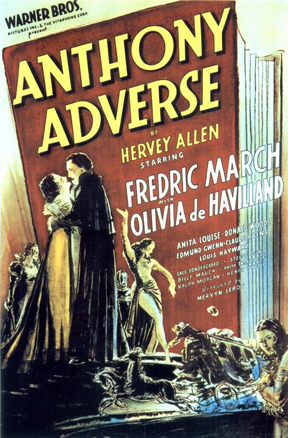
Cleaning Out The DVR: Anthony Adverse (dir by Mervyn LeRoy)


AnthonyAdverse

Late last night, I continued to clean out my DVR by watching the 1936 film, Anthony Adverse.

I recorded Anthony Adverse off of TCM, where it was being shown as a part of that channel’s 31 Days of Oscars.  Anthony Adverse was aired because it was nominated for Best Picture of 1936.  That’s significant because, if not for that nomination, I doubt that anyone would ever have a reason to watch Anthony Adverse.  It’s certainly one of the more obscure best picture nominees.  Despite a prestigious cast and being directed by the respectable Mervyn LeRoy, Anthony Adverse only has a handful of reviews over at the imdb.  And most of those reviews were written by Oscar fanatics like me.

Anthony Adverse is an epic historical film, one that tells the story of Anthony Adverse (Frederic March).  Anthony is the illegitimate son of Denis Moore (Louis Hayward) and Maria (Anita Louise), the wife of evil Spanish nobleman, Don Luis (Claude Rains, convincing as a nobleman but not as someone from Spain).  Luis murdered Denis and Maria died giving birth so Luis abandons the baby at an Italian convent.  Anthony is raised by nuns and priests and then, 10 years later, is apprenticed to an English merchant named John Bonnyfeather (Edmund Gwenn).  Bonnyfeather just happens to be Anthony’s grandfather!  Though Luis told him that Anthony died as soon as he was born, Bonnyfeather quickly figures out that Anthony is his grandson.  However, Bonnyfeather doesn’t share that information with Anthony and instead, he gives Anthony the surname “Adverse.”

Bonnyfeather raises Anthony as his own son.  Anthony grows up to be Frederic March and ends up falling in love with and marrying the beautiful Angela (Olivia De Havilland).  However, Anthony is suddenly called away on business to Havana, Cuba.  He doesn’t even have a chance to tell Angela that he’s leaving.  He does leave her a note but it blows away.  Assuming that she’s been abandoned, Angela goes to France, becomes an opera singer, and is soon the mistress of Napoleon.

Meanwhile, in Cuba, Anthony becomes convinced that Angela has intentionally abandoned him.  Consumed by grief, he ends up running a slave trading post in Africa.  He takes one of the slaves, Neleta (Steffi Duna), as his mistress and becomes known for his cruelty.  However, he eventually meets Brother Francois (Pedro de Cordoba) and starts to reconsider his ways.

(The film’s treatment of the slave trade is …. well, it’s awkward to watch.  The film is undoubtedly critical of slavery but, at the same time, it’s hard not to notice that the only slave with a prominent part in the film is played by a Hungarian actress.  Anthony may eventually reject cruelty but it’s left ambiguous as to whether or not he rejects the slave trade as a business.  If Anthony Adverse were made today, one imagines that this section of the film would be handled much differently.)

Meanwhile, back in Europe, Bonnyfeather is dying and his housekeeper, Faith (Gale Sondergaard, who won the first ever Oscar awarded for Best Supporting Actress for her performance here), plots to claim his fortune.

After I watched the movie but before I started this review, I did some research and I discovered that Anthony Adverse was based on a 1,222-page best seller that came out in 1933.  I’m going to guess that the film’s long and ponderous story may have worked better on the page than it does on the screen.  As a film, Anthony Adverse clocks in at 141 minute and it feels even longer.  Despite the impressive cast, the film just never clicks.  It’s never that interesting.

At the same time, I can understand why it was nominated for best picture.  It’s a big movie, full of characters and extravagant sets and ornate costumes.  You can tell it was an expensive movie to make and there’s enough philosophical dialogue that you can pretend there’s something going on underneath the surface.  In the 1936, Anthony Adverse may have been quite impressive but seen today, it’s forgettable.

Anthony Adverse lost best picture to another overproduced extravaganza, The Great Ziegfield.  Personally, I would have given the award to the unnominated My Man Godfrey.

http://www.youtube.com/watch?v=c_OyZlSCpo4