Lisa Reviews An Oscar Nominee: Arrowsmith (dir by John Ford)


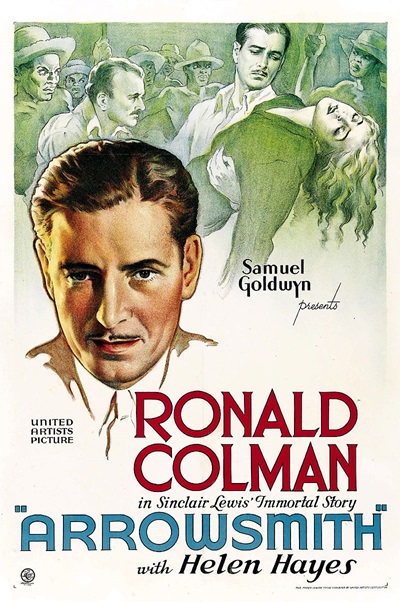
In the 1931 Best Picture nominee Arrowsmith, Ronald Colman stars as Martin Arrowsmith, a doctor who is trying to save lives without compromising his ethics.

Arrowsmith is mentored by the famed bacteriologist, Max Gottlieb (A.E. Anson) and married to a nurse named Leora (Helen Hayes).  At first, Arrowsmith makes his living as the local doctor in Leora’s small hometown in South Dakota.  However, Arrowsmith is ambitious and wants to do more with his life and career than just take care of a small town.  He wants to cure the world of disease.  When he’s offered a position at the prestigious McGurk Institute in New York, he enthusiastically accepts.  Having just suffered a miscarriage, Leora supports Arrowsmith’s decision and travels to New York with him.  No matter what happens, Leora is always there to support her husband, even when he doesn’t seem to appreciate it.

When Arrowsmith thinks that he’s discovered an antibiotic serum that appears to be capable of curing all sorts of diseases, he attempts to stay true to the methods taught to him by Dr. Gottlieb.  He takes his time.  He tests carefully.  He doesn’t rush out and give the serum to everyone.  However, Arrowsmith finds his methods continually sabotaged by his colleagues, who hope to raise money by telling the press about a miracle serum that can “cure all diseases!”  When Arrowsmith later finds himself combatting an outbreak of the Bubonic Plague in the West Indies, he again tries to employ the scientific method but finds himself being pressured by government officials to give his untested serum to every single person on the island.  Eventually, Arrowsmith’s ethics are pushed to their limits when even Leora falls ill.

Arrowsmith was based on a best-selling novel by Sinclair Lewis, though the plot was changed to make the story more palpable for film audiences.  In the novel, Arrowsmith is a bit of cad who regularly cheats on his wife.  In the film, Arrowsmith is passionate and driven but the exact nature of his relationship with wealthy Joyce Lanyon (Myrna Loy) is left so ambiguous that it actually leaves one wondering why the character is in the film at all.  What both the film and the novel have in common is an emphasis on the importance of science and the scientific method.  Arrowsmith’s idealism runs into the harsh reality of life during an epidemic.  Government officials are more concerned with saying that they’ve done something as opposed to considering whether their actions have ultimately done more harm than good.  In its way, Arrowsmith predicted the COVID era.

Arrowsmith was the first John Ford film to be nominated for Best Picture and its financial success allowed Ford the freedom to go on to become one of Hollywood’s most important directors.  Seen today, Arrowsmith feels a bit creaky and self-important, with little of the visual flair that Ford brought to his later films.  Ronald Colman’s performance as Arrowsmith seems a bit stiff, especially when compared to the much more lively (and sympathetic) performance of Helen Hayes.  Arrowsmith is a big and serious film and, if we’re going to be honest, it’s a little bit boring.  Still, it’s interesting to see the issues of today being debated 90 years in the past.

As for the Oscars, Arrowsmith was nominated for Best Picture, Adaptation, Cinematography, and Art Direction.  It lost in all four of the categories in which it was nominated.  That year, Best Picture was won by Grand Hotel, which curiously didn’t receive any other nominations at all.
The TSL’s Grindhouse: The Year of the Yahoo! (dir by Herschell Gordon Lewis)


yahoooooooooooooooooooooooo

At the time of his death last year, Herschell Gordon Lewis was credited with having directed 38 films.  Though he’s best known for ground-breaking gore films like Blood Feast and The Gore Gore Girls, Lewis actually dabbled in several different genres.  For instance, he made one of the first psychedelic drug films when he directed Something Weird.  And, as a public service, he warned us all of the dangers of smut peddlers with Scum of the Earth.

And, of course, there was that political films he made…

WHAT!?  A political film directed by Herschell Gordon Lewis!?

Yes, it’s true!  The man who helped to give birth to modern horror also directed one of the most prophetic films ever made.  The Year of the Yahoo! came out in 1972 but it feels even more relevant today.  The Year of the Yahoo! not only predicted the rise of Donald Trump but also predicted the rise of Barack Obama as well, making it one of the few truly bipartisan satires ever made.  That’s not bad for an obscure film directed by a man who was never given much respect from mainstream critics.

The Year of the Yahoo! opens in Texas.  It’s an election year.  The governor (Jeffrey Allen) would love to get rid of liberal U.S. Senator Fred Burwell (Robert Swain) and he thinks that he’s found the candidate to do it.  The Governor wants to nominate an unimpressive congressman, someone who will be easy to control.  However, the President disagrees.  The President (who is obviously meant to be Richard Nixon, even if his name is never specifically mentioned) has decided that the man to defeat Sen. Burwell is a country singer named Hank Jackson (real-life country singer Claude King).

Hank Jackson has a television show, one that he hosts with his girlfriend, Tammy (Ronna Riddle).  Hank sings songs about how America needs to return to traditional values and how people just need to come together and help each other out.  He may be old-fashioned but he’s okay with the counter-culture.  In fact, when we first meet him, he’s at a hippie party.  He turns down an offer of marijuana but he does so with a hearty laugh.  He’s a traditional guy but he’s got no issues with the long hairs.  Not our Hank!  It doesn’t matter whether it’s a Dallas oilman, an Austin hippie, an El Paso policeman, or a Galveston fisherman.  Everyone in Texas loves Hank!

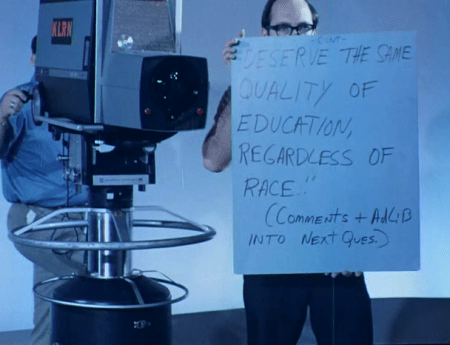
When Sid Angelo (Ray Sager, the star of Lewis’s Wizard of Gore), a political consultant with White House connections, approaches Hank about running against that lefty traitor, Sen. Burwell, Hank is skeptical but intrigued.  Once Sid get Hank to agree, Sid starts to shape Hank’s message.  As a disgusted Tammy watches, Hank starts to sell out.  Soon, Hank is making jokes about people on welfare.  He’s defending law and order.  He’s taking the side of the landlords against the rent strikers.  Everything from his campaign announcement to interviews with the local media is precisely choreographed by Sid.

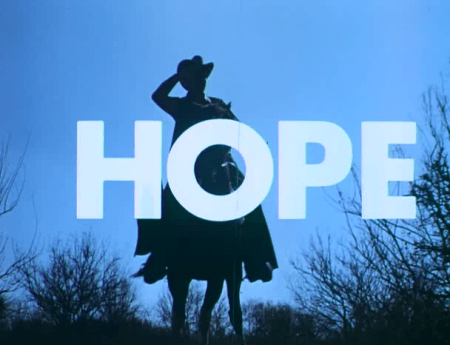
Hank’s message starts to resonate with the voters.  This is largely because he doesn’t have a message.  Instead, he just has a bunch of empty slogans and coded phrases.  Hank’s campaign commercial features him riding on a horse while the word “Hope” appears on the screen.  (I mean, who could possibly vote against hope?)  What’s going to happen when Hank’s elected?  Well, as he explains in the film’s theme song, we’re going to run the nation “like a country store.”  Just vote for Hank and “you’ll see how everyone relaxes.”

(At times, The Year of the Yahoo! almost feels like a musical.  The majority of the songs were written by Lewis, who was a legendary figure in the advertising industry before and after his career as a grindhouse filmmaker, and Claude King had a nice voice.  The songs are surprisingly catchy, even if they often are a bit too on the nose in their satire.)

Now, make no mistake about it.  This is definitely a Herschell Gordon Lewis film, which means that it often appears to have been made with more enthusiasm than skill.  At times, The Year of the Yahoo! moves way too slowly.  There’s a riot scene that is embarrassingly filmed.  The action stops for a stomach-churning sex scene between the hairy Ray Sager and a campaign volunteer.  The entire film, in fact, is full of actors who appeared in Lewis’s other films and it’s a bit weird to see familiar grindhouse performers cast as governors and campaign aides.  This is a Herschell Gordon Lewis production, with everything that implies.  While Lewis’s style was perfect for his semi-comedic gore films (Who can forget the “Have you ever had …. AN EGYPTIAN FEAST!?” scene from Blood Feast?), it feels a bit out of place in a film that is attempting to comment on reality.

And yet, it’s hard not to appreciate and kind of resoect just how serious the film’s intent seems to be.  Watching The Year of the Yahoo!, you get the feeling that Lewis actually was trying to say something important.  In The Year of the Yahoo!, Lewis not only attempted to make an important point but it was a valid point as well.  He may not have had the resources to really pull it off but consider this:

In 1972, Herschell Gordon Lewis predicted that a candidate could shoot the top of the polls by enticing voters with vague promises of hope.

In 1972, Herschell Gordon Lewis predicted that a wealthy TV celebrity, one that claimed to speak for the common man, could be packaged as a populist and sold to angry voters.

The Year of the Yahoo! was incredibly ahead of its time.  Say what you will about the film’s production values but you can’t deny this.  Everything that Herschell Gordon Lewis predicted came true.  That’s quite an accomplishment for someone often dismissed as merely being a gore director.

In fact, it’s such an accomplishment that it should give us all one thing for the future:

yahoooooo

Lisa Reviews An Oscar Nominee: Bad Girl (dir by Frank Borzage)


bad-girl

Seeing as how I started this day by watching Fifty Shades Darker, it seemed appropriate to end the day by watching yet another film about the difficulty of finding love and commitment.  This film came out a little bit earlier than Fifty Shades of Grey.  In fact, it even predates the whole concept of fan fiction.  This film came out in 1931 and it would probably be totally forgotten today if not for the fact that, 85 years ago, it was nominated for Best Picture.

Of course, that’s not to say that Bad Girl is particularly well-known.  Until I came across it on my list of best picture nominees, I didn’t know that it even existed.  According to Wikipedia, it was based on a novel and a play and it did rather well at the box office.  The Academy apparently liked it, awarding it Oscars for both Best Director and Best Adapted Screenplay.  It’s currently available on YouTube.  That’s where I saw it.  But, despite all of that, it definitely appears to be one of the more obscure films to have ever been nominated for best picture.

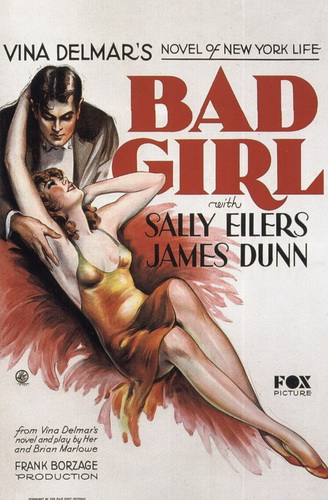
Bad Girl opens with Dorothy Hailey (Sally Eilers) in a wedding gown.  However, she’s not getting married.  Instead, she’s a store model and, in a rather surreal little sequence, Dorothy and her co-workers walk through the store in their bridal gowns while sleazy men leer at them.  As Dorothy complains to her best friend, Edna Diggs (Minna Gombell), men are “only interested in one thing.”  When Dorothy’s boss propositions her, Dorothy claims to have a prizefighter husband waiting for her at home.  In truthfulness, Dorothy lives with her overprotective brother (William Pawley), a judgmental brute who accuses her of being a tramp if she stays out too late.

At Coney Island, Edna makes a bet that Dorothy won’t be able to get surly Eddie Collins (James Dunn) to talk to her.  Dorothy takes the bet and then proceeds to go over to Eddie and play a ukulele, until Eddie gets annoyed enough to tell her to be quiet.  Eddie claims to not like women  and he accuses Dorothy of being a tease.  “Listen, sister,” he tells her, “if you don’t want guys to salute, take down the flag.”

Wow, Eddie sure does seem to be a jerk, doesn’t he?

Well, don’t worry.  It turns out that Eddie isn’t as bad as he seems, it’s just that he’s often in a bad mood because he doesn’t have much money and he wants to open up his own radio store.  However, Eddie and Dorothy quickly fall in love and soon, they’re married…

But, of course, things never go that smoothly.  It turns out that Eddie is proud and stubborn.  Fortunately, he’s played by a charming actor named James Dunn because, without Dunn’s considerable working class charm, Eddie would probably be insufferable.  Dorothy, meanwhile, fears letting Eddie know that she’s pregnant…

And you know what?

I liked Bad Girl.  

On the one hand, Bad Girl is definitely a dated film.  Any film released in 1931 is going to seem dated when watched in 2017.  But, at the same time, that also means that Bad Girl works as a nice little time capsule.  Watching Bad Girl was like stepping into a time machine.  And it turns out that the 1930s weren’t that bad!  Everyone wore nice clothes and talked like James Cagney.

But, dated it may be, there is also an almost timeless quality to Bad Girl.  Even decades after the film was originally released, the likable chemistry between James Dunn and Sally Eilers feels real and you really do care about what happens to them.  You feel like they belong together and it’s hard not to worry when they fight or when they misunderstand each other’s intentions.  (This happens rather frequently.)  Furthermore, Bad Girl is a film about people who, often times, are struggling just to make ends meet.  That’s something to which everyone can still relate.  It certainly sets it apart from a lot of the other films made both then and today.

Bad Girl was nominated for best picture but it lost to a film that was almost its total opposite, Grand Hotel.  Unlike most of the other old best picture nominees, I have never seen Bad Girl on TCM but it is on YouTube and you can watch it below!