Horror Film Review: Night of Dark Shadows (dir by Dan Curtis)


Since I just reviewed House of Dark Shadows, it only makes sense to now take a look at 1971’s Night of Dark Shadows today!

While Night of Dark Shadows is not a direct sequel to the first film, it is still definitely a part of the same cinematic universe.  There may not be any vampires in this film but it does take place in the same house and it features two members of the family that was decimated over the course of the previous film.  At one point, it’s mentioned that Joan Bennett’s character from House of Dark Shadows died after the first film but no one goes into any details.  I guess a vampire in the family is something that’s simply not discussed amongst polite company.

Night of Dark Shadows deals with Quentin (David Selby) and Tracy Collins (Kate Jackson).  Quentin is an artist who confesses that he wasn’t particularly nice before he married Tracy.  When they move into the Collins mansion, they bring two friends with them, Alex (John Karlen) and Claire (Nancy Barrett.)  Interestingly enough, Karlen and Barrett both played different characters in House of Dark Shadows.  Grayson Hall, who played Dr. Hoffman in House of Dark Shadows, also returns for Night of Dark Shadows.  This time Hall is playing Carlotta Drake, the creepy housekeeper.  (Needless to say, all mansions comes with a creepy housekeeper.)

Soon after everyone moves in, Quentin starts acting strangely.  He becomes obsessed with the painting of a beautiful woman who was named Angelique (Lara Parker) and with the story that Angelique was hanged when it was discovered that she was having an affair with Quentin’s ancestor, Charles.  (For his part, Charles was apparently walled up in the mansion.  That sounds a bit extreme to me but I guess that’s the way they did things in the 19th century.)  Quentin starts to have visions and nightmares involving his ancestor who, it turns out, looked exactly like him!  Meanwhile, Carlotta and the groundskeeper, Gerard (Jim Storm), seem to be determined to make sure that Tracy doesn’t feel welcome in her new home.  It’s almost as if they’re trying to drive everyone but Quentin away from the house.

Night of Dark Shadows is a much more polished film than House of Dark Shadows but it also unfolds at a far more leisurely pace.  It lacks the relentless energy that distinguished House of Dark Shadows.  This wouldn’t be as much of a problem if the plot itself wasn’t so totally predictable.  From the minute that Quentin first sees that portrait of Angelique, you know that he’s going to get possessed and start acting strangely.  There are a few atmospheric scenes but, for the most part, the film just doesn’t grab the viewer’s attention the way that House of Dark Shadows did.

On the plus side, David Selby is properly intense and brooding in the dual roles of Quentin and Charles Collins while Lara Parker does an equally good job as the wonderfully evil Angelique.  Grayson Hall, who tended to go overboard in House of Dark Shadows, gives a much better and far more menacing performance here.  Night of Dark Shadows isn’t a bad film.  It’s just not a particularly memorable one.
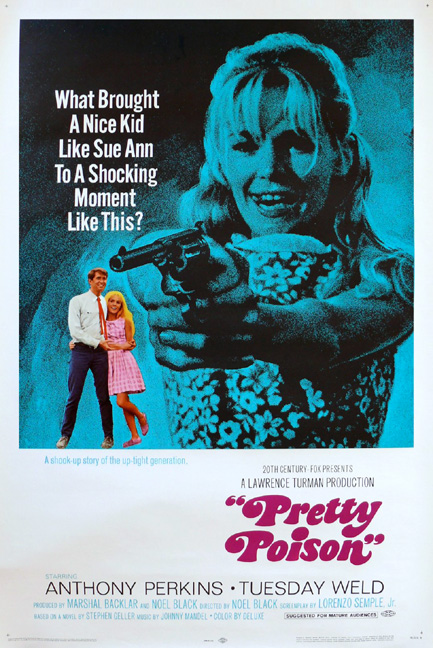
Embracing the Melodrama Part II #29: Pretty Poison (dir by Noel Black)


Prettypoison1

“I don’t care if critics like it; I hated it.  I can’t like or be objective about films I had a terrible time doing.”

— Tuesday Weld on Pretty Poison (1968)

It’s actually rather depressing to read that Tuesday Weld hates Pretty Poison because it really is an underrated gem, a nifty little thriller that acts as sly satire on youth, conformity, and small town life.  The main reason that the film works is because of the performances delivered by both Weld and her co-star, Anthony Perkins.

But then again, when we the viewers think back on a movie, we remember what we saw as a member of the audience and sometimes, we forget that just because a film is fun to watch, that doesn’t necessarily mean that it was enjoyable to make.  When actors and other technicians think back on a film they were involved with, they remember the experience of actually making it.  Reportedly, Weld did not get along with the director of Pretty Poison and couldn’t wait to get away from him.

Interestingly enough, in Pretty Poison, Tuesday Weld plays a teenage girl who doesn’t get along with her mother and who can’t wait to get away from her.  Perhaps being miserable while making Pretty Poison helped Weld to bring a miserable character to life.

Pretty Poison opens with a nervous-looking man named Dennis Pitt (Anthony Perkins) watching a group of high school cheerleaders practicing on a field.  His attention is focused on one cheerleader in particular, the blonde Sue Ann Stepanek (Tuesday Weld).  Even before the opening credits have ended, the film has established a familiar dynamic.  Sue Ann is the fresh-faced example of small town American innocence.  Dennis is the type of creepy older guy that every girl has had to deal with at some point in her life.  (When I was in high school, there were always guys like Dennis hanging out around the mall.  When I was in college, the Dennis Pitts of the world were the guy who still hung out around the dorms even though they hadn’t been a student in a decade.)

Having established this dynamic early on, Pretty Poison spends the rest of its running time turning that dynamic upside down.

Dennis has recently been released from a mental hospital.  Under the watchful eye of his parole officer (John Randolph), Dennis gets a mind-numbingly dull job at a local mill and tries to live a normal life.  When Dennis finally does get a chance to talk to Sue Anne, he lies to her and tells her that he’s a secret agent and that he’s in town on a mission.  Sue Anne responds to Dennis’s awkward flirting and soon, she’s accompanying him on his “missions.”  During one such mission near the mill, they’re spotted by a security guard.  Sue Anne responds by enthusiastically murdering him.

Yes, the cheerleader’s a sociopath.

Sue Anne’s tyrannical mother (Beverly Garland) does not approve of her relationship with Dennis.  Sue Anne wants her mother out of the way and she expects her secret agent boyfriend to help her out…

Pretty Poison is a sharp mix of dark comedy and heightened drama, one that gets progressively darker as it progresses.  From the minute the film first shows Sue Anne intensely practicing on that field while Dennis watches her, it’s pretty obvious that the film was meant to be an allegory for American society in 1968.  Sue Anne is the perfect, all-American cheerleader who kills people because she can.  Dennis is the neurotic outsider who knows that he’ll never be able to get anyone to believe the truth.

And it all works, largely because both Anthony Perkins and Tuesday Weld are so well-cast.  It is, of course, impossible to watch Perkins without first thinking about Psycho but he actually manages to make Dennis into a very different character from Norman Bates.  If Norman was a psycho who, at first sight, looked like an innocent, Dennis is an innocent who, at first sight, looks like a psycho.  Tuesday Weld, meanwhile, turns Sue Anne into a disturbingly plausible killer, the type who, within minutes, can alternate between moodiness and giddiness, all the while squealing with orgasmic joy while bashing in someone’s head.

Tuesday Weld may hate Pretty Poison but it’s still a pretty good movie.

http://www.youtube.com/watch?v=bC2BMIwQl1Y