Grindhouse Classics : “The Gruesome Twosome”


Ask most people what their favorite Herschell Gordon Lewis flick is, and the common answers you’re likely to hear will be either Blood Feast, 2,000 Maniacs, or  The Gore-Gore Girls, with the occasional vote for The Wizard Of Gore simply because it was mentioned in Juno, they saw it due to the fact that Diablo Cody gave it her “certified cool” stamp of approval, and they then proceeded to go no further in the “Godfather of Gore”‘s cinematic ouevre than that.

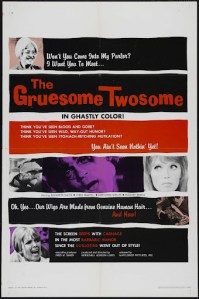
Fair enough. But for this armchair critic’s money, Lewis’ most fun — and most deranged (they usually go hand-in-hand with HGL) — work is 1967’s The Gruesome Twosome. The premise is pure genius, the humor is right up there at the forefront, and it’s as subtle as a hammer-blow to the forehead. What more could you possibly ask for?

Old Mrs. Pringle (Elizabeth Davis) is an eccentric yet hopelessly entrepreneurial senior citizen who runs not one, but two home-based businesses — a wig shop downstairs primarily catering to co-eds from the local college (yes, there was once a day when wigs were considered very hip fashion accessories by the under-65-and-without-cancer set), and a boarding house  upstairs that pretty much rents rooms solely to — those same co-eds from the local college. It doesn’t take a seasoned exploitation viewer like myself or unobtainium13 vet Lisa Marie Bowman (who you can either thank, or blame, for getting me to start contributing to this site) to figure out at this point why Mrs. Pringle’s wigs have such fine-quality, completely-realistic-feeling hair, does it?
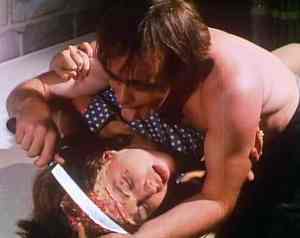
Well, okay, in case you’re slow on the uptake,the not-so-good Mrs. P.’s demented full-grown son, Rodney (Chris Martell), is taking the girls into the back room of the shop, scalping them, and then killing them — thus ensuring that their “room for rent” sign never has to come down, and that they never run out of wigs. And this is almost always shown in loving, close-up, excruciating, far-less-than-realistic detail. Truth be told, although Lewis had taken something of an extended hiatus from the gore genre he basically started single-handedly  before returning to it with this film, he hadn’t been away so long that he forgot we wouldn’t have it any other way and he knew that his job was simply to deliver the goods. Sure, there’s a “plot” here of sorts — college student Kathy Baker (Gretchen Wells), a self-appointed “female James Bond,” starts doing the cops’ job for them and investigating the disappearances of all her classmates when one of her fellow residents of the all-girls’ dormitory doesn’t come home one night, much to the chagrin of her boyfriend, but as with any Lewis film, the payoff here comes primarily in the form of the ingenious set-up and the resultant heavy doses of viscera said set-up inevitably gives rise to — the rest is all filler.

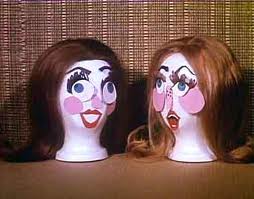
And it’s the quality of that filler that sets The Gruesome Twosome apart. Whether it’s the truly hysterical conversation between two styrofoam wig-form heads at the beginning of the film (a scenario Lewis had to improvise quickly on the fly to pad out the runtime to 70 minutes when the original opening scene was inadvertently destroyed, thus making it a genuine example of necessity being the accidental mother to genius), or the extended slapstick-style sequence where Kathy sics the cops on the poor German- immigrant gardener/handyman who works at the school who just likes to bury bones for his dog in his back yard, or Mrs. Pringle’s constant back-and-forth (in her mind, at any rate) dialogue with her stuffed bobcat, Napoleon, the downright clever nature of the padding in this film marks it as a cut above (pun only somewhat intended) its contemporaries.
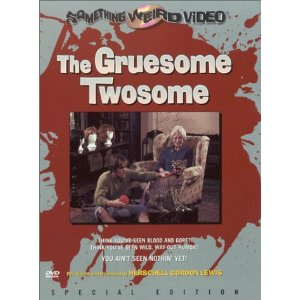
As is the case with pretty much every Herschell Gordon Lewis flick, The Gruesome Twosome is available on DVD from Something Weird Video in a “special edition” that features a remastered (and quite nice-looking) full-frame transfer, remastered mono sound, a full-length, and very entertaining, commentary track from Lewis himself, and the ubiquituous-on-these-things “Gallery of Herschell Gordon Lewis exploitation artwork.” Definitely an essential purchase either on its own or as part of the HGL box set that also contains A Taste Of Blood, She-Devils On Wheels, Something Weird, The Wizard Of Gore and The Gore-Gore Girls. If you haven’t got it, get it — and if you’ve got it already, there’s no such thing as a bad time to watch it again. Have fun — and don’t touch my hair.
Review: Night of The Hunted (dir. by Jean Rollin)


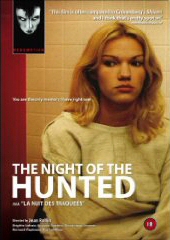
When, at that age of 22, I first saw Jean Rollin’s Night of the Hunted, I cried as much as the first time I saw Titanic at the age of 12.  In both cases, the tears were inspired by a “doomed” love story.  The main difference between the two films is that I don’t cry over Titanic anymore.  But Night of Hunted still brings me to tears every time I see it.

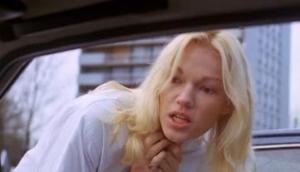
The film opens with the image of a terrified young woman (Brigitte Lahaie) running through a dark forest until she eventually reaches a highway.  She’s picked up by a young man (Vincent Gardere) who, being a guy, proceeds to take her back to his apartment in Paris.  She confesses that she can’t remember who she is, why she was running, or even being picked up by the young man in the first place.  Saying that she needs some sort of memory to fill the emptiness, she proceeds to make love to Gardere.  Gardere, being a guy, doesn’t object.

However, he does make the mistake of later leaving Lahaie alone in the apartment afterwards.  As soon as Gardere leaves, Lahaie forgets ever meeting him and why she’s even in the apartment in the first place.  Even as she tries to figure out what’s going on, the apartment is visited by a doctor who tells Lahaie that she is his patient and that she needs to go with him to a “clinic” where he can treat her.  No longer remembering her encounter with Gardere, Lahaie agrees.

Needless to say, the “clinic” turns out to be what Lahie was so desperately trying to escape just a few hours before.  We learn that Lahie is merely one of several hundred people who, months earlier, were exposed to a biological warfare experiment gone wrong.  Now, as a result, her brain is slowly dying one cell at a time.  The clinic is actually a government-run prison where she and her fellow victims have been sent to be forgotten about and to eventually die.  Lahie finds herself surrounded by men and women who, as they slowly lose everything that made them unique, revert back to their most primal instincts.  While Gardere tries to find her, Lahie struggles to survive just one final night in both the clinic and in the prison of her own fading mind.

Director Jean Rollin is best known for his sexually-themed vampire films but the Night of the Hunted is not as huge a departure for him as it may first seem.  One of Rollin’s reoccurring themes is the importance of our memories, no matter how idealized they may sometimes be and this theme is present in every frame of Night of the Hunted.

The lead role is played by Rollin’s frequent muse and collaborator, Brigitte Lahaie.  Because the majority of Lahaie’s career has been spent making adult films, she’s never gotten the due she deserves as an actress.  Playing a difficult role here, Lahaie is the movie’s greatest strength.  She brings a real sincerity and empathy to her role and its impossible to imagine this movie working without her.  If nothing else, this movie is a wonderful display of Lahaie’s often underrated talent. 

Rollin made the film for very little money and used a cast made up almost entirely of nonprofessionals and French adult film veterans.  So, yes the film does sometimes have a grainy look and the editing is definitely jagged.  When the characters shoot at each other, it is obvious that they’re firing toy cap guns.  To me, however, this works in the film’s favor.  The raw quality of the film perfectly mirrors that constant fear and confusion that Lahaie and her fellow prisoners live in.  No, the film is not technically perfect but a flawed masterpiece is preferable to uninspired technical perfection any day.

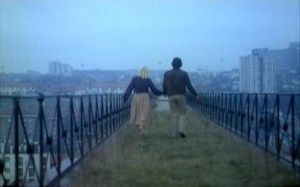
Despite working with a miniscule budget, Rollin captures some haunting images in this film.  Never has Paris looked as desolate as in this movie.  One of Rollin’s trademarks has always been his own fascination with architecture and, as a result, the cold skyscraper where Lahaie is held prisoner almost becomes a character itself.  I’ve always considered Jean Rollin to be horror cinema’s equivalent to Jean-Luc Godard and, with its images of a sterile city run by passionless autocrats, Night of the Hunted brings to mind Godard’s Alphaville.

 The film’s most haunting image comes at the end and it is this image that brings tears to my eyes every time.  Whatever flaws the film may have, Night of the Hunted has one of the best final shots in the history of cinema.  Even if everything preceeding it had been worthless, this movie would be worth sitting through just for the stark beauty of the final shot.  Night of the Hunted ends on a note that manages to be darkly sad and inspiringly romantic at the same time.  It’s an ending that makes Night of the Hunted one of the most romantic films of all time.

Night of the Hunted was released in 1980 and, like the majority of Rollin’s films, was never released in the States.  Redemption, however, has released it on DVD (which is how I first saw it in 2008.)   While the transfer is undeniably rough, that actually gives the movie a documentary-like quality that works in its favor.  The film is in French with English subtitles.   As is so often the case with subtitles, a lot of the film’s nuance is sacrificed in translation.  Fortunately, the combination of Rollin’s visual sense and Lahaie’s lead performance more than makes up for it.