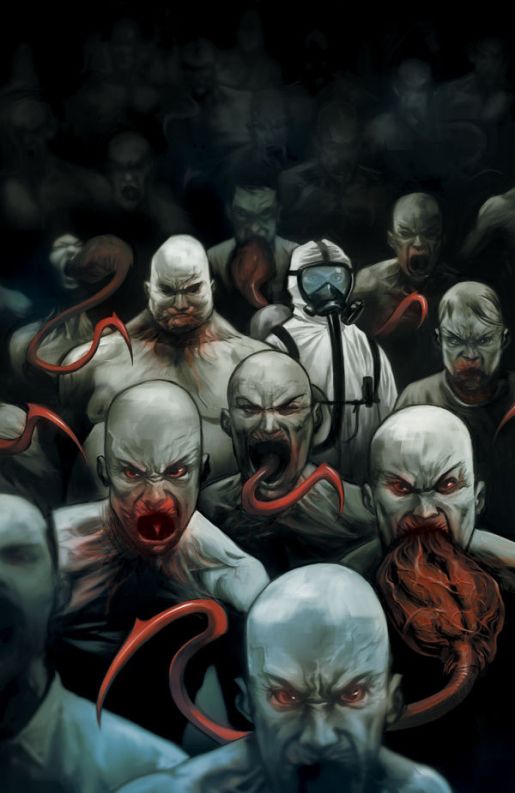
The vampires of The Strain appear to be the next step of the Reapers, Del Toro introduced in Blade II. These creatures far removed from the handsome angst filled vampires of True Blood, Twilight, etc and more in the line with the apex predators that caused nightmares.
Below is the breakdown of the hemophagic corpses (via the wiki page)
Vampire Biology
The vector for vampirism is a capillary worm, which, once introduced into the human host’s bloodstream (either through a vampire’s feeding or direct invasion by the worm through a wound or orifice), introduces an incurable and fast-acting virus. By manipulating the host’s genes, the virus causes a human to undergo numerous radical physical changes.
Vampire Physicality
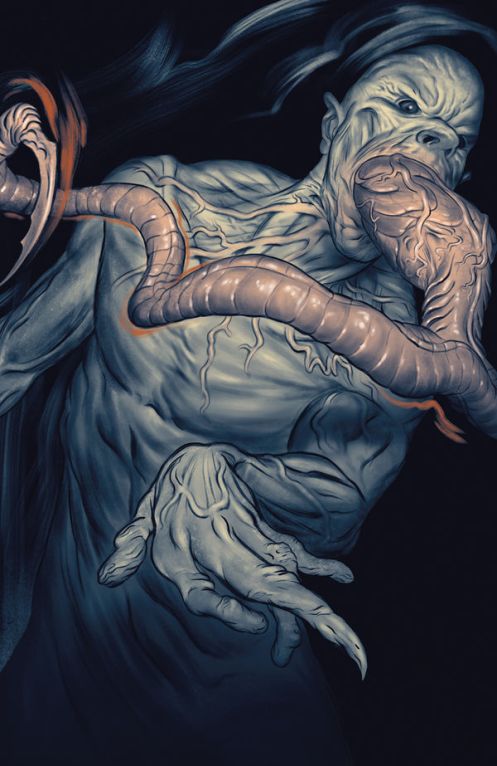
The first and most distinct vampire adaptation is the development of a long, retractile proboscis beneath the host’s tongue, which is able to extend up to six feet from the mouth. This “stinger” is both the vampire’s feeding and reproductive mechanism, shooting forth to latch onto human prey’s throat or thigh, both draining the victim’s blood for nutrition and infecting the human with capillary worms. The vampire’s jaw is set at a lower hinge than a human, the mouth gaping like a snake’s when the stinger is deployed. As the structure of the stinger is actually modified tissue from the human lungs and throat, vampires are incapable of physical speech.
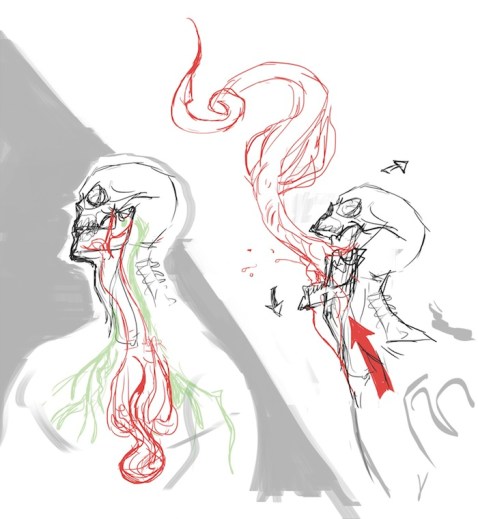
A vampire’s physical appearance is governed mainly by the host body shedding those human traits that are obsolete to its new life cycle. Hair and fingernails are gradually lost, while the external nose and ears atrophy, leaving a fully matured vampire’s skin as smooth and featureless as marble. The vampire’s complexion is extremely pale between feedings, but appears a flushed red after a recent blood-meal. Eye coloration is a black pupil surrounded by a red sclera, with a white nictitating membrane sliding across for protection. The middle fingers of both hands grow and strengthen, and a thick talon develops in place of the lost fingernail. As vampire reproduction is achieved through viral infection of hosts and not through any sexual mechanism, the human genitalia also atrophy, leaving a mature vampire with no discernible gender.
The digestive and circulatory systems of a vampire are simplified and fused, the vampire’s interior organs most resembling a series of connected sacs. Nutrition from a blood feeding is transported throughout this system via a thick, viscous white fluid that forms the vampire equivalent of blood. The capillary worms are present in this fluid, swimming throughout the circulatory system and often visible beneath the vampire’s thin skin. Like rodents, a vampire is unable to vomit, its suction-based digestive process functioning only one way. All bodily waste is excreted from a single rectal orifice in the form of a pungent ammonia-based spray; a vampire will excrete for the entire duration of a feeding, purging old food as it consumes new blood.
The vampire’s body temperature runs extremely high, at 120 degrees Fahrenheit, and a human is able to feel their ambient heat from several feet away.
Many of the physical changes from human to vampire occur gradually following the initial worm infection, and are accompanied by great pain. A newly “turned” human will lie in a state of suspended animation for an entire day, rising the next night as a nascent vampire. The stinger is present for the vampire’s first foray, in order to facilitate feeding, but other traits (hairlessness, talons on the mid-digit, lack of distinct internal organs) will develop within the first seven nights following infection. The vampire’s mental state will also be confused at first, and its movements will be clumsy and awkward. As it matures, however, the vampire will become supremely agile, able to leap great distances and climb sheer surfaces with the aid of its talons. Full maturity, physically and mentally, occurs within the first thirty nights.
In spite of the vampire’s morbid biology stripping legend of most of its romance, the most famously admired trait of the undead remains intact: immortality. Unless slain by violence or sunlight, a vampire’s parasitic body structure will neither fade nor weaken with the passage of time, giving them an effectively endless “life”-span. Even in those cases where the host body is damaged beyond repair, a vampire of sufficient power can transfer their consciousness (via a torrential capillary worm transfer) from one human form to another.
Vampire Senses
The sensory apparatus of the vampire is highly adapted for their nocturnal life cycle. Color vision is replaced with the ability to sense heat signatures, and the world is perceived in a monochrome brightened by sources of warmth (such as human prey). Hearing is greatly enhanced, in spite of the loss of external ears.
The vampires’ greatest sensory asset, however, is the “hive mind” that all new vampires share with the Ancient that propagated them. Each vampire, through some undefined telepathic link, is able to send and receive thought and sensory information to and from their Ancient progenitor. In this manner, the Ancient vampires direct the actions of their individual spawn through mental communication, regardless of distance. Perhaps akin to its radiation shielding properties, the element lead has the effect of blocking this mental connection.
In spite of their biological inability to speak, vampires can communicate with humans through telepathy, transmitting thoughts directly into a person’s internal monologue. Those vampires seeking to pose as human can train themselves to move their lips in a pantomime of speech, but the actual communication is still via thought-transference.
An Ancient vampire is also able to use this telepathic ability as a weapon; known as the “murmur”, this mental shock-wave has the ability to completely overwhelm the minds of surrounding human beings, rendering them unconscious.
Vampires also experience an overwhelming compulsion to infect family members and those they cared about as humans (their “dear ones”). They possess a unique ability to locate such targets, this sense being likened to a pigeon’s homing instinct.
Vampire Weaknesses
Many of the traditional vampire “weaknesses” of common folklore remain effective, although their potency is explained in terms of specific effects on vampire biology.
Sunlight is the vampire’s ultimate destroyer, specifically ultraviolet light in the UVC range. This is due to the germicidal properties of the wavelength, as it breaks down the virus-laden tissues of the vampire’s body. A localized source of UVC light, such as a fluorescent lamp, can be used to repel a vampire, much as a burning torch can repel an animal. Complete exposure, either to direct sunlight or a powerful UVC source, will result in complete desiccation of the vampire’s body, leaving behind nothing but ashes.
Silver, whether in the form of a metal weapon or even a fine chemical mist, can also wound or kill a vampire. Much like sunlight, this is due to the disinfecting properties of the element damaging the vampire’s viral biology. While conventional weapons (lead bullets, steel blades) can cause physical damage, they will not repel a vampire. Silver causes vampires both debilitating pain and a certain amount of fear, and binding a vampire in silver will completely incapacitate them.
Severing the spinal column through any method is another effective way to destroy a vampire. While the vampire’s simplified internal organ structure makes them difficult to harm with attacks to the body, decapitation will result in the vampire’s death.
Although there appears to be no biological imperative behind it, vampires cannot cross running water. This is alluded to as having something to do with the origin of the Ancients, but no further explanation is given. This aversion to water can be overcome, however, if the vampire is assisted (or “invited”) by a human.
Traditional religious protections against vampires, such as a crucifix or holy water, display no practical effect. The prevalence of this lore is explained as having been the product of Bram Stoker’s “fevered Irish imagination”.
Garlic, another common folk defense, has no noticeable use in repelling vampires.
Silver-backed mirrors, while they will not harm a vampire, will reveal their presence. While vampires do indeed cast a reflection, it is blurred and distorted, akin to an image vibrating at an impossible speed. Modern chrome-backed mirrors, however, will not have this effect, and the vampire will appear normally in such a looking-glass.
Images courtesy of Dark Horse Comics

 Through the Shattered Lens