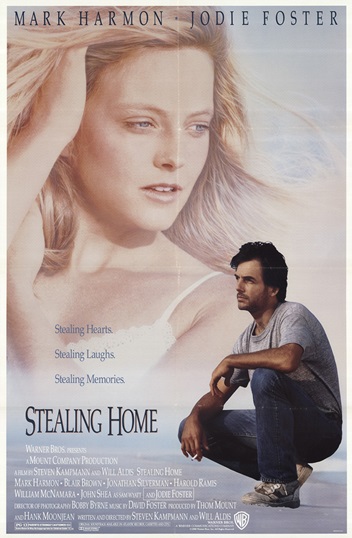
So, I Watched Stealing Home (1988, dir. by William Porter and Steven Kampmann)


Back in December, Lisa agreed to watch a baseball movie with me to make up for making me watch The Catcher in 2023.  The one we picked was Stealing Home, because it starred Mark Harmon and Jodie Foster and it looked like it would be a sweet movie.

Stealing Home opens with Billy Wyatt (Mark Harmon), a minor league baseball player who is getting ready to take the field and who is standing for the National Anthem.  I immediately liked Billy because he was standing for the Anthem and not taking a knee.  I also like aging minor leaguers because they’re still playing the game even though they know they’ve probably missed their window to move up to the majors.  Billy Wyatt loves both the game and his country.

As Billy waits to play ball, he thinks about another type of love, the love that he had for Katie Chandler (Jodie Foster).  Katie was six years older than him and encouraged him to always pursue his dreams, whether it was in baseball or love.  The movie flashes back to Billy living in a motel with a cocktail waitress and getting a phone call from his mother who tells him that Katie has committed suicide and she wants Billy to spread her ashes at a special place.  Billy then flashes back to his childhood and his teen years, in which he’s played by William McNamara who does not look like he could ever grow up to be Mark Harmon.  Billy’s best friend is Alan Appleby, who is played as a teenager by Jonathan Silverman and as an adult by Harold Ramis.  Jonathan Silverman growing up to be Harold Ramis seems even more unlikely than William McNamara becoming Mark Harmon.  Billy remembers losing his virginity to Appleby’s prom date, losing his dad to a car wreck, and a Fourth of July weekend that he spent on the beach with Katie and his mom (Blair Brown).

Only Jodie Foster plays Katie Chandler and we only see Katie thorough Billy’s eyes.  Jodie Foster gives a lively performance as Katie but she always more of a plot device than a fully rounded character.  We never find out why Katie killed herself.  Her father says that Katie was unhappy during her adult life but why?  Even after Billy gets her ashes and tries to figure out where she wanted him to spread them, he never thinks about why she killed herself.  In fact, he hadn’t even talked to her for years.  That really bothered me.

The movie ends with Billy stealing home during a game and proving that he’s still got it as far as baseball goes.  I love baseball but I still felt like Katie’s untold story was probably more interesting than Billy’s.  I liked Mark Harmon’s performance and I really wanted to like Stealing Home more than I did.  I wish the movie had been more about who Katie was instead of being about who Billy thought Katie was.
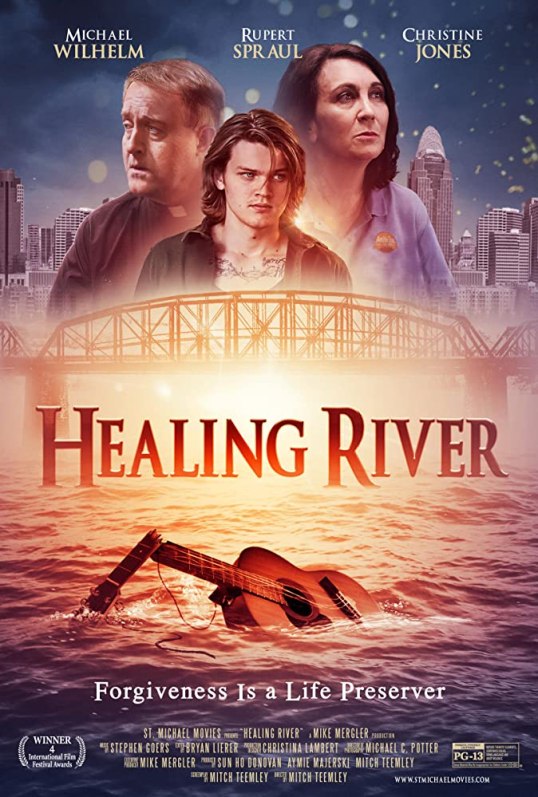
Film Review: Healing River (dir by Mitch Teemley)


Ingrid Ambelin (Christine Jones) owns a coffee shop in Cincinnati.  She has one son, a responsible young man named Michael (Spencer Lackey), and she also tends to think of herself as being a mother figure to everyone who works for her.  She’s the type of boss who keeps an extra set of clothes in the backroom, just in case one of her cashiers makes the mistake of coming to work in something that Ingrid considers to be too revealing.  (Actually, to be honest, that’s the sort of thing that would drive me crazy if I worked for Ingrid.)  Ingrid is old-fashioned but she means well.

Alec McCortland (Rupert Spraul) is a musician and a drug addict, someone who has never had anyone willing to look out for him.  Alec is the type who frequently goes to rehab but always relapses as soon as he gets out.  He’s angry but he’s also young.  In fact, he’s young enough that, when he accidentally drives his car straight into Michael, he’s tried as a juvenile.

At first, Ingrid is outraged that Alec will not be tried as an adult.  She forms a support group that meets in the basement of her church.  At first, Father Peter (Michael Wilhlem), who also happens to be Ingrid’s brother and Michael’s uncle, feels that the group will help her overcome her anger but instead, he watches as Ingrid and the group become obsessed with getting revenge.  In fact, when Ingrid catches Alec again breaking the law, she reports him and gets him thrown in jail.

And then, something unexpected happens.  At the urging of her brother, Ingrid finally visits Alec in prison and, as the two of them talk, Ingrid comes to realize that Alec is not the demon that she assumed he is and Alec finally starts to come to terms with his guilt over the death of Michael.  To the shock of her family and her employees, Ingrid comes to forgive Alec.  She works to try to reunite Alec with his father.  And when Alec is up for release, she volunteers to serve as his legal guardian….

I’m a big fan of the concept of forgiveness.  At the same time, I also know just how difficult it can be to truly forgive anyone, much less someone who has committed a heinous an act as Alec does in this film.  Therefore, I was curious to see how Healing River would handle the topic and I have to say that I was pleasantly surprised.  Healing River is a film that celebrates forgiveness and shows why forgiveness is necessary but, at the same time, it also doesn’t pretend as if forgiveness is easy.  For the most part, it takes an honest approach to the concept of forgiveness.  It’s portrayed as being important but it’s also not portrayed as being a magical elixir.  Even after Alec and Ingrid get to know each other and grow close, there’s still a lot of pain to be dealt with.

It helps that, as opposed to a lot of other inspirational films, Healing River has a little bit of an edge.  No one in the film, including Ingrid, is presented as being a saint.  The characters actually curse and I was glad they did because what mother wouldn’t curse while trying to explain how she feels about the death of her son?  Far too often, films like this seem to be set in a fantasy world that’s specifically designed not to challenge the target audience’s beliefs.  Healing River, however, takes place in the real world and, in the real world, people curse when they’re in pain.

There are a few scenes where the film’s low-budget does become a bit of a distraction.  An early scene featured a Hebrews-related pun that made me cringe.  (“Hebrews …. she brews.”)  There’s a narrative development in the third act that feels a bit clumsy.  It’s a flawed film, as most films are.  But it’s a sincere film and it’s a film that honestly explores both why forgiveness is important and why it’s also so difficult.

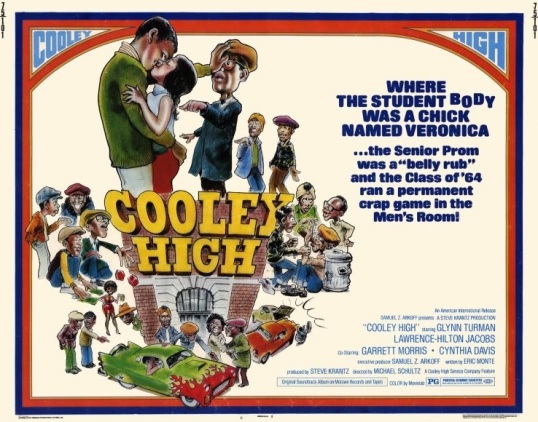
Back to School #17: Cooley High (dir by Michael Schultz)


http://www.youtube.com/watch?v=tmw1Llp92PU

For our next entry in Back to School, we take a look at a film that is often referred to as being a “black American Graffiti,” 1975’s Cooley High.

Cooley High follows the adventures of two lifelong friends who are both seniors at Edwin G. Cooley Vocational High School in Chicago, Illinois.  The charismatic Cochise (Lawrence Hilton-Jacobs) is a popular and friendly basketball star.  Meanwhile, Preach (Glynn Turman) is an aspiring writer who, despite his obvious intelligence, is also one of the worst students at the school.  Preach divides his time between skipping school, gambling, and writing poetry.  Alone among their friends, Cochise and Preach both seem to have a chance to escape from life in the projects.  At the start of the film, Cochise has just received a scholarship to play basketball in college.  As for Preach, he’s the eternal optimist.  He knows he’s going to make it, even if he doesn’t seem to be quite sure how he’s going to do it.

For the first half of the film, Cooley High is largely a plotless collection of vignettes featuring Cochise, Preach, and their friends skipping school, chasing girls, getting into minor trouble, and trying to avoid major trouble.  The emphasis is on comedy but, unlike a lot of high school comedies from the 70s and 80s, the humor grows organically from the characters.  Facing a future that’s likely to be dominated by prejudice, poverty, and limited opportunity, what can the students of Cooley High do other than laugh?  The second half of the film takes a far more dramatic turn, with Preach and Cochise accused of both stealing a car and snitching on the actual thieves in order to get out of jail.  The film’s downbeat conclusion may be predictable but it’s effective all the same.

One reason why I wanted to review Cooley High is because a few months ago, while I was trying to find something to watch on TV, I came across an episode of a show called Unsung Hollywood.  The title of the episode was “The Story of Cooley High” and it told the story of how and why this film was made.  It was actually pretty interesting to watch, as it featured interviews with screenwriter Eric Monte (who based the character of Preach on himself), director Michael Schultz (who directed a lot of memorable films in the 70s — including Sgt. Pepper’s Lonely Hearts Club Band — but has never quite gotten the recognition that he deserves), and the film’s two stars.  Even more interesting, however, were the interviews with the local Chicago residents who essentially played themselves during the filming of Cooley High.  Some of them had fond memories of appearing in the film while others were upset that the film’s box office success didn’t open up any new opportunities for them.  Most haunting of all was the fate of an amateur local named Norman Gibson.  After giving a genuinely good performance as a petty criminal who comes to a violent end in Cooley High, Gibson was murdered a year after the film was released.

As I mentioned before, Cooley High is often compared to American Graffiti and the two films do have some things in common, like the period setting and a great soundtrack.  Ultimately, though, Cooley High can stand on its own.

cooley