Here at The Shattered Lens, we’re celebrating Clint Eastwood’s birthday on May 31st. I decided to revisit his 1999 film, TRUE CRIME.
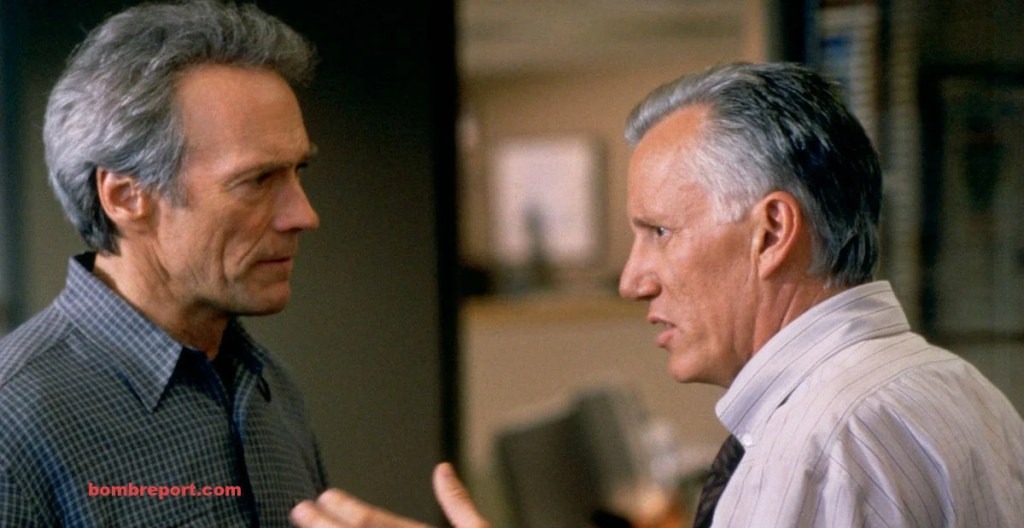
Clint Eastwood directs and stars as ace journalist, Steve Everett, who also happens to be a bad friend, a terrible dad, and an even worse husband. Literally the only thing that he’s got going for him is his “nose,” his ability to sniff out a story where no one else can. Even that has begun to fail him, mostly due to his recents bouts with alcoholism, which he seems to somewhat have a handle on at the time of this story. When a young, beautiful colleague tragically passes away in an auto accident, Steve is given her previous assignment to cover the execution of convicted murderer Frank Beechum (Isaiah Washington). Not the kind to write a human interest “puff piece” like the Oakland Tribune is wanting, Everett begins digging into the past and pretty soon that nose of his starts telling him that Beechum is a victim of circumstantial evidence. Despite his editor Bob Findley’s (Denis Leary) objections, he’s able to convince his newspaper boss Alan Mann (James Woods) to let him dig deeper into the story. As he tries to juggle his myriad personal problems with his growing belief in Beechum’s innocence, Everett is also facing a clock that is ticking down to the midnight execution. Will he be able to find the crucial piece of evidence that will set Beechum free?
TRUE CRIME appears to be somewhat of a forgotten Clint Eastwood film. I saw it at the theater when it came out in 1999, but it was not financially successful, only bringing in $16 Million at the box office. Regardless of that, I still love the film. It’s certainly not perfect. It’s probably too long, Beechum is probably too angelic after being “born again,” and the resolution may be a little unrealistic, but I still enjoyed every second of it. One of the coolest things about Clint Eastwood is his willingness to play such flawed men on screen, yet we still love him. He’s great in this film! Anyone who’s read much of my work knows that my love of actor James Woods goes back to being in junior high and renting his movies BEST SELLER and COP. It’s such a treat seeing the legendary pair on screen together even if Woods’ role is sort of a glorified cameo. Woods is hilarious in his limited screen time. My last shout out is to Isaiah Washington as the innocent man who’s about to be put to death. After all these years and appeals, he’s accepted his fate, but the scene where he tells Everett his story and Everett tells him that he believes he’s innocent is so powerful. Add to that Washington’s scenes with his wife and daughter, and I was very much emotionally invested in this film. Washington’s performance was key to the film working, and he’s great!
Overall, TRUE CRIME is a film that takes its sweet time, but it ultimately tells a tense, engrossing story that ratchets up the tension to 10 prior to its last second resolution. I consider it very underrated and highly recommend it. I’ve included the trailer below:
Age is one of those strange factors when it comes to relationships.
My Dad was 35 when he married my Mom, who was 10 years his junior. Aaron and Sam Taylor-Johnson have a 23 year age difference between each other and they’re doing fine (I hope). Florence Pugh and Zach Braff have a 21 year difference. Anna Nicole Smith was about 27 when she married a near 90 year old J. Howard Marshall. If your mind is totally shutting down on you on the age differences, I’d tell you that maybe Paul Thomas Anderson’s Licorice Pizza may not be for you, but to still give it a chance. The story is so well written that you’ll often forget there any kind of age differences. If that’s not a problem, the movie is more than worth your time.
A Licorice Pizza is another word for a vinyl album. Although I grew up with records (Purple Rain and Jaws were on constant rotation as a kid), I can’t say I’ve ever heard the term before.
Licorice Pizza is a love story at heart, between 15 year old Gary Valentine (Cooper Hoffman, son of the late Phillip Seymour Hoffman, an Anderson regular) and 25 year old Alana Kane (Alana Haim, of the band Haim) set in the early 1970s. Gary’s young, but is both very curious and confident, actively looking for the next opportunity ahead of him (even if he has to create it). Alana’s successful at what she does, is resourceful in her own right and doesn’t hesitate to call someone out on their crap.
I caught Licorice Pizza on the Friday after Thankgsiving at the Village East by Angelika just below 14th Street in Manhattan. which hosts one of the best 70 MM screens in the borough. This was the same theatre I attended for Paul Thomas Anderson’s The Master in 70MM. The place is absolutely beautiful and reminds me of the old Ziegfeld. Think of 70MM as what IMAX was before IMAX ever existed.
By far, Licorice Pizza‘s greatest strengths are the plot and cast. For Hoffman and Haim, these are their first acting performances, but they flow so well in every scene (with Haim the stronger of the two) that it feels completely natural. Hoffman is energetic and smooth, and I hope to see him do more in the future. Haim is a marvel, and if she doesn’t end up with some kind of award for all this, I’d be very shocked. She dances with all of these actors as if she’s done it for years, and in the rare instance where there’s a hiccup – there’s a moment regarding the character’s age – the recovery’s so quick that you have to wonder if that was scripted or not. It reminds me of Michael Mann’s Miami Vice, in that being undercover is basically taking on a persona and throwing yourself fully into it to make it believable. Both leads are the heart of all this.
Jack Holden (Sean Penn) takes Alana Kane (Alana Haim) for a ride in P.T. Anderson’s Licorice Pizza
Of course, it helps to have backup to support the leads. Alana Kane’s family is also Alana Haim’s. Her sisters, Danielle and Este, along with their parents are all on hand here. The film is also peppered with stars like Tom Waits (Bram Stoker’s Dracula), Sean Penn playing a variant on Bill Holden(Milk), Christine Ebersole (The Wolf of Wall Street), Benny Safdie (Uncut Gems) and Maya Rudolph (Bridesmaids, and she’s Anderson’s wife) that help to round out the weirdness of Los Angeles in the 1970s. Of particular note are both George DiCaprio (Father of Leonardo) as a waterbed salesman, and Bradley Cooper as legendary producer Jon Peters (who was responsible for Batman, A Star is Born and Man of Steel). Of all of the supporting cast, Cooper has by far the most positive and zany appearance, with his version of Peters feeling more like a live action Rocket Raccoon. His character here is almost the opposite of the one he plays in Nightmare Alley. I also loved Benny Safdie’s politician here. Each supporting character has a story of their own that Alana & Gary are pulled into.
And then there’s John Michael Higgins, who plays a restaurant owner who makes fun of his Japanese wife’s ability to speak English. He talks to her in a made up broken version of Japanese, which my audience seemed to be okay with. They laughed, mostly. It’s like the Christmas Story Chinese Food scene, where the family has to listen to a broken version of “Deck the Halls”. Depending on who you are, it may come across as cringeworthy, and is honestly the only thing that stumble steps the movie in any way. Then again, one could argue that it’s just the 70s. Things were different. Anyone recollecting what life was life back then is bound to have a relative or someone just like that.
All that aside, I loved the flow of the movie. Between The Master and Inherent Vice, I half expected Licorice Pizza to take some dark turns. While the movie does get a little strange where the effects of the gas shortage plays in (also one of the best scenes), the film is incredibly lighthearted and fun. Like every romantic comedy, you have all of the great elements. Gary pursues Alana, but her attentions are turned towards another. By the time Alana starts to realize that maybe Gary is good for her, he’s kind of moved on. You may find yourself hoping everything works out – it’s hard not to love these characters. All of this is done with a soundtrack from the era that rivals some of the best offerings from Tarantino’s Once Upon a Time in Hollywood or Gunn’s Guardians of the Galaxy. A little Bowie, some Nina Simone, some Paul McCartney and Wings & even Donovan pepper the film. For the score, Radiohead’s Johnny Greenwood is back once again as Anderson’s go-to composer.
Overall, Licorice Pizza is a surprisingly lighthearted tale from Paul T. Anderson. It never overreaches or spends too much time in any one place, understanding that love is a complex thing. Grounded by two talented newcomers, a plethora of supporting heavies, a wonderful soundtrack and a screenplay that’ll make you smile, Licorice Pizza is an easy recommendation.
There’s a certain type of independent film that you tend to see quite frequently towards the end of the year. It’s the type of film where a single mother and her precociously intelligent child move to a new town and get to know their neighbors. Usually, the child has to deal with a bully or two while the mother reflects on her own rebellious past. Almost inevitably, there’s a cantankerous older neighbor who seems a little bit intimidating at first but who eventually turns out to be a decent guy. That older neighbor is often played by a character actor who has never quite gotten the appreciation that he deserves.
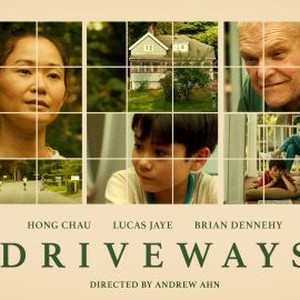
Driveways is one of those films. This time, the mother is named Kathy (Hong Chau) and her 9 year-old son is named Cody (Lucas Jaye). Cody is intelligent but shy. He struggles to fit in. He worries about the fact that his mom is constantly smoking and whenever she curses, he gives her a slightly judgmental look. If he gets too anxious, he has a habit of vomiting. He’s one of those kids who you just want to protect from the outside world and assure him that everything’s going to (eventually) be okay.
The neighbor is Del and he’s played by the late, great Brian Dennehy. Del is a veteran of the Korean War and a widower. He spends a lot of time sitting out on his porch. He’s a nice guy and one of the things that I appreciated about this film is that Del was nice from the minute he first appeared. Usually, in films like this, it takes a while for the neighbor to let down his defenses and show that he’s not some sort of bitter ogre. Usually, there’s all sorts of conflicts and “Get off my lawn” moments but, in Driveways, Del pretty much warms up to Kathy and Cody as soon as he meets them. He shows Cody how drink from a hose. Kathy gives him a ride to VFW Hall, where he plays bingo with his friends. Soon, Del is Cody’s only friend on the block and Del is also one of the few sources of support that Kathy has as she cleans out her recently deceased sister’s home.
There’s not really a lot of drama in Driveways. There is one annoying neighbor named Linda (Christine Ebersole), who shows up for some of the film’s weaker moments. And there’s a wonderfully acted scene where Del goes shopping with friend (played by Jerry Adler) who has Alzheimer’s. Otherwise, this is a low-key film about three people who are at the beginning, the middle, and the end of life. It’s occasionally a little predictable but it’s sweet-natured film and it has a good heart.
And, most importantly, it gives Brian Dennehy one final great role. When Dennehy passed away earlier this year, Tommy Boy was soon trending on twitter because, whenever a great actor dies, it seems that their worst films always end up trending. (This is largely because people on twitter have terrible taste.) Dennehy was a great actor with a commanding screen presence and it’s somewhat surprising that he died without having ever been nominated for an Oscar. In Driveways, he brings Del to poignant life. At the end of the film, he delivers a lengthy monologue about his life and its a powerful moment and one that deserves awards consideration. A supporting actor nomination for Brian Dennehy would not only be a way to acknowledge a great performance but also a great career, in which he appeared in a lot more films than just Tommy Boy. Here’s hoping!
The 1984 film Amadeus is about a man who learns, after it’s a bit too late to really do anything about it, that he is thoroughly mediocre.
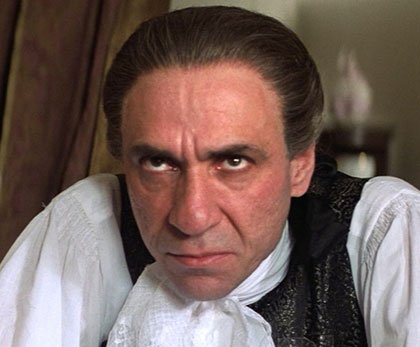
When we first meet Antonio Salieri (played by F. Murray Abraham), he’s an old man who has been confined to a mental asylum because he attempted to slit his own throat. What should drive Salieri — a respected, if not particularly beloved, composer in 18th Century Vienna — to attempt to take his own life? As he explains it to Father Vogler (Richard Frank), it’s the guilt of knowing that he’s responsible for death of the greatest composer of all time, Wolfgang Amadeus Mozart.
When Mozart (Tom Hulce) first showed up in Vienna, Salieri was already the court composer to the thoroughly vacuous Emperor Joseph II (Jeffrey Jones). At the time, Salieri believed himself to be a genius touched by God. As he recounts to Father Vogler, he prayed to God when he was a boy and he struck what he believed was an ironclad deal. God would make Salieri a great composer and Salieri would remain a faithful believer.
But then Mozart shows up and, from the minute that he first hears one of Mozart’s compositions, Salieri realizes that Mozart is the one who has been blessed with genius. Mozart is the one who is writing the music that will be remembered for the rest of time, long after Salieri and all of his other rival composers have been forgotten. Upon first hearing Mozart, Salieri suddenly realizes that he has been betrayed by God. He is a mediocre talent and he’s always been a mediocre talent.
The worst part of it is not just that Mozart’s a genius. It’s also that Mozart knows he’s a genius. He’s a bit of a brat as well, with a remarkably annoying laugh and vulgar manners that scandalize proper society. Despite the efforts of his rivals to dismiss his talent, Mozart is beloved by the common people. He’s an 18th century rock star and it seems as if no amount of scandal and petty jealousy can slow him down. Even worse, the emperor takes a interest in Mozart and commissions him — and not Salieri — to write an opera.
Rejecting a God that he feels has betrayed him, Salieri plots Mozart’s downfall….
Goddamn, this is a great movie. Seriously, everything about Amadeus works.
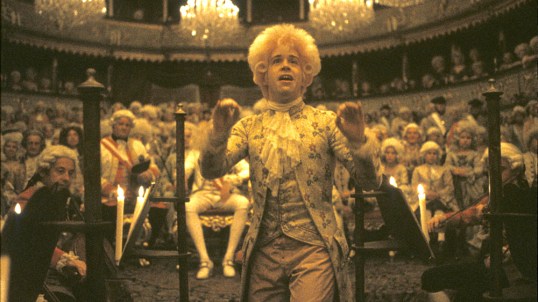
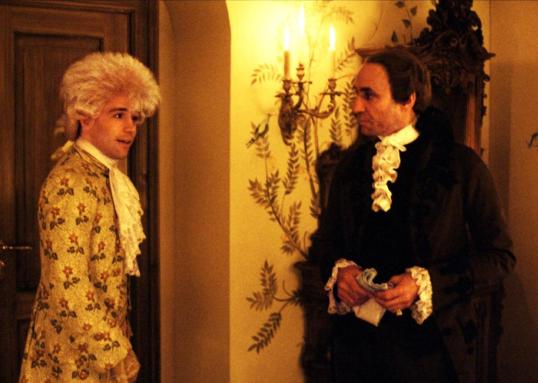
The ornate sets and the costumes not only wonderful to look at but they also actually tell us something about the characters who inhabit them. One look at the beautiful but cluttered home that Mozart shares with his wife, Constanze (Elisabeth Berridge), tells you almost everything you need to know about not only Mozart’s tastes (which are expensive) but also his talent (which is undisciplined but also limitless). The empty-headedness of Emperor Joseph is perfectly mirrored by the pretty but uninspired decor of his court while the grubby chaos of the mental asylum seems to have sprung straight from Salieri’s tortured soul. As visualized in Amadeus, there’s a cold beauty to Vienna, one that is fascinating but, at the same time, menacing. As for the costumes, Mozart’s powdered wig somehow seems to be brighter than everyone else’s and his colorful wardrobe demands your attention. Meanwhile, when a costumed and masked Salieri shows up at Mozart’s door, he’s like the Grim Reaper coming to collect a soul.
The witty script is full of sharp lines and director Milos Forman does a wonderful job of balancing comedy and drama. The scenes involving Joseph II are frequently hilarious and Jeffrey Jones does a great job of portraying Joseph as essentially being a very influential dunce. The scene where Joseph tells Mozart that he liked his latest composition but that “there are simply too many notes” is a classic and one to which any artist, whether they’re Mozart or not, will be able to relate. (“Just cut a few and it will be perfect.”)
The film is dominated by the performances of F. Murray Abraham and Tom Hulce. Hulce is wonderfully flamboyant in the early part of the film and, bravely, he doesn’t shy away from portraying Mozart as occasionally being a bit of a spoiled brat. It’s not just that Mozart can be annoying. It’s also that he’s often deliberately annoying. When we first see Mozart, it’s easy to understand why his very existence so grated on Salieri’s nerves and why Salieri considers him to be an “obscene child.” But as the film progresses, Hulce lets us in and we come to see that Mozart is actually a very vulnerable young man. When his disapproving father (Roy Dotrice) comes to visit, we suddenly understand both why Mozart is so driven to succeed but also why he is so instinctively self-destructive.
Meanwhile, F. Murray Abraham — well, what can I say about this performance? In the role of Salieri, Abraham gives one of the greatest film performances of all time. In many ways, Abraham has a tougher job than Hulce. If Hulce has to convince us that Mozart has been touched by genius despite the dumb things that he often does, Abraham has to make petty jealousy compelling. And somehow, Abraham manages to do just that. Whereas the role of Mozart allows Hucle to wear his emotions on the surface, Abraham has to play a character who keeps most of his thoughts and impulses hidden and the fact that we end up understanding Salieri (if never actually sympathizing with him) is a testament to F. Murray Abraham’s skill as an actor. Abraham won the Oscar for Best Actor for his work in Amadeus and it was more than deserved.
At the end of the film, Salieri declares himself to be the patron saint of mediocrities and, to a large extent, that’s what sets Amadeus apart from other biopics. Most people are mediocre. Most people are not going to end their life as a Mozart. They’re going to end their life as a Salieri or worse. This is one of the few films to be made about a runner-up. It’s interesting to note that, even though the film is more about Salieri than Mozart, it’s still called Amadeus. It’s not named Antonio or Salieri. Even in a film made about Salieri, Mozart is advertised as the main attraction.
(It should also be noted that many historians believe that Salieri and Mozart were actually fairly friendly acquaintances and that, beyond the normal rivalry that any two artists would feel, neither held any significant ill will towards the other. In other words, enjoy Amadeus as an outstanding piece of cinema but don’t necessarily mistake it for historical fact.)
Along with Abraham’s victory, Amadeus also won Best Picture of the year. Of the nominees, it certainly deserved it. (My pick for the best film of 1984 is Once Upon A Time In America with Amadeus as a close second.) It’s a great film and one that definitely deserves to be watched and rewatched.
Suck it, The Big Short. The Wolf of Wall Street is the best film to be made about Wall Street this century.
Martin Scorsese’s 2013 financial epic tells the true story of a group of rather sleazy people who got rich and who basically, to quote Robert De Niro from an earlier Scorsese film, “fucked it all up.” Jordan Belfort (Leonardo DiCaprio, giving what I still consider to be the best performance of his career) is the son of an accountant named Max (Rob Reiner). Fresh out of college, Jordan gets a job on Wall Street. Under the mentorship of the eccentric (but rich) Mark Hanna (Matthew McConaughey), Jordan discovers that the job of a stock broker is to dupe people into buying stock that they might not need while, at the same time, making a ton of money for himself. With the money comes the cocaine and the prostitutes and everything else that fuels the absurdly aggressive and hyper-masculine world of Wall Street. Jordan is intrigued but, after the stock market crashes in 1987, he’s also out of a job.
Fortunately, Jordan is never one to give up. He may no longer be employed on Wall Street but that doesn’t mean that he can’t sell stocks. He gets a job pushing “penny stocks,” which are low-priced stocks for very small companies. Because the price of the stock is so low, the brokers get a 50% commission on everything they sell. Because Jordan is such an aggressive salesman, he manages to make a fortune by convincing people to buy stock in otherwise worthless companies. As Jordan’s boss (played, in an amusing cameo, by Spike Jonze) explains it, what they’re doing isn’t exactly regulated by the government, which just means more money for everyone! Yay!
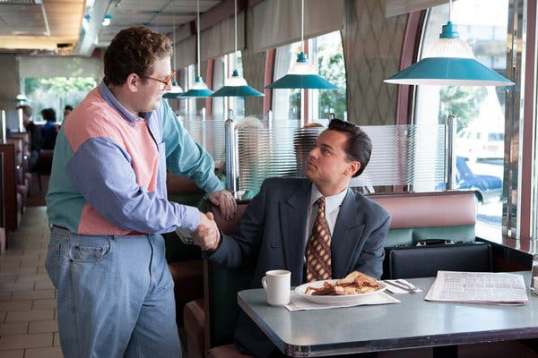
Working with his neighbor, Donny Azoff (Jonah Hill, at his most eccentric), Jordan starts his own brokerage company. Recruiting all of his friends (the majority of whom are weed dealers who never graduated from high school), Jordan starts Stratton Oakmont. Using high-pressure sales tactics and a whole lot of other unethical and occasionally illegal techniques, Jordan soon makes a fortune. When Forbes Magazine publishes an expose that portrays Jordan as being little more than a greedy con man, Stratton Oakmont is flooded by aspiring stock brokers who all want to work for “the wolf of Wall Street.”
And, for a while, Jordan has everything that he wants. While the Stratton Oakmont offices become a den of nonstop drugs and sex, Jordan buys a huge mansion, a nice car, and marries a model named Naomi (Margot Robbie). His employees literally worship Jordan as he begins and ends every working day with inspirational (and often hilariously profane) sermons, encouraging his people to get out there and sell no matter what. Of course, making that much money, Jordan has to find a way to hide it from the IRS. Soon, with the help of Naomi’s aunt (Joanna Lumley), he is smuggling millions of dollars into Switzerland where a banker (Jean Dujardin, who is both hilariously suave and hilariously sleazy a the time) helps him hide it all.
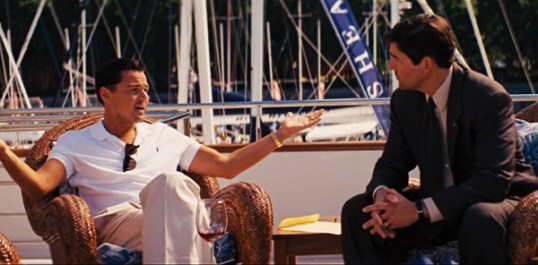
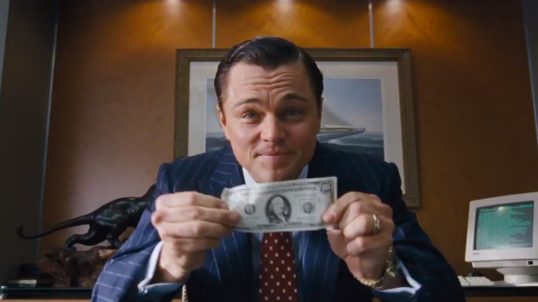
When Jordan learns that the FBI and SEC are looking into his dealings, Jordan invites Agent Patrick Denham (Kyle Chandler) to come visit him on his yacht and, in a scene that launched a thousand memes, the two of them have a friendly conversation that’s largely made up of passive aggressive insults. Jordan taunts Denham over the fact that Denham washed out when he tried to get a job on Wall Street. Denham laughingly asks Jordan to repeat something that sounded like it may have been a bribe. When Denham leaves the boat, Jordan taunts him by tossing a wad of hundred dollars bills into the wind….
And here’s the thing. Yes, the media and our political class tells us that we’re supposed to hate that Jordan Belforts of the world. One can imagine Bernie Sanders having a fit while watching Jordan brag about how he cheated the IRS. If Adam McKay or Jay Roach had directed this film, one can imagine that they would have used the yacht scene to portray Jordan Belfort as pure evil. (McKay probably would have tossed in Alfred Molina as a waiter, asking Belfort if he wants to feast on the lost future of the children of America.) But the truth of the matter is that most viewers, even if they aren’t willing to admit it, will secretly be cheering for Jordan when he throws away that money. DiCaprio is so flamboyantly charismatic and Scorsese, as director, so perfectly captures the adrenaline high of Jordan’s lifestyle that you can’t help but be sucked in. He may be greedy and unethical but he just seems to be having so much fun! Just as how Goodfellas and Casino portrayed life in the mafia as being an intoxicating high (as well as being more than a little bit dangerous), The Wolf of Wall Street refrains from passing easy judgment and it steadfastly refuses to climb onto a moral high horse. Jordan narrates his own story, often talking directly to the camera and almost always defending his actions. As a director, Scorsese is smart enough to let us make up own minds about how we feel about Jordan and his story.
Of course, when Jordan falls, it’s a dramatic fall. That said, it’s not quite as dramatic of a fall as what happened to Ray Liotta in Goodfellas or Robert De Niro in Casino. No one gets blown up, for instance. But Jordan does lose everything that gave his life meaning. By the end of the film, he’s been reduced to giving seminars and challenging attendees to sell him a pen. (“Well,” one hapless gentleman begins, “it’s a very nice pen…..”) During the film’s final scenes, it’s not so much a question of whether Jordan has learned anything from his fall. Instead, the movie leaves you wondering if he’s even capable of learning. At heart, he’s the wolf of Wall Street. That’s his nature and it’s really the only thing that he knows how to do. He’s a bit like Ray Liotta living in the suburbs at the end of Goodfellas. He’s alive. He has his freedom and a future. But he’s still doesn’t quite fit in. Much like Moses being denied the opportunity to physically enter the Promised Land, Jordan’s punishment for his hubris is to spend his life in exile from where he truly belongs. And yet, you know that Jordan — much like Henry Hill — probably wouldn’t change a thing if he had the chance to live it all over again. He’d just hope that he could somehow get a better ending while making the same decisions.
Unlike something like The Big Short, which got bogged down in Adam McKay’s vapid Marxism, The Wolf of Wall Street works precisely because it refuses to pass judgment. It refuses to tell us what to think. I imagine that a lot of people watched The Wolf of Wall Street and were outraged by the way Jordan Belfort made his money. I imagine that an equal number of people watched the film and started thinking about how much they would love to be Jordan Belfort. The Wolf of Wall Street is a big, long, and sometimes excessive film that dares the audience to think of themselves. That’s one reason why it’ll be remembered after so many other Wall Street films are forgotten.
The Wolf of Wall Street was nominated for best picture of the year. It lost to 12 Years A Slave.



 Through the Shattered Lens