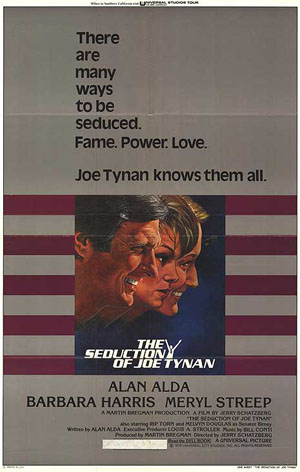
You know how sometimes you see a film and you can just tell that it was probably a big deal when it was first released but now, in the present day, it’s just not that interesting? That’s the way that I felt when I saw 1979’s The Seduction of Joe Tynan on Netflix. This is one of those film’s that you just know was probably praised for being adult and mature when it was first released but seen today, it’s just kinda bleh.
Joe Tynan (Alan Alda) is a Democratic senator from New York, a committed liberal who is also an ambitious pragmatist. As quickly becomes apparent, Joe is happiest when he’s at work. He struggles to talk to his rebellious teenage daughter (Blanche Baker). While he may love his wife (Barbara Harris), she’s also one of the few people in his life who isn’t always telling him how great he is and, to an extent, she resents having to live in his shadow. At times, it seems like the only thing holding Joe’s family together is the possibility that Joe could soon be nominated for the presidency.
When a Southern judge is nominated for the Supreme Court, Joe is asked by his mentor, Sen. Birney (a great Melvyn Douglas), to not oppose the nomination. While Joe originally agrees to keep quiet, he soon changes his mind when he’s approached by lobbyists who make it clear that, if he goes back on his word to Birney, they’ll be willing to support Joe for President.
Leaving behind his family, Joe heads down south where he meets a researcher named Karen Traynor (Meryl Streep). With Karen’s help, Joe discovers that the judge actually is a racist. He also discovers that, politically, he has a lot more in common with Karen than he does with his own wife and soon, they’re having an affair.
The Seduction of Joe Tynan is an odd film. As written, Tynan is a decent but flawed man. He may do the right thing but he does so largely because of his own ambition. That’s not a problem, of course. If anything, that would seem to be the making of a great political film. Some of the greatest film characters of all time have been morally ambiguous. But then, Alan Alda (who also wrote the script) gives a performance that would seem to indicate that he was scared of being disliked by the audience. Alda is believable when he’s being a self-righteous crusader but, whenever he has to play up the pragmatic and ruthless side of Joe Tynan, he almost seems to have zoned out. It’s interesting to compare Alda’s lukewarm performance here with the far more nuanced performance that he would give, as a less idealistic Senator, decades later in The Aviator. As far as the film’s senators are concerned, Melvyn Douglas and Rip Torn (playing a libertine colleague) are far more believable than Alda.
The film’s best performance is delivered by Meryl Streep. That might not sound shocking but actually, Streep’s performance here is surprising because it’s far more natural and less mannered than some of her more acclaimed performances. Believe it or not, you actually forget that you’re watching Meryl Streep.
Ultimately, you have to respect the fact that the film attempted to tell an adult and mature story about politics but that doesn’t make The Seduction of Joe Tynan any less forgettable.
 Through the Shattered Lens