Horror Film Review: The Pit and the Pendulum (dir by Roger Corman)


The second of Roger Corman’s Edgar Allan Poe adaptations, 1961’s The Pit and The Pendulum opens in much the same way as The Fall of the House of Usher.  A young Englishman (played by John Kerr) rides a horse across a colorful but desolate landscape.  A castle sits in the distance.

Of course, as opposed to  the 19th Century British setting of The Fall of the House of Usher, The Pit and the Pendulum takes place in 16th Century Spain, at a time when the country was still scarred by the horrors of the Inquisition.  And Francis Barnard is not traveling to the castle to see his fiancée but instead, he’s searching for information about the disappearance of his sister, Elizabeth (played by the one and only, Barbara Steele).  At the castle, Francis meets Elizabeth’s husband, Nicholas (Vincent Price) and Nicholas’s sister, Catherine (Luana Anders).  Nicholas explains that Elizabeth died under mysterious circumstances, while suffering from a rare blood disorder that seemed to quickly sap away her will to live.  Nicholas’s best friend, Dr. Leon (Anthony Carbone), explains that Elizabeth died of fright after she locked herself in one of the iron maidens in the castle’s torture chamber….

Oh yes, the castle has a torture chamber.  Nicholas’s father was a leader of the Inquisition and he used the castle as a place to conduct his business.  Nicholas’s father was a madman who suspected that his wife was cheating on him.  One day, while young Nicholas was exploring the torture chamber, he witnessed his father murder both his wife and his brother.  Nicholas watched as his mother was entombed alive and ever since, he’s been terrified of the idea of premature burial.  In fact, his fear that he may have buried alive Elizabeth while she was still alive is driving him mad.  The sudden arrival of the suspicious Francis doesn’t help matters….

The Pit and the Pendulum opens with splashes of color spreading across the screen, a sign that Corman was once again in a pop art state of mind when he directed this film.  The Pit and The Pendulum takes everything that worked (and didn’t work) about The Fall of the House of Usher and it turns it all up by a notch or two.  The castle is even more gothic.  Vincent Price’s Nicholas is even more mentally fragile than his Roderick Usher, though Nicholas is also a quite a bit more sympathetic.  If Roderick was a control freak who used his family’s curse as an excuse to embrace his own authoritarian tendencies, Nicholas is just a frail man suffering from PTSD.  He’s definitely more of a victim than a victimizer … or, at least, he is at first.  Much like Mark Damon is The Fall of the House of the Usher, John Kerr is a bit of a stiff in the role of Francis but it doesn’t matter.  Vincent Price is the main attraction here and Corman’s direction shows that he understood that.

And then there’s the Pendulum.  It takes a while for the Pendulum and its swinging blade to make an appearance but when it does, it lives up to the hype.  The Pendulum swings and Corman goes all out, zooming into Price’s crazed eyes while the Pendulum comes closer and closer to its latest victim.  The images are tinted red and green and the Pendulum itself seems to swing in a slow motion, the cinematic equivalent of a nightmare come to life.

The Pit and the Pendulum is a wonderful work of gothic pop art.  Featuring Vincent Price at his most wonderfully unhinged, this is a film we should all watch this Halloween.
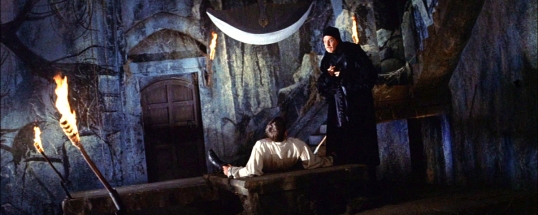
Pit and the Pendulum (1961, dir by Roger Corman, DP: Floyd Crosby)


Lisa Reviews An Oscar Nominee: 49th Parallel (dir by Michael Powell)


Hello and welcome to the TSL’s continuing coverage of Oscar Sunday!  Today, along with some other Oscar-related things, I’m going to post reviews of some of the films that have been nominated for best picture over the years!  Let’s start things off with the 1941 Best Picture nominee, 49th Parallel!

Before anything, I should clear up some confusion about this film.  This is a British film about Nazis trying to reach the border between Canada and the U.S.  When it was first released in the UK, it was named after the coordinates of the border.  However, in the actual film, the Nazis never actually go to the 49th Parallel.  Instead, the film concludes at Niagara Falls.  However, it was probably reasonable assume that British audiences would not necessarily know or care whether Niagara Falls was actually located on the 49th Parallel.  Considering that they were currently at war with Germany, they had more important things to concern themselves with.

However, it was apparently felt that American audiences would notice that Niagara Falls wasn’t actually located on the 49th Parallel.  (Personally, I think the British may have been giving us too much credit.)  So, when the film was released in the United States, the title was changed to The Invaders.  When the film was subsequently nominated for Best Picture, it was nominated under the name The Invaders.  I’ve actually come across some online sources that claim that The Invaders and 49th Parallel are two separate films.  No, they’re the same film, it’s just that the film in question has two different titles.  Out of respect to the people who actually made the movie, I’ve decided to use the original title in this review.

When watching 49th Parallel (it’s available on YouTube), it helps to know something about history.  Today, there’s a tendency to overlook the fact that World War II had already been raging for nearly two years before the United States got involved.  Though the U.S. was an ally to Britain, it remained officially neutral until the Japanese bombed Pearl Harbor.  Up until that moment, many prominent Americans were isolationists and took the attitude that the war was Europe’s problem.  (On the other hand, Canada, as a Dominion of the British Empire, followed Britain into the war in 1939.)  Though the 49th Parallel may have been a British film that was largely set in Canada, it was also meant to frighten Americans and hopefully bring them over to the British side.

(When interviewed about the film, screenwriter Emeric Pressbruger said, “”Goebbels considered himself an expert on propaganda, but I thought I’d show him a thing or two.”)

Directed by Michael Powell, 49th Parallel opens with a German U-boat creeping into the waters around Canada.  The Nazis are hoping to disrupt shipping operations but it turns out that they’re no match for the Royal Canadian Navy.  (GO CANADA!)  When the U-boat sinks into the Hudson Bay, only six Nazis manage to survive.  Led by the arrogant Lt. Hirth (Eric Portman), the Nazis attempt to make their way to the border and to the safety of America.

Of course, it doesn’t turn out to be an easy journey.  Not only are the Germans in an unfamiliar country but they also keep running into Canadians.  Without fail, nearly every Canadian they meet is polite but willing to fight and die for his country.  The Canadians themselves are played by actors who, in the 40s, would have been familiar faces.  Laurence Olivier plays a fur trapper, getting top-billing for his cameo appearance.  Raymond Massey, who was best known for playing Abraham Lincoln, shows up as a Canadian solider.  Leslie Howard is the writer who discovers that Nazis have no respect for art.  Anton Walbrook is a German-Canadian farmer who rejects the attempts of Lt. Hirth to bring him over to the Nazi side.  The Canadians are so sympathetic that one of the Nazis is even moved to reject the Third Reich and is promptly executed by his compatriots, showing the audience the foolishness of hoping that the “good Germans” would ever be able to overthrow the bad ones.

It’s pure propaganda but it’s anti-Nazi propaganda so that’s not really a problem.  Powell keeps the story moving at a steady pace and all of the actors get impassioned performances.  You can tell this movie was more than just a job for them.  Instead, it was their way of fighting for their country and hopefully inspiring others to join in the battle against Hitler.  The film is both a love letter to Canada and a plea to the United States to renounce neutrality.  (Interestingly enough, by the time 49th Parallel made it to U.S. screens, America had finally declared war on the Axis Powers.)

49th Parallel was nominated for best picture but it lost to another World War II propaganda film, Mrs. Miniver.